
White gums after wisdom tooth extraction are usually granulation tissue, a pale healing layer. A 2023 Bioengineering review reports it forms within the first 7 days. MedlinePlus says the socket heals in 1 to 2 weeks. White tissue with mild soreness is a normal sign of healing. White tissue with severe pain, pus, fever, or a foul taste needs a call to the dentist or oral surgeon.
Key Takeaways
- A Bioengineering review reports that granulation tissue replaces the blood clot within the first 7 days.
- MedlinePlus says the socket takes 1 to 2 weeks to heal, and the pace differs for each person.
- Pain that grows worse several days after surgery points to dry socket, not normal healing.
- Pus, fever or chills, and severe swelling are infection signs listed by MedlinePlus.
- Poking the white tissue or using a straw can disturb the clot and the healing layer.
What Causes White Gums After Wisdom Tooth Extraction?
White gums after wisdom tooth extraction come from fibrin and granulation tissue. The body builds these two layers to close the socket. A Bioengineering narrative review (2023) describes the clot as blood cells and platelets enmeshed in a fibrin network. Granulation tissue replaces that clot within the first 7 days.
Granulation tissue is a mix of new blood vessels, connective tissue, and immune cells. Granulation tissue can look pale, cream, or white. A dentist at an emergency dental visit can confirm which layer is present.
Why Are My Gums White After Tooth Extraction?
Your gums are white after tooth extraction because the clot is turning into granulation tissue, which looks lighter than normal gum. The Bioengineering review notes that the clot sits in a fibrin network first. Fibrin and new tissue then cover the wound.
Other causes exist. NHS guidance lists dry socket and infection as complications of wisdom tooth removal. Pain, bad taste, and fever help separate those causes from normal healing, so the sections below compare them.
Do Gums Turn White While Healing?
Yes, gums turn white while healing after an extraction because the socket fills with pale granulation tissue. The Bioengineering review dates this stage to the first 7 days. The tissue is delicate and gradually gives way to firmer tissue and bone.
That change appears in many cases of gums white after wisdom tooth extraction that need no treatment. Color alone does not signal a problem. Pain, drainage, and fever matter more, as the next section explains.
What Color Should My Gums Be After Extraction?
Gums should be pink with a pale or white patch inside the socket after extraction, and the patch should shrink over time. The surrounding gum can look slightly red and swollen at first. Pink edges and a shrinking white patch match normal healing.
Dark red, bright red, or yellow-white drainage does not match normal healing. MedlinePlus lists severe swelling and pus as signs of infection. Those signs call for the dentist, not home care. Alpha Dental covers routine checks through its oral care services.
How Should Gums Look After Wisdom Tooth Extraction?
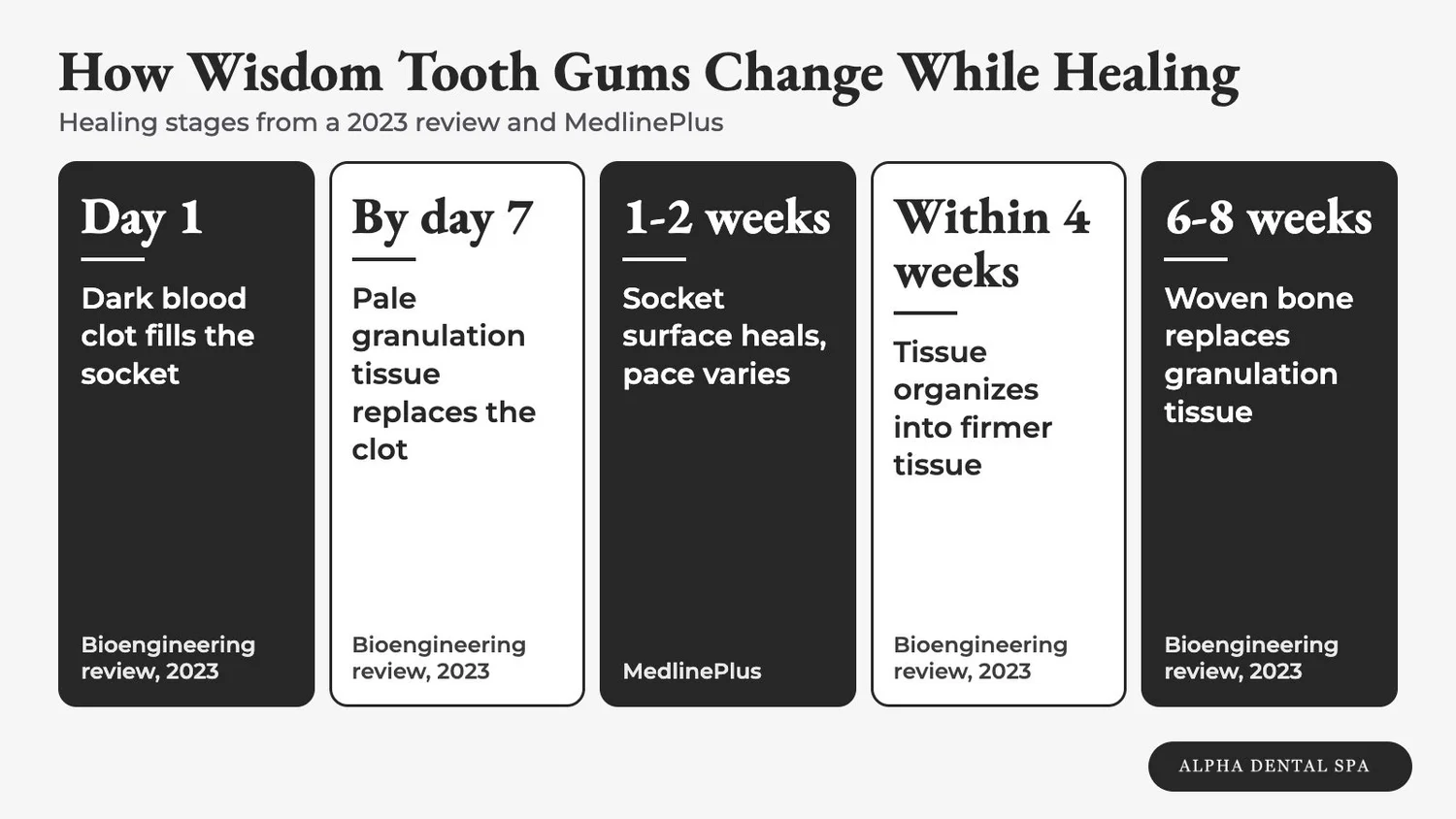
How should gums look after wisdom tooth extraction depends on the week. The socket starts as a dark clot, turns pale as granulation tissue forms, and then closes as gum and bone rebuild. The table below pairs each stage with sources.
| Stage | What you may see | Source |
|---|---|---|
| First day | Dark blood clot fills the socket | Bioengineering review, 2023 |
| Within 7 days | Pale or white granulation tissue replaces the clot | Bioengineering review, 2023 |
| 1 to 2 weeks | Socket heals, with some variation | MedlinePlus |
| Within 4 weeks | Granulation tissue organizes into firmer tissue | Bioengineering review, 2023 |
| 6 to 8 weeks | Woven bone replaces almost all granulation tissue | Bioengineering review, 2023 |
The graphic below shows the same healing stages in order. Each stage in it comes from the same review and MedlinePlus.
What Should Gum Look Like 2 Weeks After Extraction?
Gum should look mostly closed and pink 2 weeks after extraction, though a small dip can remain. MedlinePlus says the socket takes 1 to 2 weeks to heal. Some bone and tissue near the site can take longer.
A leftover white patch at 2 weeks is not automatically a problem. A patch with pain, swelling, or pus is a reason to call. The Bioengineering review places soft tissue organization within the first 4 weeks.
How Long Does White Granulation Tissue Last?
White granulation tissue lasts from the first week until firmer tissue replaces it, within about 4 weeks. The Bioengineering review places granulation tissue formation in the first 7 days and its organization within the first 4 weeks. Each person heals at a different rate, says MedlinePlus.
The review also reports that woven bone replaces almost all granulation tissue within 6 to 8 weeks. The white color fades as that replacement happens. A gum recovery timeline gives more detail on the closing stage.
Can White Gums Go Back to Normal?
Yes, white gums go back to normal as granulation tissue matures into firm pink gum. The Bioengineering review describes granulation tissue being replaced by firmer tissue and woven bone. Normal pink color returns as that replacement finishes.
Mature bone then forms around week 4 at the base and about week 12 at the surface, sealing the socket. Gum healing after wisdom tooth extraction therefore continues well after the white patch fades.
When Will My Gums Heal After Wisdom Tooth Extraction?
Your gums heal after wisdom tooth extraction in 1 to 2 weeks on the surface, according to MedlinePlus. Deeper bone and tissue changes continue for weeks or months. NHS guidance adds that pain and swelling can last up to 2 weeks.
Surface closure comes first, and bone remodeling follows. Healing gums after wisdom tooth extraction should look better each week, not worse.
Is It Normal to See a Hole in Your Gum After Wisdom Teeth Removal?
Yes, a hole in the gum after wisdom teeth removal is normal because the tooth root left an empty socket. MedlinePlus says a blood clot fills the socket as the bone grows back. The socket stays open at first and fills in gradually.
A hole in gums after wisdom tooth extraction can look deep to the tongue. The clot, then the white tissue, then new gum fill it. A hole in gum after wisdom tooth extraction closes in that order. Skipping touching, poking, and straws protects that process.
How Long Will I Have a Hole in My Gum After Tooth Extraction?
A hole in the gum after tooth extraction lasts about 1 to 2 weeks at the surface, per MedlinePlus. The Bioengineering review reports woven bone replacing granulation tissue within 6 to 8 weeks. A shallow dip can remain after the surface closes.
Fibrous tissue and bone keep rebuilding below the gum. That is why the spot can feel different from nearby gum for weeks.
Will a Hole in My Gum Heal on Its Own?
Yes, a hole in the gum heals on its own through clot, granulation tissue, and bone. The clot must stay in place. MedlinePlus says the socket heals in 1 to 2 weeks. A lost clot, however, can lead to dry socket and needs a dentist.
The ADA says dry socket leaves bone and nerves exposed and needs professional care. Dentists clean the site and place a medicated dressing.
How Do I Know If It Is Food or Granulation Tissue?
Food in a socket looks like a distinct speck or crumb. Granulation tissue is a smooth pale layer attached to the socket. MedlinePlus advises avoiding hard foods for 1 week and not touching the socket. A gentle warm salt water rinse can clear loose food debris.
The NHS recommends rinsing gently with mouthwash or warm salt water to keep the wound clean. Do not scrape or pick at anything white. A dentist can tell food from tissue in one look.
How to Speed Up Gum Tissue Healing?
Protect the clot and keep the wound clean to speed up gum tissue healing after a wisdom tooth extraction. Healing follows its own timeline, and no step shortens it for certain. These steps from MedlinePlus and NHS aftercare guidance remove the common causes of delay.
- Skip straws for at least 24 hours, since suction can disturb the clot (MedlinePlus).
- Avoid touching the socket with your tongue for at least 3 days (MedlinePlus).
- Eat soft foods such as yogurt, mashed potatoes, and soup, and avoid hard, crunchy foods for 1 week (MedlinePlus).
- Rinse gently with warm salt water, starting after 24 hours in NHS aftercare plans (Kent Community Health NHS Foundation Trust).
- Do not smoke, because the NHS says smoking can increase infection risk.
Each step guards the white healing layer. A smoking timeline explains the tobacco step in more depth.
What Are Bad Signs After Wisdom Teeth Removal?
Bad signs after wisdom teeth removal are fever or chills, pus, severe swelling, pain that continues, and heavy bleeding. MedlinePlus lists these signs for a call to the dentist. Gum pain after wisdom tooth extraction that worsens after several days is the key warning.
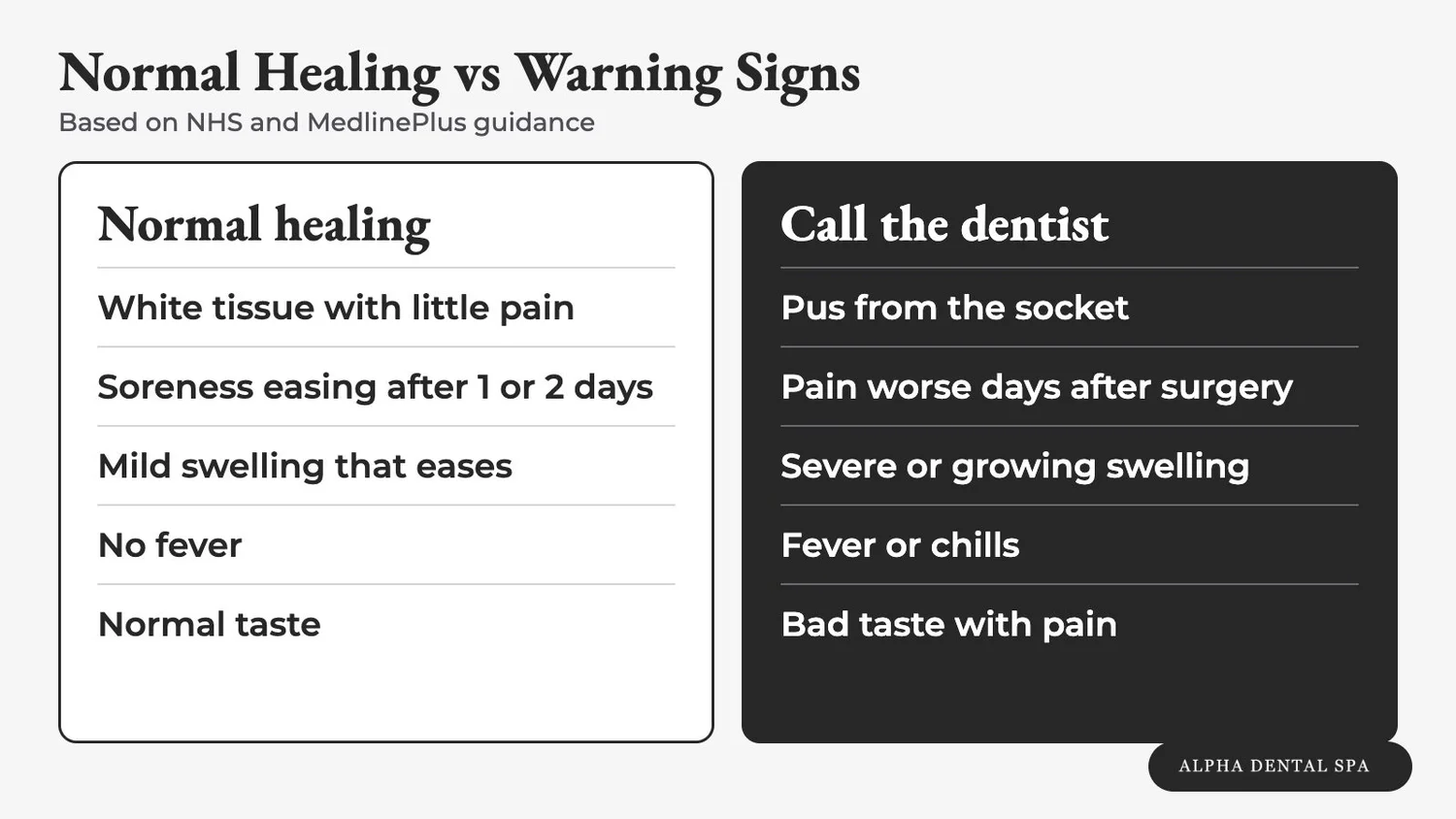
The NHS also lists bleeding that does not stop and pain with a bad taste or high temperature. The table below compares normal healing with warning signs.
| Sign | Normal healing | Call the dentist |
|---|---|---|
| White tissue | Pale layer, little or no pain | White or yellow drainage with pain |
| Pain | Improves after 1 or 2 days (NHS) | Worsens days later, or lasts hours (MedlinePlus) |
| Swelling | Mild, easing within days (NHS) | Severe or growing (MedlinePlus) |
| Fever | None | Fever or chills (MedlinePlus) |
| Taste | Normal | Bad taste with pain (NHS) |
The graphic below repeats this comparison. Each point matches the NHS and MedlinePlus lists above.
Anyone with these signs can reach dental emergencies care at the practice. Heavy bleeding or breathing trouble goes to emergency services.
Is a White Gum an Infection?
No, a white gum is not an infection by itself, because granulation tissue is normal healing. Infection adds other signs. MedlinePlus lists fever or chills, severe swelling, and pus from the extraction site as the signs of infection.
White tissue with those signs needs a dentist. White tissue with none of them is part of the healing sequence.
What Do Infected Gums Look Like After Extraction?
Infected gums after extraction look swollen and inflamed, with pus coming from the socket. MedlinePlus names severe swelling and pus from the extraction site as signs. The NHS adds pain with a bad taste, a high temperature, or feeling unwell.
A closer infected extraction look shows how the site changes. Infections may need antibiotics, per the NHS.
How Do I Know a Dry Socket Is Forming?
A dry socket is forming when severe pain starts 1 to 5 days after extraction and the socket looks empty. A Dentistry Journal systematic review (2022) lists exposed bone, bad breath, and tenderness as findings. The ADA says the clot is displaced and bone and nerves are exposed.
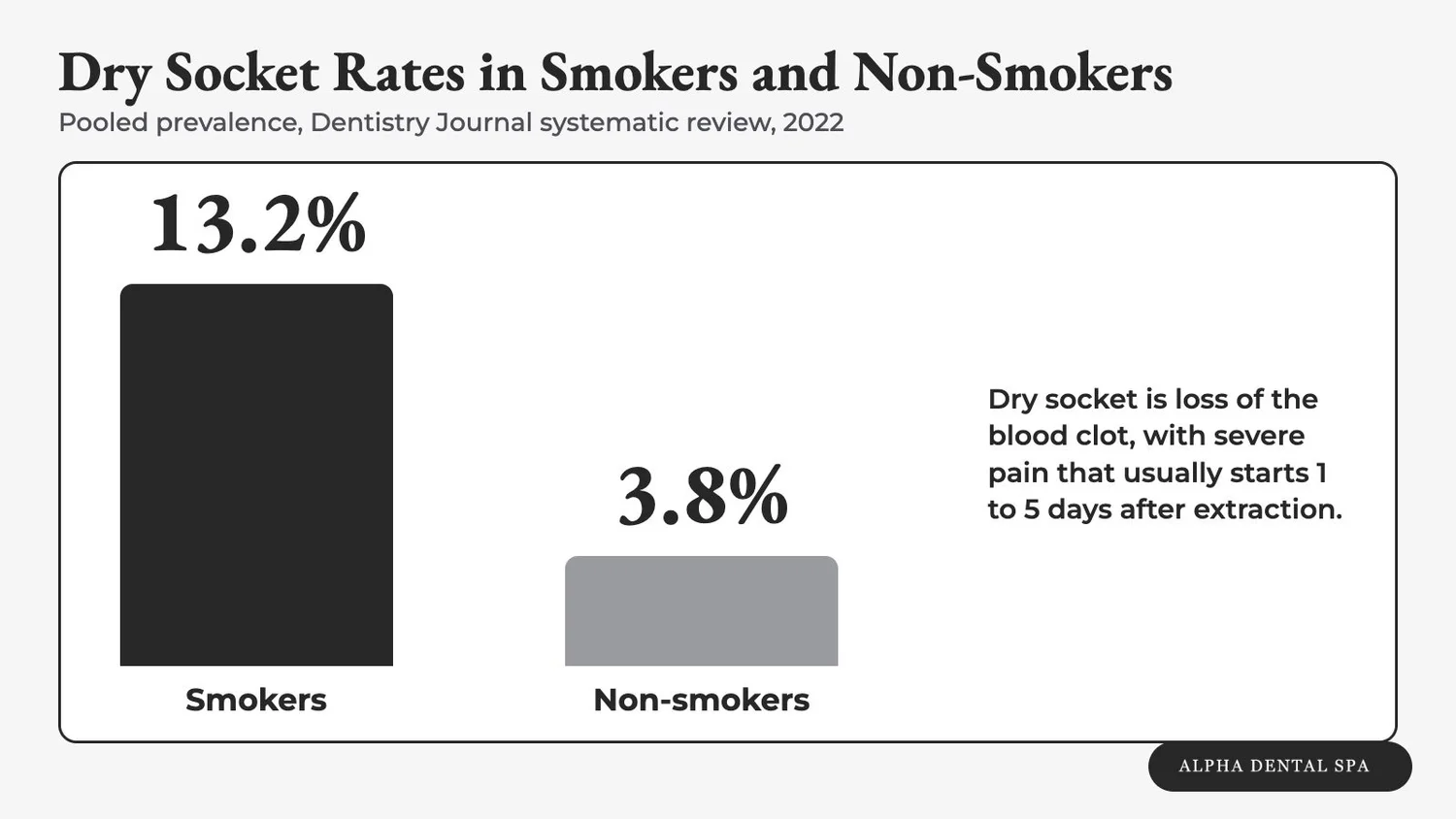
The same review pooled dry socket rates and found 13.2% in smokers and 3.8% in non-smokers. The review notes the included studies differed widely. The graphic shows both rates.
Why Is Day 3 the Worst After Wisdom Teeth?
Day 3 is not the worst day for every patient. NHS guidance says pain and swelling start to improve after 1 or 2 days. Dry socket pain, however, usually starts 1 to 5 days after surgery, according to the Dentistry Journal review. That window includes day 3.
The clot also changes into granulation tissue during these days. Pain that rises instead of easing is the reason to phone the dentist. A page on pain after removal covers typical soreness.
What Else Should You Know About Gums After Wisdom Tooth Extraction?
Are Loose Gums Normal After Wisdom Tooth Extraction?
Loose gums after wisdom tooth extraction can be a dissolving stitch or a soft healing edge. The NHS says stitches dissolve by themselves. Gum that is loose with bleeding that will not stop, or with pus, needs a dentist.
How Long Does Gum Swelling After Wisdom Tooth Extraction Last?
Gum swelling after wisdom tooth extraction starts to improve after 1 or 2 days, per the NHS. Swelling can last up to 2 weeks. MedlinePlus says a cold compress for 10 to 20 minutes at a time reduces swelling and pain. Severe or growing swelling is a warning sign.
What Does Healing Gum Tissue Feel Like?
Healing gum tissue feels tender and sore at first, and the discomfort fades over days. The NHS says some pain and swelling for up to 2 weeks is usual. Pain that rises after several days is not part of that pattern.
What Happens If You Get Rid of the White Stuff After a Tooth Extraction?
Removing the white stuff can expose the socket and slow healing, so leave it alone. MedlinePlus says to avoid touching the socket with the tongue for at least 3 days. White material that falls out with sharp pain is a reason to notify your dentist, says the ADA.
Frequently Asked Questions
Does Salt Water Help Tooth Extraction Heal Faster?
Salt water keeps the wound clean, but no cited source says it speeds healing. The NHS recommends gentle rinsing with mouthwash or warm salt water. Kent Community Health NHS Foundation Trust advises 1 teaspoon of salt in 1 cup of warm water. Rinse 2 to 3 times a day for 3 days.
Does Salt Water Stop a Dry Socket?
No, salt water does not stop a dry socket. The ADA says treatment is cleaning the site and placing a medicated dressing, changed daily until pain eases. A rinse only helps keep the area clean.
What Are the Riskiest Days for Dry Socket?
The riskiest days for dry socket are days 1 to 5 after surgery. The Dentistry Journal review says severe dry socket pain usually starts one to five days after the procedure. Smoking raised the pooled rate to 13.2% versus 3.8% in non-smokers.
How Do I Know If I Dislodged My Clot?
You know you dislodged your clot when pain returns days after surgery and the socket looks empty. MedlinePlus lists a clot that falls out days after extraction, causing pain, as a reason to call the dentist. The ADA says bone and nerves are then exposed.
What Are the Symptoms of an Infected Gum After Wisdom Tooth Removal?
Symptoms of an infected gum after wisdom tooth removal include fever or chills, severe swelling, and pus. MedlinePlus lists those signs. The NHS adds pain with a bad taste and feeling unwell.
How Painful Is the Socket When White Tissue Appears?
The socket should be only mildly sore when white tissue appears, because granulation tissue is normal healing. The NHS says pain and swelling usually improve after 1 or 2 days. Strong pain with white tissue points to dry socket.
How Does Alpha Dental Help With Healing Gums After Wisdom Tooth Extraction?
Alpha Dental helps with healing gums after wisdom tooth extraction by checking the socket, explaining what is normal, and treating complications. Dr. Hayat can look at white tissue, a hole in the gum, or swelling and confirm whether healing is on track. We see patients from Cinnaminson and nearby towns.
Patients with worsening pain, pus, or fever can ask for help with extraction emergencies through the same office. Dr. Hayat reviews each socket and explains the next step in plain language.
Patients who want a check of a healing socket can contact our team to book a visit. Bring the date of surgery, a list of your symptoms, and any medicines you take. The dentist can then compare your healing with the normal pattern for that stage and explain what to watch next.
Questions about the healing timeline are welcome at the Alpha Dental team office, and we explain each stage in plain terms.