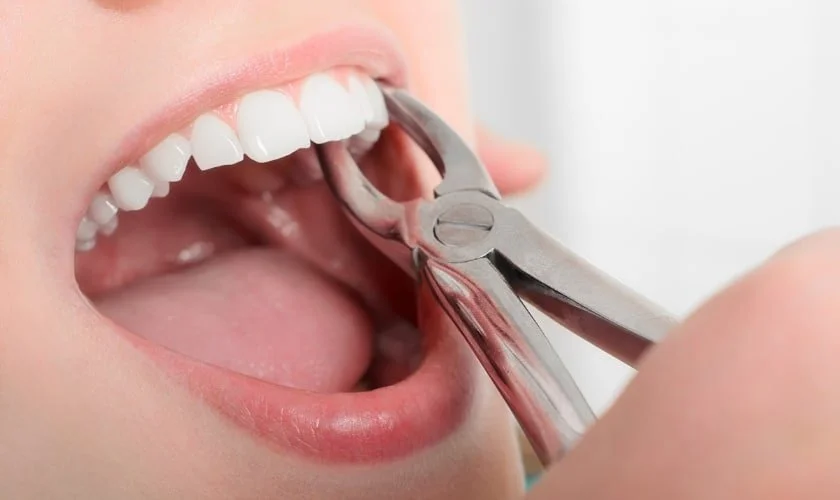
Gum tissue takes about one to two weeks to close over the surface of a tooth extraction site. Full soft tissue healing follows by weeks three to four, and the bone underneath keeps filling in for three to six months after that. Most people feel close to normal well before any of those milestones are complete. Below we cover why gum healing runs on that schedule, what happens at each stage, which day is the most uncomfortable, which teeth take longest, how to tell healing is going well, what to do about soreness at day seven, how to help the process along, how much rest you need, and when something warrants a call.
How Long Do Gums Take to Heal After Tooth Extraction?
Gums take about one to two weeks to heal over the surface of a tooth extraction site, with full soft tissue healing by weeks three to four. Those are two different milestones, and mixing them up is the reason people get conflicting answers to this question.
There are really three timelines running at once after a tooth extraction, and it helps to keep them separate:
Surface closure happens in one to two weeks, when new gum tissue grows across the opening and the socket stops being an open wound. Full soft tissue healing takes three to four weeks, when the gum has thickened, settled, and looks like the tissue around it. Bone fill takes three to six months, happening entirely out of sight beneath the gum.
The socket itself closes on its own schedule between those points. Published healing research puts the average at about twelve weeks for an extraction socket to fully close and heal. You will feel fine long before that, which is why most people never notice the later stages happening at all.
Why Gum Healing Takes One to Two Weeks
Gum healing takes one to two weeks because new tissue has to grow inward from the edges of the socket rather than appearing across it all at once. The gum cannot simply close like a zipper. A layer of new tissue migrates in from the rim, a little each day, until the two sides meet in the middle.
That inward migration is why socket width matters more than almost anything else. A narrow socket left by a small lower front tooth has a short distance to cover. A wide socket left by a molar with three roots has far more ground to close, so the same biological process takes noticeably longer in the same mouth.
How Long Will Your Gums Be Sore After Tooth Extraction?
Your gums will be sore for about three to seven days after a tooth extraction, with the soreness peaking on day two or three and fading steadily after that. Most people find that discomfort is minimal to none by day seven for a routine extraction.
Soreness and healing run on different clocks. The site stops hurting well before it finishes closing, and it finishes closing well before the bone underneath has filled in. Mild tenderness when you press directly on the area can linger into the second or third week and is a normal part of the process rather than a sign that something has gone wrong.
What Are the Stages of Gum Healing After Extraction?
The stages of gum healing after extraction are blood clot formation, granulation tissue growth, soft tissue closure, and bone remodeling. Each one hands off to the next, and knowing which stage you are in removes most of the guesswork. We walk patients in Cinnaminson through this sequence before they leave, so nothing during the first week comes as a surprise.
The First 24 Hours
In the first 24 hours a protective blood clot forms over the empty socket. Mild bleeding, swelling, and soreness are all normal, and the numbness from the anesthetic wears off within about two to four hours. That clot is the foundation the entire process is built on, since it shields exposed bone and nerve endings and signals the body to begin repair. Biting gently on gauze for the first 30 to 45 minutes helps it set.
Days 2 to 3
On days 2 to 3 swelling and discomfort usually peak before starting to subside. Bruising sometimes appears on the cheek or neck, and the jaw can feel stiff and harder to open. A yellowish or whitish film often shows up inside the socket around this point. That film is new healing tissue rather than infection, which is worth knowing in advance because it alarms a lot of people. Warm salt water rinses can begin after the first 24 hours.
Days 4 to 7
From days 4 to 7 soft granulation tissue fills the socket and the opening starts to narrow. Swelling recedes, and most people notice a clear improvement in comfort around day 4 or 5. Any stitches placed usually dissolve or are ready to come out near the end of this window. Slightly firmer soft foods become comfortable again.
Weeks 2 to 3
By weeks 2 to 3 the gum tissue visibly closes over the socket. The area looks and feels close to normal, everyday activity is unrestricted, and the site may still feel slightly tender when pressed directly. This is the milestone most people mean when they say their gums have healed.
Months 3 to 6
Over months 3 to 6 the jawbone fills the socket from the bottom up and reshapes itself. This stage is invisible from the outside and requires nothing from you. It is also the stage where the most measurable change happens, which is covered in the section on bone below.
Research on post-extraction healing, including the systematic review work by Tan and colleagues on ridge dimensional change, gives the figures behind the stage-by-stage summary below.
StageWhat Is HappeningWhat You Will NoticeWhat to DoFirst 24 hoursA blood clot forms and seals the socketMild bleeding, swelling starting, numbness fadingGauze pressure, ice on the cheek, no rinsing or strawsDays 2 to 3Blood flow and repair cells reach the siteSwelling and soreness at their peak, possible bruising and jaw stiffnessBegin gentle salt water rinses, switch to warm compresses after 48 hoursDays 4 to 7Granulation tissue fills the socketSwelling receding, comfort improving, whitish film in the socketRinse after meals, reintroduce firmer soft foodsWeeks 2 to 3New gum tissue closes across the openingSite looks near normal, mild tenderness on pressureResume normal brushing, return to a near-normal dietMonths 3 to 6Bone fills the socket and the ridge reshapesNothing visible, the area feels normalKeep regular checkups, plan any tooth replacement
That bone stage is doing more than it appears to. Tan and colleagues found horizontal bone loss of 29 to 63% and vertical bone loss of 11 to 22% in the first six months after extraction, with the fastest changes in the first three to six months. A separate systematic review put the average ridge width reduction at 3.87 mm with mid-buccal height loss of 1.67 mm, and Schropp and colleagues found roughly two-thirds of all hard and soft tissue change happening within the first three months. That is why replacement options are usually discussed early rather than years later, and it is also why our practice raises the topic at the extraction visit.
What Is the Worst Day After a Tooth Extraction?
The worst day after a tooth extraction is usually day two or day three, when swelling and soreness reach their peak. After that point the trend runs one direction, and almost everyone feels meaningfully better by day four.
The reason day one is often easier than day two catches people off guard. Local anesthetic is still wearing off for the first few hours, and the inflammatory response that produces swelling takes a day or so to build. Blood flow and repair cells arrive at the site in force during the second day, which is exactly what healing requires and exactly what makes the cheek puffy and the jaw stiff.
Knowing the peak is coming changes how it feels when it arrives. Swelling that worsens on day two is the process working. Swelling that is still worsening after day three is a different signal, and that distinction is covered further down.
What Tooth Takes the Longest to Heal After Extraction?
Lower wisdom teeth take the longest to heal after extraction, followed by lower molars. Three things stack up in the lower back of the mouth to stretch the timeline.
Socket size comes first. A molar has two or three roots and leaves a wide, deep socket, so the new gum tissue migrating in from the edges has considerably more distance to cover than it would at a narrow single-rooted front tooth. Bone density is the second factor, since the lower jaw is denser and less richly supplied with blood vessels than the upper jaw, which slows the repair process. Surgical difficulty is the third, because an impacted wisdom tooth often has to be sectioned and removed in pieces, which creates a larger wound than a simple lift-and-lift-out extraction.
The numbers reflect that stacking. Dry socket affects roughly 2 to 5% of routine extractions, but the figure climbs as high as 38% for impacted lower wisdom teeth, and the complication occurs up to ten times more often in the lower jaw than the upper. Over 5 million wisdom teeth are removed each year in the United States, according to the American Association of Oral and Maxillofacial Surgeons, so a slower-than-expected recovery after one is common rather than unusual. None of this means an extraction is the first plan, and saving a tooth is always considered before removing it.
How Can You Tell if Your Gums Are Healing Well?
You can tell your gums are healing well when pain decreases a little each day, swelling goes down after day three, and the socket gradually narrows and fills with pink or whitish tissue. The direction of travel matters more than any single day's appearance.
The whitish or yellowish material that shows up in the socket between days two and seven is the single most misread sign in the whole process. That is granulation tissue, made of new blood vessels and collagen, and it is the body building a foundation for new gum. It looks like something has gone wrong, and it is the opposite.
Healthy progress also shows in the surrounding gum. Redness fades rather than spreading, the edges of the socket look firm rather than ragged, and any taste in the mouth is neutral rather than foul. An extraction site that develops genuine tooth pain that builds over days rather than easing is telling you something different.
Why Is Your Gum Still Sore 7 Days After Extraction?
Your gum can still be sore 7 days after extraction because soft tissue closure is not finished yet, and mild tenderness through the second week is normal. Soreness that is gradually fading is simply the tail end of a normal recovery, particularly after a surgical extraction or a lower molar.
What the soreness is doing matters far more than the fact that it exists. Tenderness that is less than it was on day four, responds to gentle pressure only, and comes with no fever or bad taste is the expected pattern. Pain that has been increasing since day three, throbs constantly, radiates toward the ear, or arrives with a foul taste is a different pattern and warrants a call rather than another week of waiting.
Larger sockets simply run longer. A wisdom tooth site that still feels tender at day seven is often exactly on schedule, while a small front tooth site that still hurts at day seven is worth having looked at.
How Can You Make Your Gums Heal Faster After Extraction?
You can make your gums heal faster after extraction by protecting the blood clot, keeping the area clean without disturbing it, and eating in a way that supports tissue repair. The biology sets the pace, and these habits keep anything from slowing it down.
Protect the clot for the first 24 hours, since losing it is the leading cause of delayed healing
Rinse gently with warm salt water after meals, starting a day after the extraction
Use a cold pack on the cheek in 20-minute intervals for the first 48 hours, then switch to warm compresses
Sleep with your head raised on an extra pillow for the first few nights
Eat soft, protein-rich foods, since protein is what tissue repair is built from
Keep brushing your other teeth normally, and brush gently near the site after the first day
Avoid tobacco entirely, because it is the strongest habit-based factor working against clot stability
Those habits are the same ones we recommend around gentle extractions for every patient, regardless of which tooth came out.
Does Salt Water Speed Up Healing After Tooth Extraction?
Salt water speeds up healing after tooth extraction by reducing the bacterial load in the socket without disturbing the new tissue forming inside it. It does not accelerate tissue growth directly. What it does is remove the obstacles, clearing food debris and lowering the bacterial count so the healing process runs without interference.
Mix about half a teaspoon of salt into eight ounces of warm water. Swish gently and let the water fall out of your mouth rather than spitting, since forceful spitting creates the same suction that dislodges a clot. Start a day after the extraction, never the same day.
What Not to Do Immediately After a Tooth Extraction?
What not to do immediately after a tooth extraction comes down to anything that creates suction, pressure, or heat at the site. The list below runs in order of how much damage each one can cause.
Do not smoke or vape. The suction, the heat, and the chemicals all work against the clot at once, which is why this sits at the top of the list.
Do not use a straw. The suction pulls directly on the clot, and a drink taken from the glass is just as good.
Do not rinse or spit forcefully. Gentle swishing is fine after the first day; forceful spitting is not.
Do not eat hot or crunchy food for the first day. Heat can soften the clot and sharp edges can lodge in the socket.
Do not exercise strenuously. Raised blood pressure works against a site that is trying to stop bleeding.
Do not poke the area with your tongue or fingers. Curiosity is the most common way a settled clot gets disturbed.
How to Prevent Dry Socket
You prevent dry socket by keeping the blood clot in place during the first 72 hours, which means no smoking, no straws, and no forceful rinsing. Dry socket happens when the clot is lost before the socket has healed, leaving bone and nerve exposed, and it typically announces itself with sharp pain beginning one to three days after the extraction and lasting five to ten days.
Tobacco is the factor most within your control. Comparative incidence data puts dry socket at 12% among smokers against 4% among non-smokers, and a prospective study calculated the odds ratio for smoking at 6.41 and for poor oral hygiene at 9.53. Both of those are habits rather than bad luck. Pain that becomes severe around day three or four, especially with a foul taste, is worth urgent care rather than waiting, since the condition is treatable and treating it brings quick relief.
How Many Days of Rest Do You Need After a Tooth Extraction?
You need to rest for the remainder of the day after a tooth extraction, and most people return to work or school within one to two days. Strenuous exercise is best left alone for about a week.
Simple extractions are lighter than people expect. Many patients are back to a desk job the next morning and describe the first day as inconvenient rather than difficult. Surgical extractions and impacted wisdom teeth ask more, and two to three days away from demanding work is a sensible plan for those.
Physical work changes the calculation more than office work does. Heavy lifting raises blood pressure at the site in the same way exercise does, so a job that involves it warrants the same week of caution. Patients in Cinnaminson who ask us about timing usually find that planning an extraction before a couple of quiet days removes most of the worry. If pain is what pushed the appointment forward in the first place, knowing what counts as a dental emergency is worth reading beforehand.
When Should You Call Your Dentist During Healing?
You should call your dentist during healing when pain increases after day three instead of decreasing, when swelling worsens after day three, or when you develop a fever. Those three patterns are the clearest signals that something needs attention rather than more time.
A few others belong on the same list. A foul taste or odor coming from the socket, visible discharge, bleeding that has not slowed after 30 to 45 minutes of firm gauze pressure, and a socket that looks empty with visible bone all warrant a prompt call. None of these is common, and all of them are far easier to resolve early.
The general rule is simpler than any list. Recovery should feel a little better each day from day four onward, so anything moving the other way is worth checking. We keep room in the schedule for extraction care follow-ups precisely because early attention keeps a small issue small.
Severe swelling that affects breathing or swallowing is the exception that does not wait for a dental appointment, and the emergency room is the right destination for that. For everything else, a dental office is both faster and better equipped, and we make time for same-day care when healing goes off track.
Frequently Asked Questions
How Long Does It Take for the Hole to Close After Tooth Extraction?
The hole left by a tooth extraction takes about two to three weeks to close at the surface and around twelve weeks to fully close and heal. A small indentation can remain visible for a while after the tissue has sealed over, which is normal. Larger sockets from molars and wisdom teeth sit at the longer end of that range.
Is It Normal for the Extraction Site to Look White?
Yes, it is normal for the extraction site to look white or whitish-yellow between days two and seven. That material is granulation tissue, the new blood vessels and collagen your body builds as a foundation for new gum. It is one of the most commonly mistaken signs of healthy healing. White tissue combined with severe pain, a foul taste, or fever is a different picture and should be checked.
When Can You Brush the Extraction Site?
You can brush around the extraction site gently after the first 24 hours, and you should brush your other teeth normally from the start. Keep the bristles off the socket itself for the first few days, then work gradually closer as the tenderness fades. Skip an electric brush directly over the site until the area has fully closed.
What Can You Eat While Your Gums Heal?
While your gums heal you can eat soft foods at room temperature, including yogurt, scrambled eggs, mashed potatoes, oatmeal, soft pasta, and applesauce. Protein matters more than people expect, since tissue repair is built from it. Most people return to a normal diet within seven to ten days after a routine extraction, and up to two weeks after a wisdom tooth.
How Painful Is Tooth Extraction on a Scale of 1 to 10?
Tooth extraction itself rates near zero on a scale of 1 to 10, because the area is fully numbed before anything begins. Most patients describe pressure rather than pain during the procedure. Afterward, a routine extraction usually sits in the 2 to 4 range for a few days and eases from day four onward.
Why Do Dentists Try to Save a Tooth Before Pulling It?
Dentists try to save a tooth before pulling it because a natural tooth holds its position, keeps the bone around it stimulated, and needs no replacement. Once a tooth is gone, the ridge loses measurable width and height over the following months, and the neighboring teeth begin to drift. Reviewing replacement options early keeps those changes manageable, whether that means an implant, a bridge, or dentures.
The Bottom Line
Gums take about one to two weeks to close over a tooth extraction site, three to four weeks to finish healing fully, and the bone underneath keeps filling in for three to six months. Soreness peaks on day two or three and fades from day four, which means the hardest part arrives early and passes quickly. Lower wisdom teeth and molars run longest, because the socket is wider and the new tissue has further to travel.
Protecting the clot in the first 72 hours, rinsing gently with salt water after the first day, and staying away from tobacco cover almost everything that is within your control. Anything moving the wrong way after day three is worth a call rather than a wait. The team at Alpha Dental is glad to check a site that does not feel like it is healing on schedule, and you are welcome to get in touch whenever a question comes up during recovery.