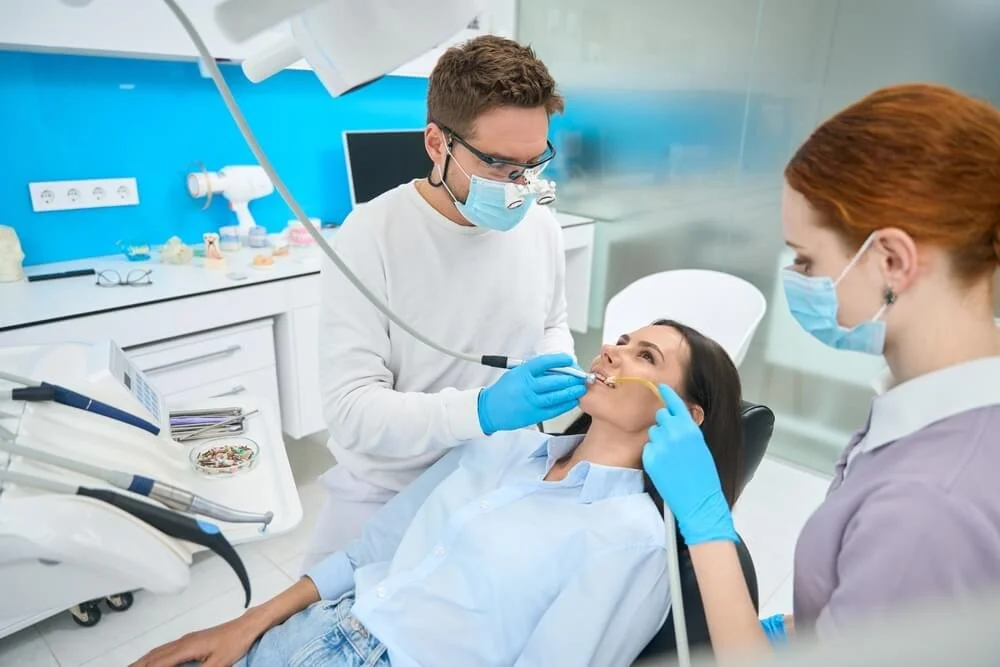
Preventive dental care protects long term oral health by removing hardened tartar that a toothbrush cannot reach, catching decay and gum disease while both are still silent, and stopping small problems from turning into root canals, extractions, and tooth loss. The payoff compounds over decades, because most damage in the mouth moves in one direction only. Enamel that dissolves does not grow back. Gum tissue that recedes does not climb back up. Bone that pulls away from a tooth root does not rebuild on its own.
Below we walk through what preventive dental care actually includes, why brushing and flossing alone cannot finish the job, how gum disease and tooth decay progress stage by stage, what a cleaning visit does about it, how often those visits are needed at different risk levels, and what the research says about the long term outcome difference.
What Is Preventive Dental Care?
Preventive dental care is the group of dental services designed to stop oral disease from starting, rather than repair damage after it has already happened. The category covers professional cleanings, routine exams, diagnostic imaging, sealants, fluoride application, and hygiene coaching. Restorative dentistry sits on the other side of that line, and includes fillings, crowns, root canals, and extractions.
The distinction matters because the two categories differ in cost, in comfort, and in what they can recover. Restorative dentistry replaces lost tooth structure with a material substitute. Preventive dentistry keeps the original tooth structure intact. A tooth that never needed a filling remains stronger than the same tooth after it has been drilled and filled, because the remaining enamel and dentin stay continuous rather than bonded to a restoration.
That difference in outcome is why our routine exams and cleanings sit at the front of every treatment plan we build. Prevention is the least invasive dentistry available.
What Is Included in Preventive Dental Care?
Preventive dental care includes six core components: a clinical examination of the teeth and soft tissues, professional removal of plaque and calculus, diagnostic imaging to see what the eye cannot, polishing of the tooth surfaces, protective treatments such as sealants and fluoride for patients who benefit from them, and personalized coaching on home technique.
Home technique carries real weight in that list. Daily brushing and flossing control the soft plaque biofilm that forms on tooth surfaces every day, which is the raw material for everything that follows. Professional care handles what the biofilm becomes once it hardens.
What Are the Benefits of Getting Preventive Dental Care?
The benefits of getting preventive dental care are early detection of silent disease, removal of hardened tartar that home care cannot touch, lower lifetime treatment cost, protection of natural tooth structure, earlier discovery of oral cancer, and reduced risk of the systemic conditions linked to chronic oral inflammation.
The cost benefit is measurable. A Cigna analysis cited by the University of Illinois Chicago College of Dentistry found that every dollar spent on preventive dental care saves between eight and fifty dollars in later restorative and emergency treatment. Emergency treatment carries the steepest price of all, and Americans generate a lot of it. Data from the American Dental Association shows roughly two million emergency room visits per year for dental pain, and 39 percent of those patients end up returning to the emergency room, because hospital emergency departments rarely staff a dentist and typically treat the pain rather than the cause.
Early detection is the benefit patients notice least and gain most from. According to the Centers for Disease Control and Prevention, one in five adults aged 20 to 64 has at least one untreated cavity right now, and most of those adults feel nothing at all.
What Are the Benefits of Maintaining Good Oral Health Care for Individuals?
The benefits of maintaining good oral health care for individuals are keeping natural teeth for a full lifetime, chewing and speaking without pain, avoiding the cascade of restorative procedures that follows untreated decay, and lowering the inflammatory load the mouth places on the rest of the body.
Keeping natural teeth is not a given. CDC data from the 2017 to March 2020 National Health and Nutrition Examination Survey shows that 13.2 percent of adults aged 65 and older have lost every natural tooth. Complete tooth loss changes diet, speech, facial structure, and bone volume in the jaw, and every one of those changes traces back to disease that was preventable decades earlier.
Why Brushing and Flossing Alone Cannot Do the Whole Job
Brushing and flossing alone cannot do the whole job because they remove soft plaque, and plaque does not stay soft. Plaque hardens into calculus within roughly 24 to 72 hours, and calculus bonds to the tooth surface with a mineral grip that no toothbrush bristle, floss strand, or mouthwash can break.
Calculus, commonly called tartar, is the crux of the entire preventive argument. Once the mineral bond forms, the deposit stays put until a trained hand removes it with a scaler or ultrasonic instrument. Every day it stays put, it functions as a rough scaffold that collects more bacteria, which means the problem accelerates rather than holds steady.
Why Does Plaque Turn Into Tartar?
Plaque turns into tartar because saliva is saturated with calcium and phosphate minerals, and those minerals precipitate into the plaque biofilm and crystallize. The process is called calcification, and it starts fast. Areas closest to the salivary gland openings, meaning the inside surfaces of the lower front teeth and the outside surfaces of the upper molars, mineralize first and heaviest.
Mineralized deposits behave differently from the soft film they came from. Soft plaque wipes away under bristle pressure. A calcified deposit resists it completely, and its porous surface holds bacterial colonies close against the gum margin where the tissue is thinnest.
Can Tartar Be Removed at Home?
No, tartar cannot be removed at home. Home tools apply pressure to a surface. Calculus removal requires shearing a mineralized deposit off enamel or root cementum without gouging the tooth underneath, which is why hygienists train specifically in instrumentation. Attempts to scrape deposits off with metal picks bought online tend to damage enamel and irritate gum tissue, and they never reach the deposits below the gumline, which are the ones that matter most.
Deposits below the gumline sit in the space between the tooth root and the gum tissue that hugs it. That space is where the next stage of the problem begins.
How Gum Disease Starts and Progresses
Gum disease starts when bacteria in subgingival plaque and calculus trigger an inflammatory response in the gum tissue, and it progresses when that inflammation moves from soft tissue into the bone and ligament holding the tooth in place. The two stages have very different endings: gingivitis reverses completely, and periodontitis does not.
The scale of the problem is national. The CDC reports that 42 percent of adults aged 30 and older have periodontitis, and about 8 percent have the severe form. Earlier CDC surveillance published in the Journal of Dental Research put the figure at 47.2 percent, roughly 64.7 million American adults, rising to 70.1 percent among adults 65 and older.
What Does Stage 1 Gum Disease Look Like?
Stage 1 gum disease looks like red, puffy gum margins that bleed during brushing or flossing, often paired with persistent bad breath. That first stage is gingivitis, and it involves the gum tissue only. Bone height stays normal, the attachment between gum and tooth stays intact, and the tooth stays as stable as it ever was.
Color and contour give it away before anything else does. Healthy gum tissue is firm, pale pink in most patients, and comes to a knife edge where it meets the tooth. Inflamed tissue is darker, rounder at the margin, and glossy.
What Are Two Signs That You Have Gum Disease?
The two signs that you have gum disease are bleeding gums during brushing or flossing and persistent bad breath that returns quickly after cleaning. Bleeding is the most reliable early indicator, because healthy gum tissue does not bleed under normal brushing pressure. Patients frequently read bleeding as a sign they brushed too hard, when it is almost always a sign the tissue is already inflamed.
Later signs arrive in a predictable order: gum recession, sensitivity at the exposed root surface, visible gaps opening between teeth, and eventually looseness. Looseness means bone loss has already progressed, which is late.
Is Gingivitis 100% Reversible?
Yes, gingivitis is 100 percent reversible. Gingivitis involves inflammation of the gum tissue with no loss of bone or connective attachment, so removing the bacterial cause allows the tissue to return to full health. Professional calculus removal combined with consistent daily plaque control typically resolves the inflammation within one to two weeks.
Full reversibility is exactly what makes the gingivitis window valuable. Catching the disease at that stage costs a cleaning appointment. Missing it costs a great deal more, because the next stage takes something that cannot be given back.
Can Gum Disease Be Cured Completely?
Gum disease can be cured completely at the gingivitis stage, but periodontitis can be controlled rather than cured. Periodontitis destroys the alveolar bone and the periodontal ligament fibers that anchor the tooth root, and neither structure regenerates spontaneously once lost. Treatment halts the destruction and stabilizes what remains, which is a genuinely good outcome, though it is stabilization rather than reversal.
Stabilization holds only with maintenance. Research published in the Journal of Dental Research tracking 5,117 adults across 16 years of insurance claims found that patients carrying periodontal risk factors such as smoking or diabetes had tooth extraction event rates of 16.9 percent with two preventive visits per year, compared with 22.1 percent at one visit per year, an absolute risk reduction of 5.2 percent.
Can I Regrow Receding Gums?
No, you cannot regrow receding gums. Gingival tissue that has migrated down the root does not migrate back up on its own, and the root surface it exposes stays exposed. Surgical grafting can cover a recession defect with tissue taken from elsewhere, though that is a repair rather than regrowth, and the same is true of the underlying bone.
The one-directional nature of that damage applies to the tooth itself as well, which raises the obvious question about cavities.
Can Cavities Be Reversed?
Cavities can be reversed before the enamel surface breaks, and cannot be reversed afterward. Early demineralization, the chalky white spot lesion that appears before a hole forms, remineralizes when fluoride and salivary minerals rebuild the crystal structure. Once the surface collapses into a cavitation, the lost structure is gone permanently and requires a restoration.
That cavitation threshold is the whole reason exam intervals matter. A white spot lesion caught at a routine visit gets treated with fluoride and technique changes. The same lesion found two years later gets a drill.
Left alone, decay follows a predictable escalation. Each step costs more, takes longer, and removes more natural tooth than the step before it:
Demineralization. Acid produced by plaque bacteria strips calcium and phosphate from the enamel surface. Reversible at this stage.
Cavitation. The weakened enamel surface collapses and a physical hole forms. No longer reversible.
Dentin involvement. Decay reaches the softer dentin layer beneath the enamel and spreads faster, because dentin is less mineralized. Sensitivity to cold and sweet often starts here.
Filling. The decayed structure is removed and replaced with a resin restoration.
Pulp involvement. Bacteria reach the nerve and blood supply inside the tooth. Pain becomes constant rather than triggered, and infection can spread into the surrounding bone.
Root canal and crown. The infected pulp is removed, the canals are sealed, and the weakened tooth is capped. A root canal saves the natural tooth, though the tooth is more brittle afterward.
Extraction. The tooth is removed once it can no longer be restored, and replacement with dental implants or a bridge is planned from there.
Replacement. The gap is closed with a fixed prosthetic or with partial or complete dentures, depending on how many teeth are involved.
Eight steps separate a reversible white spot from a missing tooth. Preventive visits exist to interrupt that sequence at step one or two, where interruption is cheap and painless.
What Happens If You Don't Go to the Dentist for Years?
If you don't go to the dentist for years, calculus accumulates below the gumline, gingivitis progresses into bone loss, and early decay advances through the enamel into the dentin and pulp, usually without producing pain until the damage is extensive. The silence is structural, not coincidental.
Enamel contains no nerve endings. Sensation begins in the dentin tubules and intensifies at the pulp, which means a lesion has to travel most of the way through the tooth before the patient feels anything. Periodontitis is quieter still, since bone resorption itself produces no pain signal at all. By the time a toothache arrives, the problem is typically several stages old.
The endpoint of long avoidance is missing teeth and urgent pain. CDC data shows that 25.9 percent of adults aged 20 to 44 and 25.3 percent of adults aged 45 to 64 carry untreated dental caries, and smoking sharpens every one of those numbers: over 40 percent of adults aged 20 to 64 who smoke have untreated cavities compared with 20 percent of adults who never smoked, and 43 percent of smokers aged 65 and older have lost all of their teeth.
Sudden severe pain, facial swelling, or a knocked out tooth becomes a dental emergency rather than a routine appointment, and emergency care always costs more than the visit that would have prevented it.
Does Gum Disease Affect the Rest of Your Body?
Yes, gum disease affects the rest of your body. Periodontal pockets create a chronically inflamed, ulcerated surface that allows oral bacteria and inflammatory mediators to enter the bloodstream, and researchers have documented associations between periodontal disease and cardiovascular disease, type 2 diabetes, respiratory infection, and adverse pregnancy outcomes.
Diabetes carries the clearest two-way relationship. High blood glucose worsens periodontal inflammation, and periodontal inflammation worsens glycemic control. A Mayo Clinic study of 11,734 commercially insured adults found that patients with diabetes who had at least one preventive dental visit each year averaged 549 dollars in annual medical cost savings compared with patients who had none, alongside a lower likelihood of hospitalization.
Cost savings of that kind reflect fewer complications rather than cheaper dentistry, which is the point. Oral inflammation is a modifiable input into whole body health, and preventive visits are how it gets modified.
What Happens During a Dental Cleaning?
During a dental cleaning, the hygienist charts the gum tissue, removes plaque and calculus above and below the gumline, polishes the tooth surfaces, and the dentist examines the teeth and soft tissues for signs of decay, gum disease, wear, and abnormal tissue changes. A typical preventive appointment covers the following:
Periodontal charting. Pocket depths are measured around each tooth with a calibrated probe. Depths of one to three millimeters indicate health, and increasing depth indicates attachment loss.
Scaling. Hand instruments and ultrasonic scalers remove calculus from the crown and root surfaces, including the subgingival deposits home care cannot reach.
Polishing. A prophy cup and paste remove surface stain and residual biofilm, leaving a smoother surface that resists new plaque adhesion.
Clinical examination. Each tooth is checked for demineralization, cavitation, cracks, failing restorations, and wear from grinding.
Soft tissue evaluation. The tongue, floor of the mouth, cheeks, palate, and throat are inspected for lesions, color changes, and lumps.
Home care guidance. Technique, tool selection, and problem areas specific to that patient are reviewed.
Soft tissue evaluation deserves particular attention, because timing changes outcomes dramatically for oral cancer. Data published in Cancer Epidemiology, Biomarkers & Prevention using National Cancer Institute figures shows a five-year survival rate of 83.7 percent when oral cancer is found at a localized stage, falling to 38.5 percent once it has metastasized, and roughly 70 percent of cases are currently diagnosed at those later stages. Routine exams are the most common setting in which a suspicious lesion gets noticed early.
At our Cinnaminson office, we keep these appointments unhurried on purpose, since a rushed exam is where small findings get missed. Patients who want a full picture of what we handle beyond prevention can review our dental services.
How Often Should You Get Your Teeth Cleaned?
Most patients should get their teeth cleaned every six months, and patients with elevated risk benefit from every three to four months. The correct interval depends on caries risk and periodontal risk rather than on a universal rule, and the risk factors that shorten the interval are smoking, diabetes, a history of periodontitis, dry mouth, heavy calculus formation, and a recent history of new decay.
The six-month default exists because it works well for the average low-risk adult, not because it is biologically fixed. A patient who forms heavy calculus within eight weeks is left with four months of untreated deposits under a six-month schedule. A low-risk adult with minimal deposit formation is well covered by it.
Patient profileTypical intervalPrimary risk driversDocumented outcome dataLow-risk adultEvery 6 monthsLight calculus formation, no active decay, healthy pocket depthsExtraction event rate of 13.8% over 16 years at 2 visits per year, versus 16.4% at 1 visitHigh-risk adult (smoking, diabetes, or prior periodontitis)Every 3 to 4 monthsImpaired healing, faster attachment loss, heavier deposit formationExtraction event rate of 16.9% at 2 visits per year, versus 22.1% at 1 visit, a 5.2% absolute risk reductionAdult with diabetesEvery 3 to 4 monthsBidirectional link between glycemic control and periodontal inflammation$549 average annual medical cost savings with at least one preventive visit per yearChild, ages 6 to 12Every 6 monthsNewly erupted molars with deep grooves, developing brushing skill50% of children aged 6 to 9 have had cavities; sealants prevent about 80% of molar cavitiesOlder adultEvery 3 to 6 monthsGum recession, root surface decay, dry mouth from medication70.1% of adults 65 and older have periodontal disease; 13.2% have lost all natural teeth
Sources: Centers for Disease Control and Prevention, Division of Oral Health; Journal of Dental Research, patient stratification study of 5,117 adults across 16 years of claims data; Mayo Clinic study of 11,734 commercially insured adults; CDC National Health and Nutrition Examination Survey 2017 to March 2020.
Setting the right interval is a clinical judgment rather than a scheduling default, and it changes as risk changes. Dr. David Cho sets recall intervals patient by patient based on what the charting and exam actually show.
How Preventive Care Changes at Every Age
Preventive care changes at every age because the dominant risk shifts from grooved new molars in childhood, to plaque control and early gum inflammation in adulthood, to root surface decay and recession in later life. The core visit stays the same. The priorities inside it do not.
Children and Teens
For children and teens, the dominant cavity risk is the deep pit and fissure anatomy of newly erupted permanent molars, which arrive around age 6 and again around age 12. Those grooves are narrower than a toothbrush bristle, which makes them nearly impossible to clean fully.
Sealing those grooves closes the gap. The CDC reports that dental sealants prevent about 80 percent of cavities in children, and that school-age children without sealants have almost three times more cavities than children who have them. The need is real: half of all children aged 6 to 9 have already had cavities in their primary or permanent teeth, and Pew Charitable Trusts data cited by the University of Illinois Chicago College of Dentistry found cavities to be five times more common than asthma among US children.
Consequences reach past the mouth for this age group. The National Maternal and Child Oral Health Resource Center reports that children in low-income families with limited access to preventive care miss three times as many school days from oral health problems. Building the habit early is why we start children's dental care with short, calm, low-pressure visits.
Adults
For adults, the dominant risk shifts to periodontal inflammation and to decay at the margins of older restorations. Fillings placed in adolescence do not last forever, and the seam between an aging restoration and the tooth becomes a collection point for plaque.
Adult risk also concentrates in specific groups. CDC surveillance from 2009 to 2014 found periodontitis twice as common among adults with low income, at 60 percent, compared with 30 percent among adults with higher income, which reflects differences in access to preventive visits more than differences in effort.
Older Adults
For older adults, the dominant risk becomes root surface decay, because gum recession exposes cementum, and cementum demineralizes at a higher pH than enamel does. Root surfaces begin dissolving under acid conditions that enamel would survive.
Dry mouth compounds it. Many common medications reduce salivary flow, and saliva is the mouth's own buffering and remineralizing system. Less saliva means less acid neutralization, less mineral replacement, and faster decay, which is why recall intervals often shorten in later life rather than lengthen.
Is Preventive Dental Care Worth It?
Yes, preventive dental care is worth it. The return runs eight to fifty dollars in avoided restorative and emergency treatment for every dollar spent on prevention, according to the Cigna analysis cited by the University of Illinois Chicago College of Dentistry, and the clinical return is larger than the financial one because prevention keeps natural tooth structure that no restoration fully replaces.
Natural structure is the asset being protected here. A sealed molar at age 7 can stay untouched for life. That same molar, left unsealed and decayed, can move through a filling in the teens, a larger filling in the thirties, a crown in the fifties, and a replacement in the seventies. Each step in that sequence was avoidable at the step before it.
The evidence base agrees on direction even where it disagrees on magnitude. Research published in the Journal of Public Health Dentistry examining Medicaid enrollment and claims data for beneficiaries with diabetes, heart disease, and respiratory conditions assessed preventive dental services against subsequent treatment service use and expenditures, and preventive utilization consistently tracks with lower downstream treatment intensity. Prevention shows up in the data as fewer procedures, not just cheaper ones. That principle sits at the center of how we practice general dentistry.
Frequently Asked Questions
What Is Mistaken for Gum Disease?
Gum disease is most often mistaken for brushing trauma, hormonal gingival changes during pregnancy or puberty, a reaction to a medication that causes gum overgrowth, or a localized irritation from food impaction between two teeth. Certain blood pressure medications, anti-seizure drugs, and immunosuppressants cause gingival enlargement that resembles inflammation. Bleeding after brushing is the symptom most commonly misread, since patients usually blame technique when the tissue is already inflamed.
What's the Worst Stage of Gum Disease?
The worst stage of gum disease is advanced periodontitis, also classified as stage 4, in which pocket depths exceed six millimeters, more than 33 percent of bone support is lost, teeth become mobile or shift position, and tooth loss occurs. About 8 percent of American adults aged 30 and older have severe periodontitis, according to the CDC. Treatment at this stage stabilizes the remaining support rather than restoring what was lost.
Can I Live a Healthy Life With Gum Disease?
Yes, you can live a healthy life with gum disease when it is actively managed with professional maintenance and consistent home care. Managed periodontitis stays stable for decades in many patients. Unmanaged periodontitis progresses toward tooth loss and keeps a chronic inflammatory burden in circulation, which research links to cardiovascular disease and poorer glycemic control in diabetes. The distinction is treatment, not luck.
Are Dental X-Rays Necessary Every Year?
Dental X-rays are not necessary every year for every patient, and the correct frequency depends on caries risk and clinical findings. Low-risk adults with no recent decay commonly need bitewing images every 24 to 36 months, while patients with active decay or periodontal bone loss need them more often. Imaging detects decay between teeth and bone loss around roots, neither of which is visible during a visual exam.
Do Dental Sealants Work for Adults?
Yes, dental sealants work for adults whose molars still have deep, intact pits and fissures with no existing decay or restoration. Effectiveness depends on groove anatomy rather than on age. Most adult molars already carry fillings or wear that make sealing impractical, which is why sealants are applied far more often to children, where CDC data shows they prevent about 80 percent of cavities.
What It All Comes Down To
Preventive dental care works because it operates on the one part of the timeline where damage is still reversible. Gingivitis resolves. Early demineralization remineralizes. Bone loss, cavitation, and recession do not, and every year of skipped visits moves more of the mouth from the first category into the second. Two cleanings a year, an exam that catches lesions while they are still white spots, and honest home technique cover the majority of what threatens a set of teeth over a lifetime.
Families across Cinnaminson and the surrounding South Jersey area have trusted Alpha Dental with that work for over 30 years, and we still measure success the same way: how many natural teeth our patients keep, and how comfortable they feel walking in the door. If you are due for a cleaning or it has been longer than you would like, contact us and we will find a time that works.