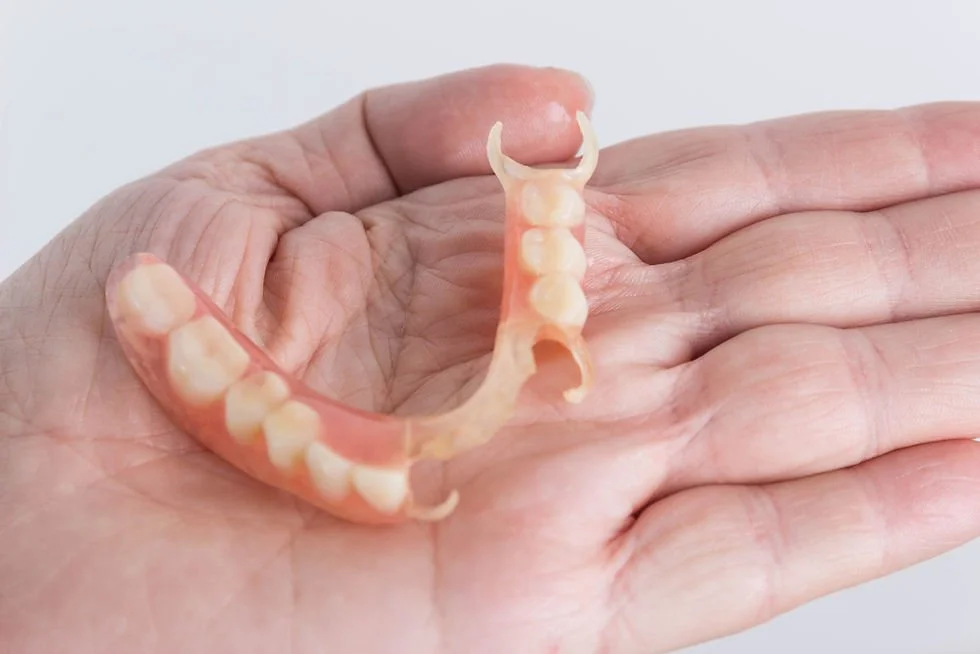
Upper partial dentures are custom removable appliances that replace one or more missing teeth in the upper jaw while anchoring to your remaining natural teeth. There are five main types: cast metal, flexible, acrylic, hybrid, and implant-retained. Each one holds on to your mouth in a different way, and that difference is what decides how thin it can be made, how much of the roof of your mouth it covers, and how long it lasts. Below we explain what a partial is, how each type stays in place, which one suits the front of the mouth, whether the palate can be left open, how one is made, how long it lasts, and how to protect the teeth holding it.
What Is an Upper Partial Denture and How Does It Work?
An upper partial denture is a removable appliance that replaces missing teeth in the upper jaw by resting on the gums and anchoring to the natural teeth you still have. Three parts do the work. Artificial teeth fill the gaps, a gum-colored base holds those teeth and sits on the ridge, and clasps or attachments grip the remaining teeth so the whole thing stays put.
A fourth part is specific to the upper jaw. A major connector crosses the roof of the mouth and joins the sections of the appliance into one rigid piece. That connector is why an upper partial can be supported across a wide area rather than balancing on a few teeth, and it is the part most patients notice first.
Partial dentures sit between two other options. A full or complete denture replaces every tooth in an arch and rests on the gums alone, while a partial works alongside your own teeth. Keeping those teeth matters, because they hold your bite in position and keep the appliance from doing all the work. If you are still weighing whether a partial or a full set fits your situation, the difference between complete dentures and partials is the place to start.
How Does an Upper Partial Denture Stay in Place?
An upper partial denture stays in place through three forces working together: retention from clasps or attachments, support from the teeth and gum ridge underneath, and bracing from the rigid connector across the palate. Retention is the one people think of, and it is only part of the story.
Clasps grip below the widest point of a natural tooth, in a slight hollow called an undercut. A metal clasp arm flexes over that widest point as the appliance seats, then springs back underneath it. A flexible partial uses the same principle with a different material, engaging soft-tissue undercuts along the gum that a rigid metal arm could never reach. An implant-retained partial replaces clasps altogether with attachments that click onto posts in the jaw.
Support comes from rest seats, which are small shaped areas on the biting surfaces of the anchor teeth. Rest seats stop the appliance from sinking into the gum under chewing pressure, and their placement is the difference between a partial that feels stable and one that rocks. That combination of forces is the same across every type of appliance, and the basics of how dentures work follow from it.
Why the Upper Jaw Is Different From the Lower Jaw
The upper jaw is different from the lower jaw because it has a palate available to it, which is both an advantage and a complication. The advantage is surface area. A connector spread across the roof of the mouth distributes chewing load over a wide region, so a well designed upper partial can stay comfortable while anchoring to very few teeth.
The complication is that the palate is where people notice everything. Thickness, temperature, speech, and the gag reflex all live there. An appliance that is mechanically ideal can still be set aside by the person wearing it because the palate feels crowded. That tension between support and tolerance shapes every design decision in the upper jaw, and it explains why the material a partial is built from matters as much as it does.
What Are the Main Types of Upper Partial Dentures?
The main types of upper partial dentures are cast metal, flexible, acrylic, hybrid, and implant-retained. They differ in the base material, the way they grip the remaining teeth, and how much rigidity they bring to the palate. Rigidity is the thread running through all five, because a rigid appliance can be made thin and a flexible one cannot.
Cast Metal Partial Dentures
A cast metal partial denture uses a thin framework of cobalt-chromium or titanium alloy, with a gum-colored acrylic base and replacement teeth attached to it. Metal clasp arms engage the undercuts on the anchor teeth, and rest seats on those teeth carry the load.
Rigidity is the point of this design. Because the alloy holds its shape under chewing force, load goes exactly where the framework directs it, and the palatal coverage can be reduced to a narrow strap rather than a full plate. That is why cast metal often turns out to be the most comfortable option in the upper jaw despite being the one people expect to feel bulky. Metal clasp arms can show at the corners of a smile, which matters more in some mouths than others.
Flexible Partial Dentures
A flexible partial denture is made from a thin nylon thermoplastic that bends slightly and snaps into place over the gums. There are no metal clasps. The base itself is tinted to match gum tissue, and the retaining arms blend into the tissue color rather than reflecting light the way polished metal does.
The flexibility that makes it comfortable also sets its limits. A flexible base bends under load, so it suits short gaps far better than long ones, and it is not the right choice where a partial has to carry real chewing force behind the last natural tooth. Flexible bases also cannot be relined or adjusted the way acrylic can, so changes in fit usually mean a new appliance rather than a repair. For a visible gap where a clasp would sit right in the smile line, those trade-offs are frequently worth accepting.
Acrylic Partial Dentures and Flippers
An acrylic partial denture uses a rigid pink acrylic base with thin wire clasps bent around the anchor teeth. A flipper is the smallest version of this design, replacing one or two teeth on a light acrylic plate, and a Nesbit is a similar appliance made for one or two back teeth.
Acrylic is built for a defined job. It is quick to make, easy to adjust at the chair, and well suited to the healing period after extractions or to holding a space while a longer plan is arranged. Because acrylic is not as rigid as an alloy framework, it needs more palatal coverage to spread the load, and it flexes under function in a way that is fine over months and becomes a problem over years. The sensible approach is to treat it as the interim appliance it was designed to be and plan the next step at the same visit.
Hybrid Partial Dentures
A hybrid partial denture combines a rigid metal framework with flexible components or hidden attachments. The framework carries the load and keeps the appliance thin, while the flexible or tooth-colored elements handle retention in the places where a metal clasp arm would be visible.
This design suits the mouth that has one esthetic problem and one mechanical problem at the same time, such as a long span at the back that needs rigidity and a visible anchor tooth at the front that needs a clasp nobody can see. Hybrids take more planning and more lab work than a single-material appliance, which is the trade in exchange for solving both problems at once.
Implant-Retained Partial Dentures
An implant-retained partial denture anchors to titanium posts placed in the jawbone instead of clasping onto natural teeth. Attachments on the underside of the appliance click onto those posts, which removes both the visible clasps and the load on the remaining teeth.
This option changes the upper jaw more than it changes the lower. Retention from implants is strong enough that the palate can often be opened up into a horseshoe shape, which is frequently the answer for someone who has tried conventional uppers and could not tolerate the coverage. The research supports it: a systematic review and meta-analysis of tooth-implant supported removable partials found 100% prosthetic survival at both three and five years, with implant survival at 99.3% and 98.8% across the same periods. Treatment takes longer because the posts need months to fuse, and candidacy depends on bone volume, which is assessed before any plan is made. Our approach to dental implants starts with that evaluation.
Long-term survival research from the Journal of Prosthetic Dentistry and from ten-year clinical evaluations gives the lifespan figures that let the five designs be compared directly.
TypeBase MaterialHow It Holds OnBest Suited ForDocumented LifespanCast metalCobalt-chromium or titanium with acrylicMetal clasps in tooth undercuts, plus rest seatsLong-term wear, several missing teeth, reduced palate coverage95.1% survival at 5 yearsFlexibleNylon thermoplasticTissue-colored arms engaging gum undercutsShort gaps where a clasp would be visibleCommonly 5 to 8 yearsAcrylic and flippersAcrylic resin with wire claspsBent wire clasps plus broad tissue contactHealing after extractions, holding a space short termCommonly 3 to 5 yearsHybridMetal framework with flexible or hidden partsRigid framework plus concealed attachmentsCases needing rigidity in back and invisibility in frontTracks the metal framework it is built onImplant-retainedMetal or acrylic over implant attachmentsAttachments clicking onto titanium postsMaximum stability and an opened-up palate100% prosthetic survival at 5 years in review data
What Is the Most Popular Type of Upper Partial Denture?
The most popular type of upper partial denture is the cast metal framework, and it is also the type most dentists consider the best general choice for the upper jaw. The reason surprises people who expect metal to feel heavy.
Comfort in an upper partial is mostly a question of how much palate is covered and how thick that coverage is. Metal is strong enough to be made thin, so a cast framework can cover a fraction of the palate that an acrylic appliance would need to do the same job. The material feels harder and the appliance feels lighter, which is the opposite of what most patients predict. Among the partial denture patients we see in Cinnaminson, the ones who adapt fastest are usually wearing the thinnest appliance rather than the softest one.
Popularity is not the same as correctness for every mouth. Cast metal assumes the anchor teeth are sound enough to carry clasps and rest seats, and it assumes the visible clasp arms can be placed where they will not show.
What Type of Partial Denture Are Patients Usually Happiest With?
Patients are usually happiest with the partial denture that covers the least palate and shows the fewest clasps, which in most cases means a well designed cast metal framework or a flexible partial for a short front gap. Satisfaction tracks two things almost perfectly: whether the appliance is noticeable in the mouth and whether it is noticeable in photographs.
Flexible partials perform better on that second measure than their reputation suggests. A randomized controlled trial comparing flexible thermoplastic partials against conventional cast alloy partials reported better patient satisfaction in the flexible group, with no abutment failures recorded in that arm during the study.
What Type of Partial Denture Looks the Most Realistic?
A flexible partial denture looks the most realistic in the front of the mouth, because its gum-colored base and tissue-toned retaining arms carry no metal to catch the light. The base can be tinted to the shade of your own gum tissue, so the edge where the appliance meets the gum stops registering as a line.
A cast framework closes most of that gap when the clasps are designed to sit behind the visible teeth. The replacement teeth themselves are shade-matched the same way in either case, so the realism question is almost entirely about where the retaining hardware sits rather than about the teeth.
What Types of Partial Dentures Work Best for Front Teeth?
Flexible partial dentures and flippers work best for front teeth, because neither one places a visible metal clasp in the smile line. The front of the mouth carries lower biting force than the back, which is why a lighter appliance can do the job there.
A flipper is the usual choice immediately after a front tooth is lost, since it can be made quickly and fills the gap the same week. A flexible partial is the better medium-term appliance for one to four front teeth, because the tissue-colored base hides the retention entirely. A cast framework is still an option at the front when the clasp design is reworked to run behind the teeth rather than across them, and that route makes sense when the same appliance also has to replace back teeth.
Span length is the deciding factor. Flexible bases bend, and bending across a long gap shows up as movement that the wearer reports as looseness. Anything beyond a short front span is better carried by a rigid framework. We plan custom dentures around that limit rather than against it.
Can You Have a Palateless Upper Partial Denture Without Implants?
Yes, you can have a palateless upper partial denture without implants, as long as the appliance is rigid and there are enough sound teeth to anchor it. Rigidity is what buys the open palate, which is the part most people do not expect.
The connector crossing the roof of the mouth comes in three broad forms. A full palatal plate covers the most area and is used where support has to be maximized, usually with an acrylic base. A palatal strap is a narrow band crossing the middle of the palate, which is the common form on a cast framework. A horseshoe connector follows the inside of the tooth arch and leaves the center of the palate completely open.
The horseshoe is the most open design and the most demanding one, because removing that much material removes rigidity along with it. It works when a cast alloy framework supplies the stiffness and the remaining teeth supply the support. It generally does not work in acrylic, which flexes too much once the middle is cut away. Where the teeth cannot carry a horseshoe on their own, implants can supply the missing retention, and that combination is often the answer for someone who has already found full palatal coverage intolerable.
What Are the Newest Types of Partial Dentures Available Today?
The newest types of partial dentures use digital scanning, computer-designed frameworks, and newer thermoplastic materials rather than any single new appliance category. The five designs above have not changed. How they are made has.
Digital impressions replace the tray of material with an intraoral scanner, which is easier for patients with a strong gag reflex and produces a file that can be checked before anything is fabricated. Frameworks can then be milled from a solid alloy blank or printed and cast, which produces more consistent fit than hand-waxed patterns and lets the thickness be controlled precisely where the palate is involved.
Materials have moved as well. Newer nylon and thermoplastic formulations hold color better and resist fracture better than the earliest flexible bases, and concealed attachment systems have replaced visible clasps in more cases than they used to. At our practice we lean on updated technology for exactly this reason, since accuracy at the design stage is what reduces adjustment visits later.
How Is an Upper Partial Denture Made?
An upper partial denture is made across several appointments, usually spread over a few weeks, with try-in stages built in so nothing is finalized before you have seen it. The sequence below is how the process runs in our office.
Examination and planning. We check the health and bone support of the teeth that will anchor the appliance, take X-rays, and decide which design fits the case.
Impressions or a digital scan. A detailed record of both arches and of how your teeth come together goes to the lab.
Framework design. The model is surveyed to find the undercuts, which determines where the clasps sit and the path the appliance follows as it seats.
Framework try-in. For a cast partial, the metal framework is tried in on its own before any teeth are added, so the fit is confirmed while corrections are still simple.
Wax try-in. The replacement teeth are set in wax so shape, size, shade, and position can be checked and changed before anything is finalized.
Delivery. The finished partial is seated, the bite is refined, and any pressure points are relieved.
Adjustment visits. Short follow-ups over the first few weeks settle the fit as the gum tissue adapts.
The try-in stages are the ones worth protecting. Every change made in wax is easy, and every change made after processing is not. Patients in Cinnaminson who speak up at the try-in about tooth shape or shade almost always end up happier with the finished appliance.
Planning the design around your own teeth is the whole point of custom denture treatment, and it is why two people missing the same teeth can end up with different appliances.
How Long Do Upper Partial Dentures Last?
Upper partial dentures last around five to fifteen years depending on the type, and cast metal partials show a pooled five-year survival of 95.1% in systematic review data. Partials retained by telescopic crowns showed 91.7% abutment survival across the same period, with no meaningful difference between the two designs.
Longer follow-up shows where the wear arrives. A ten-year evaluation of removable partial dentures recorded metal framework fracture in 10% to 20% of appliances at five years and in 27% to 44% at ten years, and found that using replacement or non-wear as the failure measure, 75% were still in service at five years and 50% at ten. Relines and repairs are part of normal ownership rather than signs of a failed appliance, and a well timed reline is usually what extends the run. Knowing the typical denture lifespan makes it easier to plan ahead rather than react.
What Actually Wears Out First on a Partial Denture?
What wears out first on a partial denture is usually the anchor teeth rather than the appliance itself. That finding reframes the whole subject, and it is the single most useful thing to know before choosing a design.
A systematic review and meta-analysis found that teeth used as abutments carry roughly twice the risk of extraction at five years compared with teeth that are not, with an odds ratio of 1.99. The gap widens further for teeth that have had root canal treatment, which showed close to three times the extraction risk with a hazard ratio of 2.96. A separate ten-year study of severely reduced dentitions put cumulative abutment survival at 65.6% and identified the number, location, and vitality of those teeth as significant factors in how long both the teeth and the appliance lasted.
The practical consequence is straightforward. A partial is designed to direct load away from the teeth least able to carry it, which is why the planning stage spends so much time on which teeth will do the anchoring. It is also why recall visits are scheduled around the natural teeth rather than around the denture, and why small fit adjustments are worth making early instead of tolerating a partial that has started to rock.
How Do You Care for an Upper Partial Denture?
You care for an upper partial denture by cleaning the appliance daily, cleaning the anchor teeth thoroughly, and taking the partial out overnight. Given that the anchor teeth are the part most at risk, most of the routine is aimed at them.
Rinse the partial after meals to clear food from around the clasps.
Brush it twice daily over a folded towel or a basin of water, using a denture brush and a non-abrasive denture cleanser rather than regular toothpaste.
Brush your natural teeth, gums, and tongue morning and night, paying close attention to where the clasps contact the teeth.
Clean around the clasp contact points specifically, since that is where decay starts on an anchor tooth.
Soak the partial overnight in cool water or a denture solution, and never in hot water, which warps both acrylic and flexible bases.
Keep regular checkups so fit, clasp tension, and the health of the anchor teeth are reviewed together.
That routine takes a few minutes a day and protects the teeth that determine how long the appliance lasts. A fuller walkthrough of daily cleaning covers the same ground in more detail.
Why Should You Take a Partial Denture Out at Night?
You should take a partial denture out at night so the gum tissue underneath gets a rest and so bacteria have less opportunity to build up against covered tissue. Tissue that is covered around the clock stays warm and moist, which favors the growth of organisms that irritate the gums.
Overnight removal also protects the appliance. Many people clench or grind during sleep, and a partial left in absorbs that force through its clasps and framework. Store it in cool water or a cleaning solution rather than letting it dry out, since drying changes the shape of the base and the fit with it.
How Do You Keep the Gums Under a Partial Healthy?
You keep the gums under a partial healthy by cleaning the tissue itself, not only the appliance. Brush the gum ridge and palate gently with a soft brush each morning before the partial goes in, which clears the film that builds up against covered tissue overnight.
Redness in the exact shape of the appliance is the sign to have it looked at. It usually means the tissue is reacting to coverage, to plaque on the fitting surface, or to a fit that has loosened and started to rub. All three respond well to early attention, and all three are simpler to correct before the tissue changes shape.
Frequently Asked Questions
What Can I Get Instead of a Partial Denture?
Instead of a partial denture you can get a dental bridge or dental implants, depending on how many teeth are missing and what condition the neighboring teeth are in. A bridge is fixed in place and suits one or two consecutive gaps with healthy teeth on either side. Implants replace the roots as well as the crowns and leave neighboring teeth untouched. Weighing dentures or implants comes down to bone volume, the number of gaps, and how they are spread across the arch.
Can You Eat Normally With an Upper Partial Denture?
You can eat normally with an upper partial denture after a short adjustment period of one to two weeks. Start with soft foods cut small, chew on both sides at once so the appliance stays seated, and add firmer foods as confidence builds. Very sticky and very hard foods stay off the list long term, since both put uneven force on the clasps.
How Long Does It Take to Get Used to an Upper Partial Denture?
It takes most people one to two weeks to get used to an upper partial denture. Extra saliva, mild soreness at a few contact points, and a sense of fullness across the palate are all normal in the first days and settle quickly. Soreness that stays in one spot past the first week means a pressure point that needs relieving rather than more time.
What Is a Flipper Tooth?
A flipper tooth is a lightweight acrylic partial denture that replaces one or two teeth, usually at the front, on a thin plate held by small wire clasps. It is quick to make and useful while a gap heals or while a longer-term plan is arranged. Flippers are built for short-term wear rather than for years of full chewing force.
Can an Upper Partial Denture Be Changed to a Different Type Later?
An upper partial denture usually cannot be changed to a different type later, because each design is built around a different load path and a different retention method. Moving from an acrylic interim to a cast framework means a new appliance rather than an upgrade of the existing one. That is worth knowing at the planning stage, particularly when implants are part of the longer-term plan, since the interim can be designed so it does not get in the way.
Do Upper Partial Dentures Affect Your Speech?
Upper partial dentures affect speech briefly, usually for a few days to two weeks. The tongue references the palate and the backs of the upper teeth for sounds like S, T, and D, so new coverage registers immediately. Reading aloud for a few minutes a day speeds the adjustment, and a thinner connector shortens the window considerably.
The Bottom Line
Upper partial dentures come in five main types, and the difference between them is how they hold on and how rigid they are. Cast metal is thin, rigid, and the most common long-term choice, flexible partials hide their retention and suit short front gaps, acrylic partials and flippers fill a gap quickly while something more durable is planned, hybrids solve a mechanical and a cosmetic problem at once, and implant-retained partials give the most stability and the most open palate. The survival evidence is strong across the board, with cast partials around 95% at five years.
The part worth carrying away is that the anchor teeth wear out before the appliance does, which is why the design and the recall schedule are built around them. If you are missing teeth in your upper jaw and trying to work out which option fits, the team at Alpha Dental is glad to look at the teeth you still have and talk it through. Whenever you are ready, book a consultation and we will find you a time.