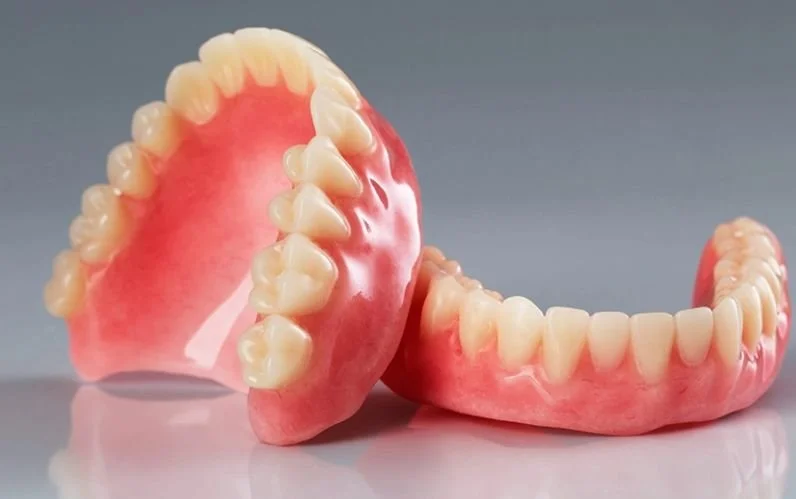
The difference between partial and complete dentures comes down to how many teeth you are missing. Partial dentures fill in gaps when some natural teeth still remain, while complete dentures replace all of the teeth in an upper or lower arch. Both are removable, custom-made, and designed to restore chewing, speaking, and the appearance of a full smile.
What Are Partial and Complete Dentures?
Partial and complete dentures are removable dental appliances used to replace missing teeth. According to the American College of Prosthodontists (ACP), approximately 178 million Americans are missing at least one tooth, and around 40 million are missing all of their teeth.
A partial denture is used when a patient still has several healthy natural teeth remaining. It clips or clasps onto those teeth and fills in the spaces where teeth have been lost. A complete denture, also called a full denture, is used when all teeth in one or both arches are gone.
We offer both partial and complete dentures at our Cinnaminson office, and we work closely with every patient to determine which type fits their needs.
How Partial Dentures Work
Partial dentures consist of replacement teeth attached to a gum-colored base. That base connects to a metal or flexible framework that clasps onto the remaining natural teeth for support.
One of the biggest benefits of a partial denture is that it prevents the remaining teeth from shifting. When a tooth is lost, surrounding teeth can gradually move out of alignment. Over time, this leads to bite problems and an increased risk of decay. A well-fitted partial keeps everything stable.
The CDC's 2024 Oral Health Surveillance Report found that adults aged 50 to 64 retain an average of about 23 teeth, down from the full set of 28 to 32. For many of these patients, a partial denture is the right solution to replace the missing ones.
Patients throughout Cinnaminson and the surrounding Burlington County communities often come to us with partial tooth loss that developed gradually from untreated decay or gum disease. In those cases, a custom partial denture restores both function and confidence.
How Complete Dentures Work
Complete dentures replace every tooth in the upper arch, lower arch, or both. They rest directly on the gums and rely on suction, saliva, and the shape of the jawbone ridge for retention. Upper complete dentures also use the palate (roof of the mouth) for additional support, which is why many patients find that upper dentures stay in place more easily than lower ones.
According to CDC data from 2017 to 2020, about 1 in 10 adults aged 65 to 74 had lost all of their teeth, and that number rose to about 1 in 5 adults aged 75 and older. Complete dentures serve this population by restoring the ability to eat a full range of foods and speak clearly.
There are two types of complete dentures: conventional and immediate. Conventional dentures are placed after the gums have fully healed from extractions, which usually takes 8 to 12 weeks. Immediate dentures are placed the same day the teeth are removed. Immediate dentures typically need to be relined once healing is complete because the gums and bone change shape during recovery.
Patients weighing whether to save a damaged tooth or move toward extraction may find it helpful to understand how dentists decide between a root canal and an extraction.
Who Is a Candidate for Each Type
The right denture type depends on the number and condition of remaining teeth, gum and jawbone health, and the patient's oral health goals.
Partial dentures are a good fit for patients who still have several strong, healthy natural teeth that can serve as anchors. They are also a good option for patients who are not candidates for implants or bridges due to bone loss.
Complete dentures are appropriate when all teeth in an arch are missing or when the remaining teeth are too damaged to save. The NIDCR notes that periodontal disease is the most common cause of tooth loss among adults, and patients with advanced gum disease sometimes reach a point where full extraction followed by complete dentures is the best path forward.
During a consultation at our Cinnaminson dental office, we evaluate the condition of your teeth, gums, and jawbone to recommend the best option.
Partial vs Complete Dentures: Side-by-Side Comparison
| Feature | Partial Dentures | Complete Dentures |
|---|---|---|
| Used when | Some natural teeth remain | All teeth in an arch are missing |
| Retention method | Clasps onto natural teeth | Suction, saliva, and ridge shape |
| Chewing efficiency | Higher (supported by natural teeth) | Lower (relies on gum tissue only) |
| Jawbone preservation | Better (natural tooth roots remain) | More bone loss over time |
| Adjustment period | Typically shorter | May take several weeks |
| Average lifespan | 5 to 7 years | 5 to 10 years |
| Covers palate | Usually not | Upper denture typically does |
Sources: American College of Prosthodontists, CDC 2024 Oral Health Surveillance Report, Cleveland Clinic
Adjusting to Life with Dentures
Both partial and complete dentures require an adjustment period. Most patients need a few weeks to get fully comfortable. During this time, it is normal to notice increased saliva, minor soreness, and some difficulty with certain words or foods.
Starting with soft foods and gradually adding harder textures helps the mouth adapt. Research published in the Journal of Prosthodontics has shown that denture wearers need more chewing cycles to break down food compared to people with natural teeth.
Patients in Cinnaminson and nearby communities like Moorestown and Delran who have questions during their adjustment period can always call our office. We schedule follow-up visits to check the fit and make any necessary modifications.
How to Care for Your Dentures
Proper daily care extends the life of your dentures and protects your gums. The American Dental Association (ADA) recommends removing dentures every night and soaking them in a denture cleaning solution. Brush them daily with a soft-bristled brush and a non-abrasive cleanser. Regular toothpaste is too harsh for acrylic and can create tiny scratches where bacteria collect.
After removing dentures, gently clean your gums with a soft, damp cloth to remove plaque and stimulate circulation. Even with dentures, regular dental checkups are important. We recommend at least one visit per year to examine the fit and monitor the health of your gums.
Patients who wear removable dentures and also have remaining natural teeth need to be diligent about brushing and flossing those teeth. Decay in an anchor tooth can compromise the stability of a partial denture.
How Long Do Dentures Last?
Most dentures last between 5 and 10 years with proper care. The fit changes over time because the jawbone continues to remodel after teeth are lost. This process, called bone resorption, gradually alters the shape of the gum ridge.
The CDC reports that the average number of permanent teeth decreases from about 27 at ages 20 to 34 down to roughly 20 at age 75 and older. For denture wearers, bone resorption means the appliance may feel looser over the years, even if the denture itself is still structurally sound.
The American College of Prosthodontists recommends replacement when dentures are more than five years old, have degraded, or when supporting teeth have been lost. Relining, which reshapes the inner surface of the denture to match the current gums, can sometimes extend a denture's useful life before full replacement is needed.
The Connection Between Missing Teeth and Overall Health
Tooth loss is more than a cosmetic issue. According to the CDC, it can lead to poor diet, low self-esteem, and difficulty speaking. A National Institutes of Health report found that denture wearers face a 1.7 times greater risk of malnutrition compared to those with a full natural set of teeth.
Adults with chronic conditions such as diabetes, heart disease, and emphysema experience significantly higher rates of tooth loss, according to a CDC study published in the Morbidity and Mortality Weekly Report. Persistent tooth pain that goes untreated often accelerates the problem. Knowing when a toothache is an emergency can help you act before a tooth is lost for good.
Replacing missing teeth with well-fitted dentures helps break that cycle. Being able to chew a wider variety of foods improves nutrition, and a restored smile often improves social confidence.
For South Jersey residents dealing with the effects of missing teeth, a visit to our Cinnaminson office is a good first step toward a solution.
When Dentures Are Not the Only Option
Dentures are not the only way to replace missing teeth. Dental implants are surgically placed titanium posts that fuse with the jawbone and support a crown, bridge, or even a full denture. Implants preserve bone because they mimic the stimulation of a natural tooth root.
Bridges are another fixed option for patients missing one or a few teeth. A bridge anchors onto the natural teeth on either side of a gap and is cemented in place permanently.
We offer dental implants, bridges, crowns, and other restorative treatments at our practice. We discuss all available options during your visit so you can make an informed choice.
Many patients worry about coverage for dentures and tooth replacement. We accept most PPO dental insurance plans and also offer an in-office dental plan for patients without insurance.
For patients in Palmyra, Riverton, Maple Shade, Mount Laurel, and the broader Philadelphia metro area, we are conveniently located on Branch Pike in Cinnaminson.
Frequently Asked Questions
What Type of Denture Are Patients Typically the Most Happy With?
The type of denture patients are typically the most happy with depends on their individual situation. Research published in the Journal of Prosthodontics found that both complete and partial denture wearers reported high satisfaction when their appliance was well-fitted. Partial denture wearers tend to report greater comfort with the lower jaw, while complete denture wearers often prefer the stability of the upper arch. A precise fit and regular follow-up adjustments play the biggest role in long-term satisfaction.
How Many Hours a Day Should You Wear New Partial Dentures?
You should wear new partial dentures most of the day during the first one to two weeks so your mouth can adjust. Wear them during meals and remove them at night for cleaning and soaking. After the initial adjustment period, removing them each night allows the gums to rest and reduces the risk of irritation.
Will Eating with Dentures Ever Feel Normal?
Eating with dentures will feel more normal over time as the mouth adapts. Most patients find that it takes a few weeks before chewing feels comfortable. Starting with softer foods and cutting items into small pieces helps during the transition. The ADA recommends chewing evenly on both sides to keep the denture stable.
Can a Dentist Pull All Your Teeth at Once for Dentures?
A dentist can pull all your teeth at once for dentures, but whether that is the right approach depends on the patient's health and the condition of the teeth. In some cases, extracting all teeth in a single visit is appropriate, and an immediate denture is placed the same day. In other cases, extractions may be done in stages to allow for gradual healing. If you experience sudden pain or swelling during your denture journey, our team provides same-day emergency dental care in Cinnaminson.
What Is the Average Age People Get Dentures?
The average age people get dentures varies, but most patients begin wearing them in their late 40s to early 50s. CDC data shows that edentulism rises sharply after age 50, increasing from about 6% of adults aged 50 to 64 to roughly 11% of adults aged 65 to 74. Partial tooth loss can happen at any adult age due to decay, gum disease, or injury.
What Disqualifies You from Getting Dentures?
What disqualifies you from getting dentures includes severe bone loss that cannot support an appliance, active oral infections that need treatment first, and certain medical conditions that affect healing. In most cases, these are temporary barriers. A thorough dental evaluation determines whether dentures, implants, or another treatment is the best fit.
How Many Bottom Teeth Do You Need for a Partial Denture?
How many bottom teeth you need for a partial denture depends on the location and health of the remaining teeth rather than a specific number. You need at least a few healthy teeth on the lower arch to serve as anchors for the clasps. The remaining teeth must be strong enough to support the denture without becoming overloaded.
Your Next Step
Whether you are missing a few teeth or an entire arch, the right denture restores your ability to eat comfortably, speak clearly, and smile with confidence. Choosing between partial and complete dentures depends on your unique oral health situation.
If you are in Cinnaminson, Moorestown, Delran, or anywhere in South Jersey and want to explore your denture options, we are here to help. At Alpha Dental, we evaluate your teeth, gums, and jawbone, explain every option, and create a treatment plan that works for you. Call us at (856) 829-1989 to schedule a visit.