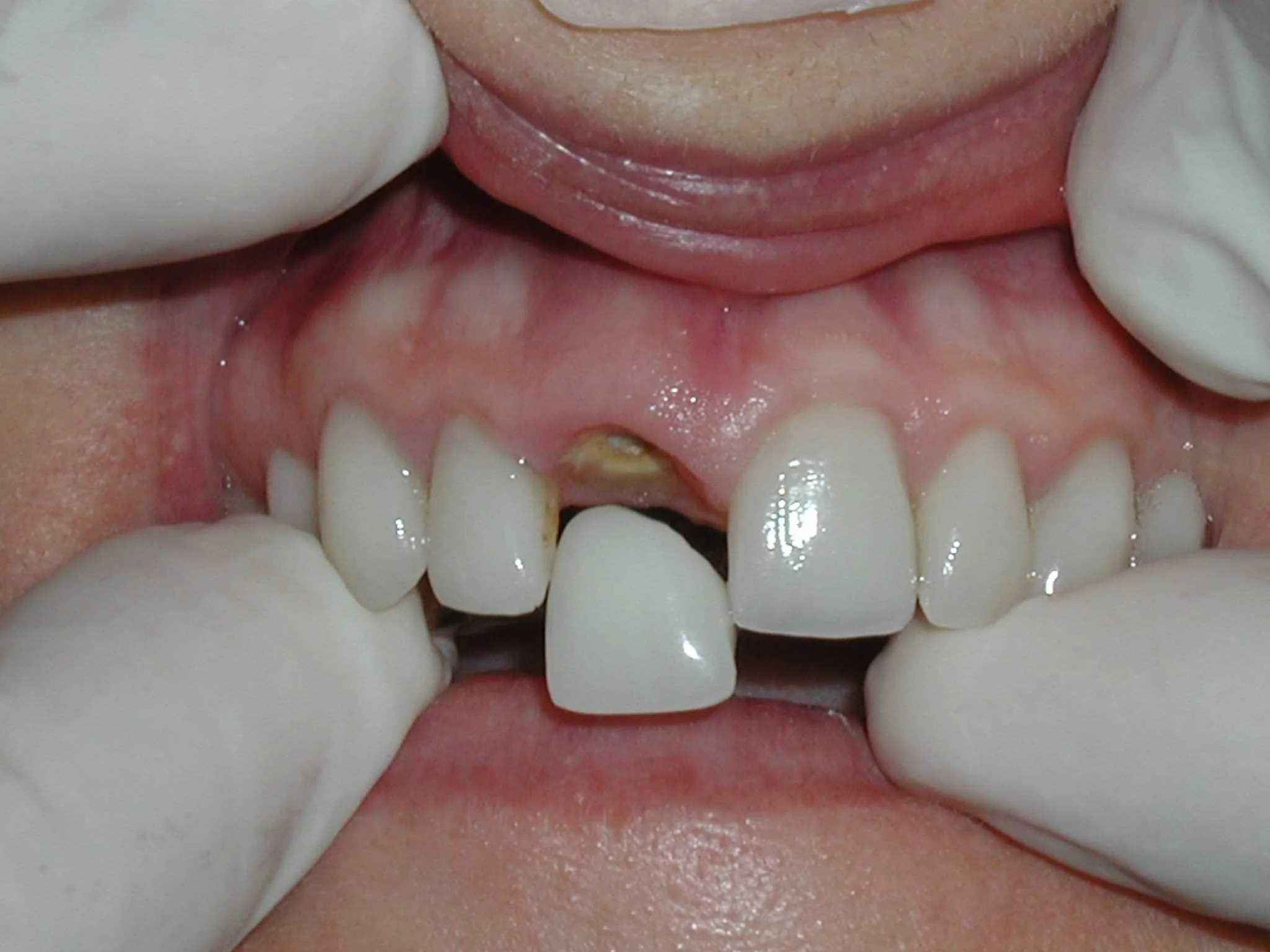
A dental flipper is a lightweight, removable acrylic appliance used to temporarily replace a missing front tooth after an extraction. It fills the gap the same day in many cases, so you never leave the office with a visible space. A flipper is built as a short-term solution while the gum and bone underneath settle, and the fit changes over those months for reasons worth explaining properly. Below we cover what a flipper is, how it stays in place at the front of the mouth, when you can get one, what the first few weeks feel like, how to eat with it, why it loosens as the site heals, how long it lasts, how to care for it, and what usually replaces it.
What Is a Front Tooth Flipper and How Does It Work?
A front tooth flipper is a removable acrylic appliance that holds one or more replacement teeth on a gum-coloured base and rests against your gums and remaining teeth. Dentists also call it a flipper tooth, a flipper denture, or an interim partial denture, and all of those names describe the same category of appliance.
The term causes more confusion than it should. A flipper belongs to the same family as the partial dentures worn long term, with one difference: it is built light and simple because it is meant to serve for months rather than years. That simplicity is the whole design brief. A flipper is fast to make, easy to adjust, and easy to replace once the site underneath has settled into its final shape.
What it does in the meantime is more than cosmetic. It fills the visible gap, it helps you form certain sounds clearly, and it keeps the neighbouring teeth from drifting sideways into the space while you wait.
What Does a Flipper Tooth Look Like?
A flipper tooth looks like a slim acrylic retainer with one or more artificial teeth attached to it. The base is tinted pink to match gum tissue, and the replacement tooth is shaped and shaded to match the teeth on either side of the gap.
In the mouth it is barely noticeable to anyone else. Out of the mouth it is small and light enough to sit in the palm of your hand. A single front tooth flipper is usually a thin plate covering part of the palate with one tooth set into the front edge of it.
How Does a Front Tooth Flipper Stay in Place?
A front tooth flipper stays in place through suction against the roof of the mouth, close contact with the gum ridge, and in some cases small clasps that grip the neighbouring teeth. Front flippers rely on the first two far more than back ones do.
That difference matters for appearance. An upper front flipper can often be made tissue-borne, meaning it sits snugly against the palate and the ridge with no visible metal at all. A flipper replacing a back tooth usually needs a clasp, because there is no broad palatal surface behind the gap to hold it and the chewing forces are higher. Lower front flippers sit in between, since there is no palate to work with and the ridge is narrow, so a small clasp is more often part of the design.
How Many Teeth Can a Flipper Replace?
A flipper can replace one to four teeth, and most replace one or two. Adding teeth adds length and weight to a thin acrylic plate, which is exactly what acrylic handles least well. Beyond a few teeth, a cast metal framework carries the span far better, which is why a longer gap usually moves out of flipper territory and into a properly designed partial.
Can You Wear a Flipper Tooth Immediately After an Extraction?
Yes, you can wear a flipper tooth immediately after an extraction, as long as it was planned and made in advance. This is the part most people do not realise until it is too late to arrange, so it is worth stating clearly.
Same-day placement works because the impression is taken before the tooth comes out. The lab builds the flipper from that model, with the artificial tooth positioned where your own tooth sits, and the finished appliance is waiting at the extraction appointment. It goes in the same visit, and you walk out with no visible gap. Deciding on this at the consultation rather than afterward is what makes it possible, so it is worth raising when a tooth extraction is first discussed.
Here is how the sequence runs from start to finish:
Consultation and planning. We look at the tooth, the neighbouring teeth, and the gum, and agree on what happens after the extraction.
Impression or digital scan. A record of your teeth is taken while the tooth is still in place, so the replacement can be matched to it.
Shade matching. The artificial tooth is shaded to the teeth beside the gap, recorded early in the visit before the teeth dry out.
Lab fabrication. The flipper is built on the model, usually over several days.
Extraction and placement. The tooth is removed and the flipper is fitted the same day, then checked for pressure points.
Early review. A short visit in the first week or two relieves any sore spots as the gum begins to change shape.
How Long Does a Flipper Tooth Take to Make?
A flipper tooth takes a few days to about two weeks to make. Most of that is lab time. The appointments themselves are short, and the total depends on the lab schedule and whether the shade needs a second look.
Can You Get a Flipper Tooth the Same Day?
You can get a flipper tooth the same day as your extraction when it is made in advance from a pre-extraction impression. Getting one made the same day from scratch is not realistic, since the appliance has to be fabricated at a lab. Where an extraction has already happened without a flipper planned, expect the usual few days to two weeks.
What Should You Expect in the First Few Weeks?
In the first few weeks you should expect a sense of fullness, some tenderness at the extraction site, and a short period of adjusting your speech. Nothing on that list is a sign of a poor fit, and all of it settles.
The gum under a fresh extraction is swollen and sore for the first several days, so a flipper that seats perfectly on the model can still press in one or two spots once it is in a real mouth. Small adjustments in the first week or two are part of the plan rather than a correction. We tell patients in Cinnaminson to expect at least one of those visits, because the tissue is changing quickly during exactly that window.
Is a Flipper Tooth Uncomfortable?
A flipper tooth is mildly uncomfortable at first and settles within one to two weeks. The most common early sensations are a feeling of fullness across the palate, extra saliva, and tenderness at a specific point where the acrylic contacts the healing gum.
A single sore spot that stays in one place is the one to report. That is a pressure point, and it takes a minute to relieve at the chair. General fullness that improves each day needs nothing but time, since the tongue adapts to the new surface faster than most people expect. Comfort is something we plan for at our practice rather than something you should wait out.
Does a Flipper Tooth Affect Your Speech?
A flipper tooth affects speech briefly, usually for a few days to two weeks, most often as a slight lisp. The tongue uses the backs of the upper front teeth and the front of the palate to form S, T, and D sounds, so new acrylic across that area registers immediately.
Reading aloud for a few minutes a day speeds the adjustment considerably. Practising in front of a mirror helps too, since it lets you see where the tongue is landing. Persistent difficulty with one particular sound after two weeks usually means the acrylic is thicker than it needs to be in one area, which is adjustable.
Can You Eat With a Front Tooth Flipper?
Yes, you can eat with a front tooth flipper, as long as you stay with softer foods and avoid biting directly with the replacement tooth. That second point is the important one and it is the most common way a flipper gets broken.
Biting into an apple or a sandwich crust uses the front teeth as a cutting edge, and a thin acrylic plate is not built to take that force at its leading edge. Cutting food into pieces and chewing with the back teeth removes the problem entirely. Chewing on both sides at once also helps, since it keeps the appliance seated rather than tipping it.
Foods worth leaving alone while you have a flipper are the hard ones like nuts, ice, and crusty bread, and the sticky ones like caramel and taffy, which can pull the appliance loose as you chew. Very hot liquids are worth cooling first, because heat softens acrylic. Beyond those, most of a normal diet is manageable within the first week or two.
Why Does a Flipper Tooth Get Loose as the Site Heals?
A flipper tooth gets loose as the site heals because the gum ridge underneath it is actively shrinking during exactly the months you are wearing it. The appliance has not changed shape. The mouth it was made for has.
The scale of that change surprises people. Tan and colleagues, in a systematic review of ridge dimensional change after extraction, found horizontal bone loss of 29 to 63% and vertical loss of 11 to 22% in the first six months, with an average horizontal reduction of 3.79 mm. A separate systematic review by Van der Weijden and colleagues put average ridge width reduction at 3.87 mm. Schropp and colleagues found that roughly two-thirds of all hard and soft tissue change happens within the first three months, and Tan's data showed 32% horizontal change already reached by the three-month mark.
Those numbers explain the whole experience. A flipper fitted on day one is resting against a ridge that will be several millimetres narrower within a few months, so a fit that felt snug in week one feels loose by week ten. That is not a fault in the appliance and it is not something you did. It is the reason a flipper is designed as a temporary appliance in the first place, and it is why custom dentures made after healing fit differently from one made before it.
The practical consequence is that adjustments are scheduled rather than reactive. Research on removable prostheses found a mean interval between relining procedures of 27 months overall, dropping to 20 months for appliances with no occlusal support, and a flipper worn through active healing needs attention considerably sooner than either figure. A flipper that has started to rock, click, or drop slightly when you speak is telling you the ridge has moved, and those fit problems are simple to correct when they are caught early.
How Long Will a Dental Flipper Last?
A dental flipper lasts a few months to about a year as designed, though some people wear one considerably longer. The lifespan is set by two separate things: how long the acrylic physically holds up, and how long the fit stays acceptable as the ridge changes.
The acrylic is usually the more durable of the two. What ends most flippers is the fit rather than a fracture, which is why the appliance is planned alongside a permanent restoration rather than on its own. Wearing one indefinitely is a real choice that some people make, and it is workable with regular adjustments and relines, though it asks more of you than a definitive restoration does. The general picture of denture lifespan follows the same logic across every removable appliance.
We usually map out the permanent plan at the same visit where the flipper is arranged, so patients in Cinnaminson know from the start roughly when the temporary stage ends. Knowing that date makes the interim period far easier to live with.
How Do You Care for a Flipper Tooth?
You care for a flipper tooth by cleaning it twice daily, rinsing it after meals, and taking it out overnight. The overnight part is the one people skip, and it is the one with the most evidence behind it.
Brush the flipper morning and night with a soft brush and a non-abrasive denture cleanser rather than regular toothpaste, which scratches acrylic
Rinse it under water after meals to clear food from the base and around any clasps
Brush your own teeth and gums normally, including the gum ridge the appliance covers
Take it out overnight and store it submerged in cool water or a cleaning solution
Never use hot water, which warps acrylic permanently
Handle it over a folded towel or a basin of water, since a drop onto a hard sink is what breaks most of them
Keep your review appointments so the fit is checked as the ridge changes
A fuller walkthrough of daily cleaning covers the same routine in more detail across every kind of removable appliance.
Can You Sleep With a Flipper Tooth In?
You should not sleep with a flipper tooth in. Acrylic covering gum tissue around the clock creates a warm, low-oxygen environment with reduced saliva flow underneath it, and that is precisely the environment yeast and bacteria grow in.
The evidence on this is substantial. Denture stomatitis, the inflammation that develops under a covered palate, affects between 20 and 67% of removable denture wearers in systematic review data, and among removable partial denture wearers specifically the range runs from 1.1% to 36.7%. Candida albicans is present in 45 to 65% of healthy mouths and rises to 60 to 100% in denture wearers. Across that literature, continuous wear without removing the appliance at night is consistently identified as the single most important risk factor.
Can You Wear a Dental Flipper All Day?
Yes, you can wear a dental flipper all day, and that is what it is designed for. Daytime wear keeps the gap filled, supports your speech, and holds the neighbouring teeth in position. Take it out for cleaning after meals where you can, and take it out for the night. Redness on the gum in the exact shape of the appliance is the sign to have it looked at rather than to wear it less.
What Is the Alternative to a Dental Flipper?
The alternatives to a dental flipper are a dental implant, a fixed bridge, or a cast metal partial denture. Each one is a definitive restoration rather than an interim appliance, and the right choice depends on the bone under the gap and the condition of the teeth beside it.
An implant places a titanium post into the jawbone in place of the missing root, which is the only option that keeps the bone underneath stimulated. It leaves the neighbouring teeth untouched and takes the longest, since the bone has to fuse to the post before the crown goes on. A flipper is very commonly the appliance worn during exactly that healing period, which is the most frequent reason anyone gets one. What the implant process actually involves is worth reading before deciding.
A fixed bridge fills the gap with a false tooth anchored by crowns on the teeth either side. It is faster than an implant and very stable, and the trade is that enamel has to be reshaped on both anchor teeth. A cast metal partial denture is removable like a flipper but built on a rigid alloy framework, which makes it thinner, stronger, and suitable for years of wear rather than months. Properly made removable dentures of that kind are the sensible destination for anyone who wants a removable option long term.
Survival data from systematic review and meta-analysis work across implants, fixed bridges, and cast partial dentures sits behind the comparison below.
OptionFixed or RemovableTreatment TimeEffect on the BoneDocumented SurvivalFlipperRemovable, interimA few days to two weeksDoes not slow resorptionA few months to about a year by designDental implantFixed3 to 6 months, longer with graftingKeeps the bone stimulated96.4% at 10 yearsFixed bridgeFixedA few weeksDoes not slow resorption89.1% at 10 yearsCast partial dentureRemovable, long termA few weeksDoes not slow resorption95.1% at 5 years
Frequently Asked Questions
Can a Flipper Tooth Be Adjusted if It Gets Loose?
Yes, a flipper tooth can be adjusted if it gets loose, and adjustment is a routine part of wearing one. A clasp can be tightened, a pressure point relieved, and acrylic added to the fitting surface to compensate for a ridge that has shrunk. Adjusting early is far easier than waiting until the appliance no longer seats at all.
Does a Flipper Tooth Help the Extraction Site Heal?
A flipper tooth does not speed healing, though it does shield the site from food and from accidental contact while the gum closes. What it genuinely helps with is keeping the neighbouring teeth from drifting into the gap, which protects the space your permanent restoration will occupy. The healing itself runs on its own schedule underneath.
Can a Child or Teenager Wear a Flipper Tooth?
Yes, a child or teenager can wear a flipper tooth, and it is often the right choice for them. A jawbone has to finish growing before an implant can be placed, which usually means the late teens or early twenties, so a flipper fills the gap in the meantime. The appliance is remade periodically as the jaw grows and the teeth around the gap shift.
What Happens if a Flipper Tooth Breaks?
If a flipper tooth breaks, stop wearing it and bring the pieces in rather than trying to glue it. Household adhesives are not safe in the mouth and they make a proper repair harder. Many breaks are repairable at a lab within a few days, and a clean fracture across the base is usually straightforward. A broken appliance with a sharp edge is worth being seen quickly, since acrylic edges cut gum tissue easily.
Can You Whiten a Flipper Tooth?
You cannot whiten a flipper tooth. Whitening gel works on natural enamel and has no effect on acrylic. If you plan to whiten your natural teeth, do that first and have the flipper shaded to the lighter result afterward, otherwise the replacement tooth will read darker than everything around it.
Do You Need a Flipper Before Getting an Implant?
You do not need a flipper before getting an implant, though most people with a missing front tooth choose one. An implant takes three to six months from placement to final crown, and a flipper covers the gap for that period. Reviewing your replacement options at the start makes it clear how long the temporary stage will actually run.
The Bottom Line
A front tooth flipper is a lightweight acrylic appliance that fills the gap after an extraction, often on the same day when the impression is taken before the tooth comes out. Expect a week or two of adjusting, softer foods, and no biting directly with the replacement tooth. The fit will change over the following months, and the reason is measurable: the ridge underneath loses a meaningful amount of width and height in the first six months, which is why adjustments are scheduled rather than a sign something went wrong.
Treat it as what it was built to be, which is a comfortable bridge to a definitive restoration rather than the destination. Deciding early whether that destination is an implant, a fixed bridge, or a long-term partial makes the whole interim period easier. If you have an extraction coming up and want to leave with the gap already filled, the team at Alpha Dental can plan that before the tooth comes out. You are welcome to reach out whenever you would like to talk it through.