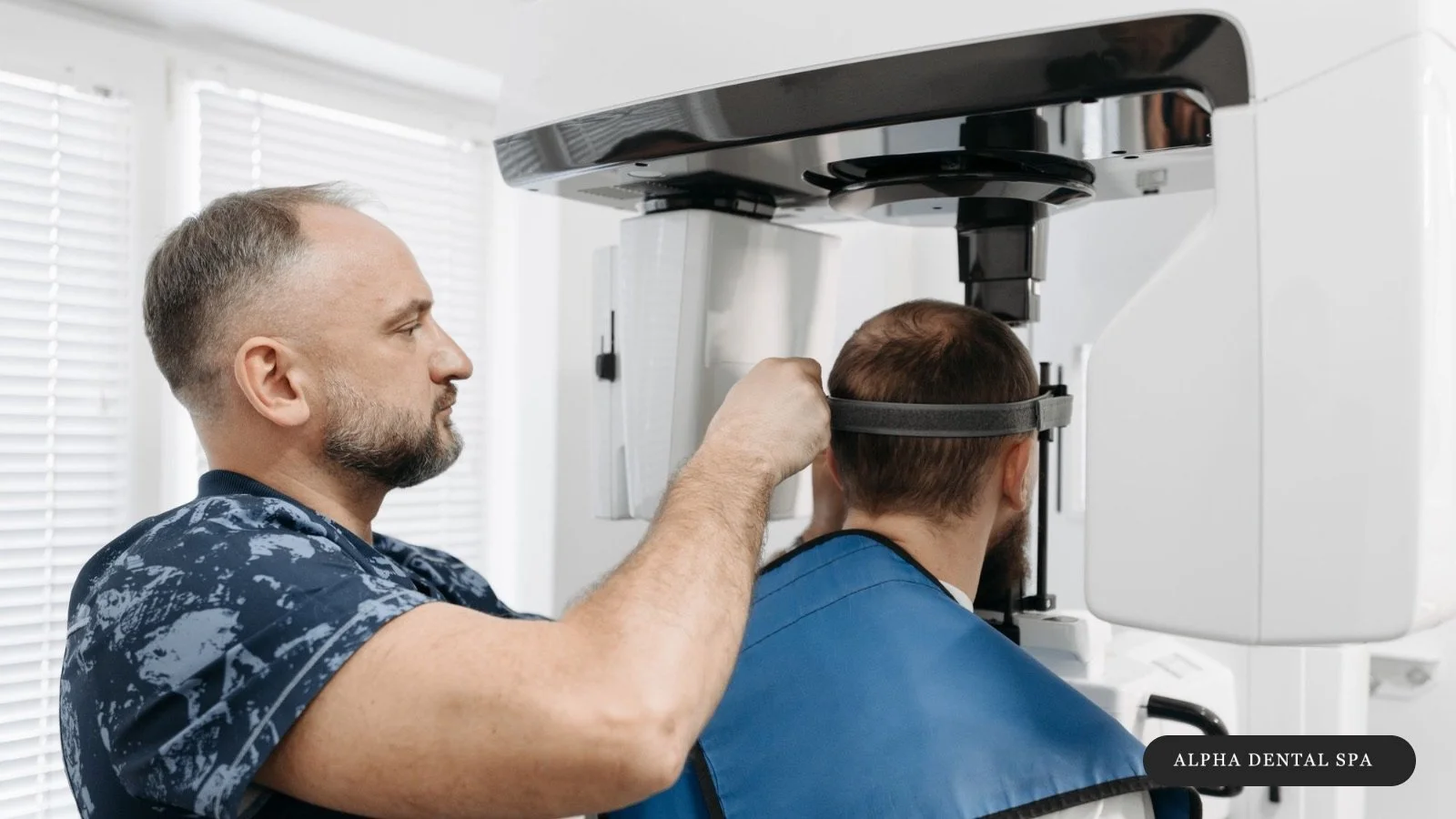
A bone graft after wisdom tooth extraction is a case-by-case decision, not a routine step. A 2021 study of 18 impacted lower wisdom teeth measured bone loss. Grafted sites averaged 0.55 mm, and ungrafted sites averaged 1.22 mm. That gap was not statistically significant. Dentists weigh a graft when imaging shows a large defect, gum disease, or a planned implant.
Key Takeaways
- A graft is a case-by-case choice, and the 2021 pilot study found no statistically significant difference with or without one.
- Impaction touching the second molar, existing gum pockets, and a planned implant are the main reasons a dentist considers a graft.
- MedlinePlus says a normal extraction socket takes 1 to 2 weeks to heal.
- Fever, chills, pus, severe swelling, heavy bleeding, and a lost clot are signs to call the dentist.
- Dry socket pain usually starts 1 to 5 days after surgery, according to a 2022 systematic review.
What Is a Bone Graft After Wisdom Tooth Extraction?
A bone graft after wisdom tooth extraction places bone material into the empty socket as a scaffold for new bone. The graft is placed during the extraction visit and covered by the gum so the socket can heal.
The material comes from one of four categories. A 2023 Bioengineering review lists autogenous grafts, allografts, xenografts, and alloplastic materials. A dentist can examine a painful extraction site at an extraction emergency care visit and check whether a graft is involved.
The four categories differ in where the material originates. Each one gives new bone a framework to grow into.
- Autogenous grafts use bone taken from the patient's own body.
- Allografts use processed bone from a human donor.
- Xenografts use processed bone from an animal source.
- Alloplastic grafts use synthetic material made in a laboratory.
A graft differs from the clot that fills every extraction socket. MedlinePlus explains that the clot fills the socket as the bone grows back in. A guide on how extractions work explains the basics. The next section covers when that natural process is enough.
Do You Need a Bone Graft After Wisdom Tooth Extraction?
No, you do not always need a bone graft after wisdom tooth extraction. The decision rests on the size and location of the bone defect. The 2021 pilot study notes that reconstructive techniques show no clinically significant improvement in attachment levels in most randomized trials. Imaging and an exam decide each case.
Searchers type "do you need bone graft after wisdom tooth extraction" and "do i need bone graft after wisdom tooth extraction". Both queries have the same answer. The dentist reads the X-ray and the gum measurements before recommending a graft.
Should I Get a Bone Graft After Wisdom Tooth Extraction?
You should get a bone graft after wisdom tooth extraction only when an exam and X-ray show a specific reason. The study authors write that it remains uncertain whether any proposed approach gives better periodontal results behind the second molar. A clear reason on imaging separates a recommended graft from an optional one.
Those reasons appear in the table in the next section. A dentist explains the reason before booking the procedure.
Is a Bone Graft Necessary After Wisdom Tooth Extraction?
A bone graft is not necessary after wisdom tooth extraction for every site. The 2021 study found no significant difference between groups. Bone loss appeared in 2 of 9 grafted teeth and 5 of 9 non-grafted teeth. Graft sites averaged 0.55 mm, and collagen sponge sites averaged 1.22 mm. The difference was not statistically significant.
The study was small, with 16 patients and 18 teeth. The authors state that larger long-term studies are needed. A small sample explains why dentists treat each socket on its own.
Do I Need a Bone Graft After Wisdom Tooth Extraction?
You need a bone graft after wisdom tooth extraction only when a defect is unlikely to heal well alone. Three findings raise that chance in the 2021 study. They are a pocket over 3 mm, age over 26, and a horizontal or mesioangular impaction. Those findings raise the chance of a defect.
The age and pocket findings describe risk factors for periodontal problems behind the lower second molar. They do not prove a graft will be needed. Your dentist confirms the next step with an X-ray.
What Happens If You Do Not Get a Bone Graft After Wisdom Teeth Removal?
Skipping a bone graft after wisdom teeth removal leaves the socket to heal through clot, granulation tissue, and bone. A 2023 Bioengineering review says granulation tissue replaces the clot in the first 7 days. Woven bone replaces almost all granulation tissue in 6 to 8 weeks.
In the pilot study, 4 of 9 non-grafted teeth showed no measured bone loss. The next section lists the cases where a dentist leans toward grafting anyway.
When Does a Dentist Recommend Bone Grafting After Wisdom Tooth Extraction?
A dentist recommends bone grafting after wisdom tooth extraction when imaging shows a defect that may not fill with bone alone. The recommendation depends on the defect, the neighboring tooth, and future plans. The table below summarizes the findings that raise the question.
| Finding | Why it matters | Source |
|---|---|---|
| Impacted tooth touching the second molar | Pocket and bone loss can develop behind the second molar | 2021 pilot study |
| Pocket deeper than 3 mm before surgery | Raises the chance of a distal pocket | 2021 pilot study |
| Planned implant in the space | Ridge shrinks 3.79 mm sideways in 6 months | Tan et al., 2012 |
| Age over 26 at surgery | Linked to periodontal problems behind the second molar | 2021 pilot study |
The pilot study adds numbers to the first row. It reports that 66% to 77% of wisdom teeth are impacted. Of those, 68.5% sit in close contact with the neighboring root. Kugelberg's two-year data, cited in that study, found 43.3% of second molars with a pocket over 7 mm.
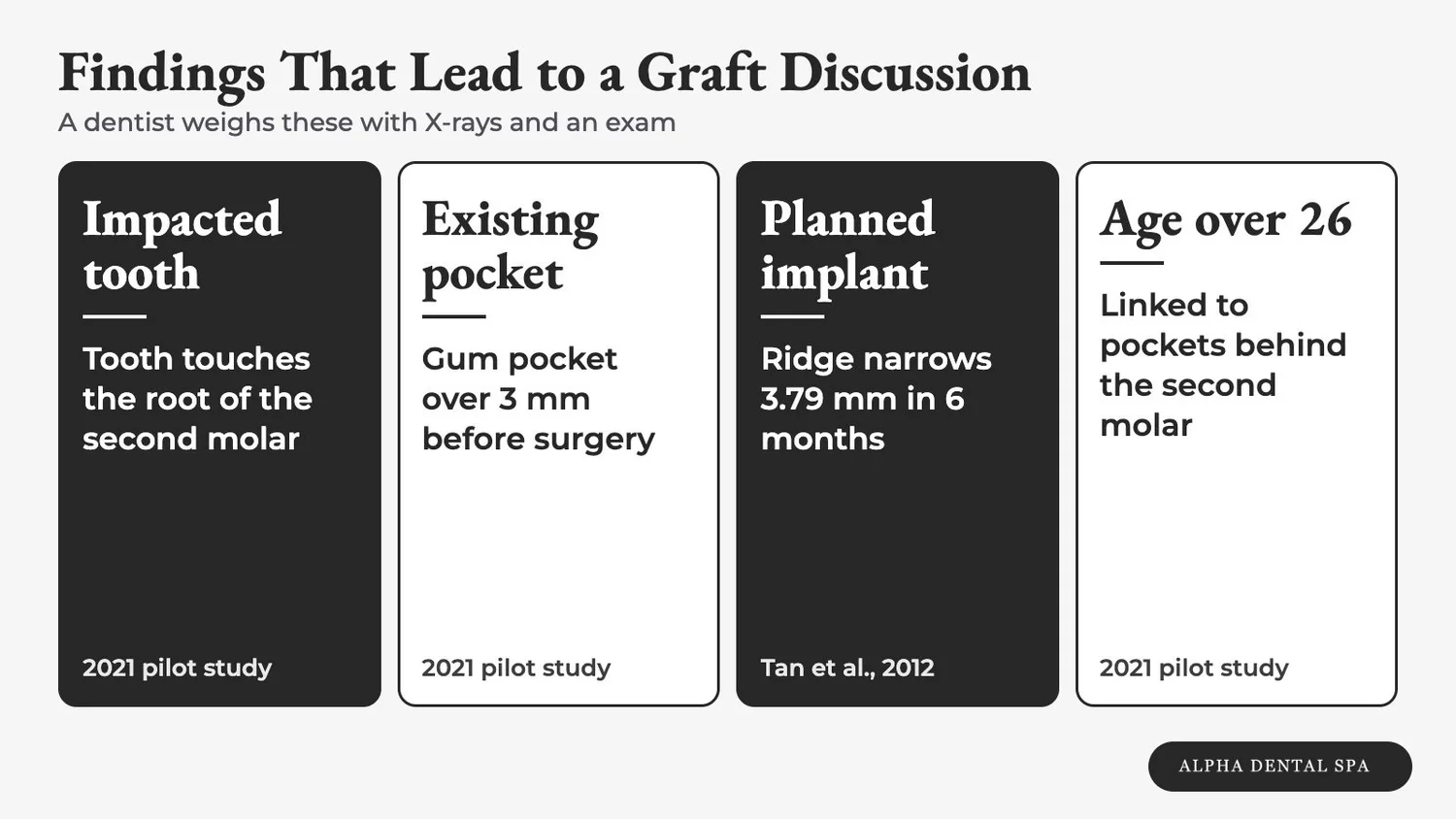
The graphic above shows four findings that lead to a graft discussion. Each card matches a row in the table.
Can I Get a Bone Graft Later After Tooth Extraction?
Yes, a dentist can place a bone graft after the socket has healed, and the timing is planned around the ridge changes. Tan and colleagues measured ridge changes for up to 12 months after extraction. Timing is planned with your dentist.
That 2012 review measured vertical loss of 1.24 mm on the cheek side at 6 months. The review says these changes matter for prosthetic planning. A dentist compares the changes with the plan for the space.
Does a Planned Implant Change the Answer?
A planned implant changes the answer because the ridge must keep enough width and height to hold it. Tan et al. say ridge dimension changes guide treatment planning for replacement teeth. Implant plans raise the graft question.
A dentist reviews implant timing and similar timing choices when a replacement is planned.
What Is Normal After Bone Grafting After Wisdom Tooth Extraction?
Normal healing after bone grafting after wisdom tooth extraction includes mild swelling and soreness. The socket closes over 1 to 2 weeks. MedlinePlus lists that 1 to 2 week window for a standard extraction socket. Soreness that eases each day is the normal pattern.
Oral surgery post-operative instruction sheets also describe small gritty granules appearing in the mouth during the first days. Follow your own surgeon's sheet, and call the office when the amount worries you. The table below sets normal findings beside warning findings.
| Normal | Call the dentist |
|---|---|
| Bruising and swelling at the site | Severe swelling or pus |
| Soreness that eases each day | Pain that grows days after surgery |
| Light oozing on day one | Heavy bleeding hours after surgery |
| Pale tissue over the socket | Fever or chills |
The warning column follows MedlinePlus, which also lists a lost clot as a reason to call. Report urgent socket pain without waiting for the next visit.
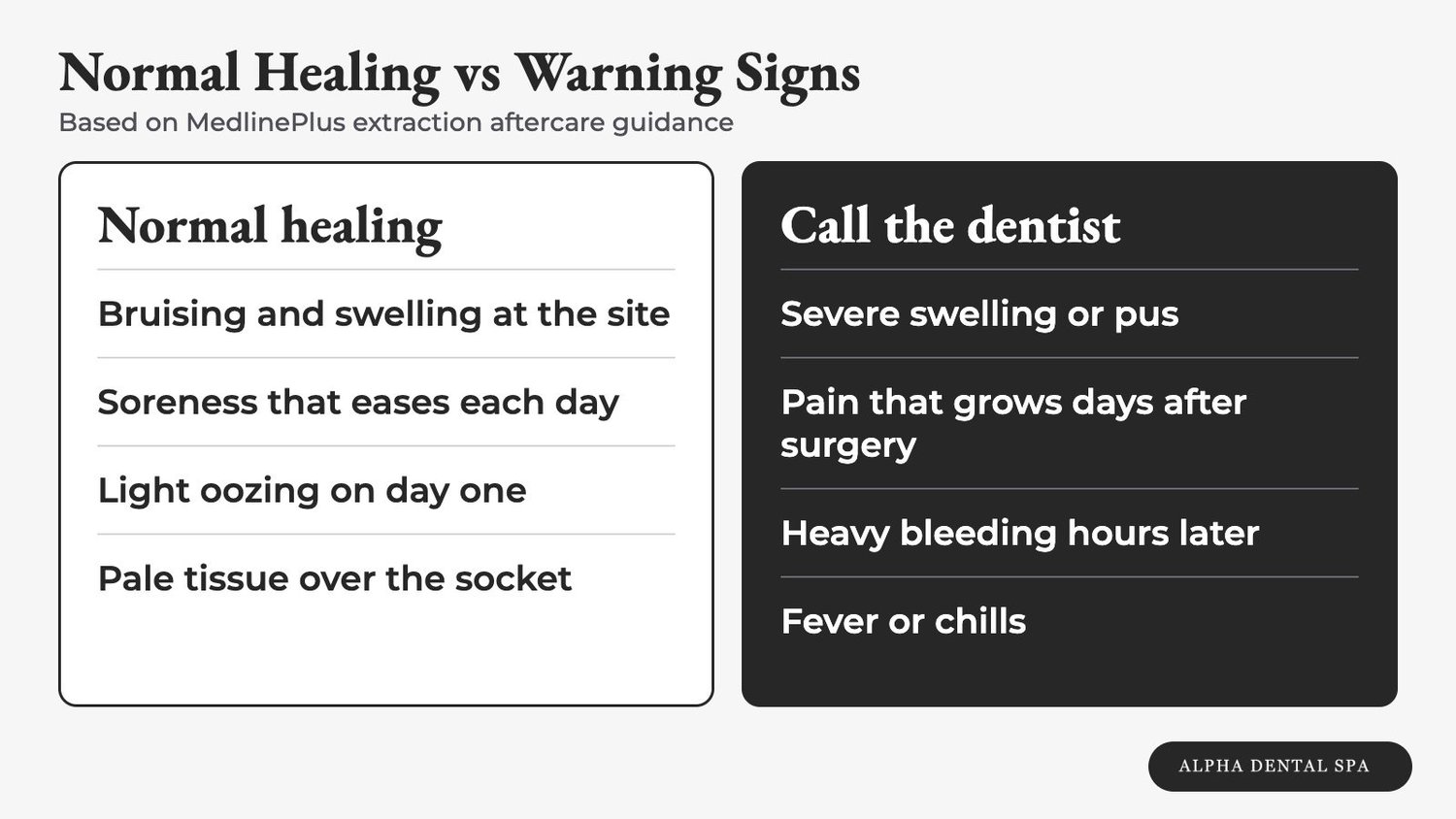
The graphic above repeats the table in a two-column layout. Keep it nearby during the first week.
How Painful Is a Bone Graft After Tooth Extraction?
A bone graft after tooth extraction brings soreness that a dentist can manage with the same pain plan used for the extraction. The ADA's 2024 guideline names NSAIDs, with or without acetaminophen, as first-line treatment for acute dental pain in ages 12 and older. The ADA names NSAIDs first-line.
The FDA sets the acetaminophen limit at 4,000 mg in 24 hours for ages 12 and older. An extraction pain level guide explains what soreness feels like on each day. Your surgeon sets the exact dose for you.
Is a Bone Graft More Painful Than Wisdom Teeth Removal?
No evidence in the studies reviewed here shows that a bone graft is more painful than wisdom teeth removal. The 2021 study reports that soft tissue healing complications were lower in grafted sites, without reaching statistical significance. Soft tissue complications were lower with grafts.
Pain differs between patients, and the study did not rate pain. Your surgeon explains what to expect for your socket. Report pain that grows worse days after surgery.
How Long Does Recovery Take With a Bone Graft?
Recovery with a bone graft starts with a socket surface that heals in 1 to 2 weeks, based on MedlinePlus. Bone inside the socket matures over a longer period. A 2023 Bioengineering review places woven bone formation at 6 to 8 weeks in an ungrafted socket.
A trial of 30 participants measured ridge preservation after lower wisdom tooth extraction with cone beam CT at 3 months. Your dentist sets follow-up visits that match the graft type and the site.
Will Gums Grow Over a Bone Graft?
Yes, gum tissue grows over a bone graft as the socket heals, as the surface closes. MedlinePlus puts surface healing at 1 to 2 weeks. Gum closure follows the same 1 to 2 week window.
Healing speed varies by person. A guide on gum healing weeks shows what each stage looks like. Call the dentist when the site stays open or raw.
What Can You Not Do After a Dental Bone Graft?
After a dental bone graft, you should not use a straw, smoke, or eat hard food during early healing. MedlinePlus says no straw for at least 24 hours and no tobacco. Protect the clot above everything else.
The steps below follow MedlinePlus guidance for an extraction socket. Your surgeon may add steps for a graft.
- Bite on damp gauze to help the clot form.
- Apply a cold compress for 10 to 20 minutes at a time.
- Skip straws for at least 24 hours.
- Avoid smoking and all tobacco use.
- Start gentle rinse and spit about 3 days after surgery.
- Eat soft foods and avoid hard, crunchy foods for 1 week.
Tobacco matters because a 2022 Dentistry Journal review found dry socket in 13.2% of smokers and 3.8% of non-smokers. A guide on tobacco after extraction gives a day-by-day answer.
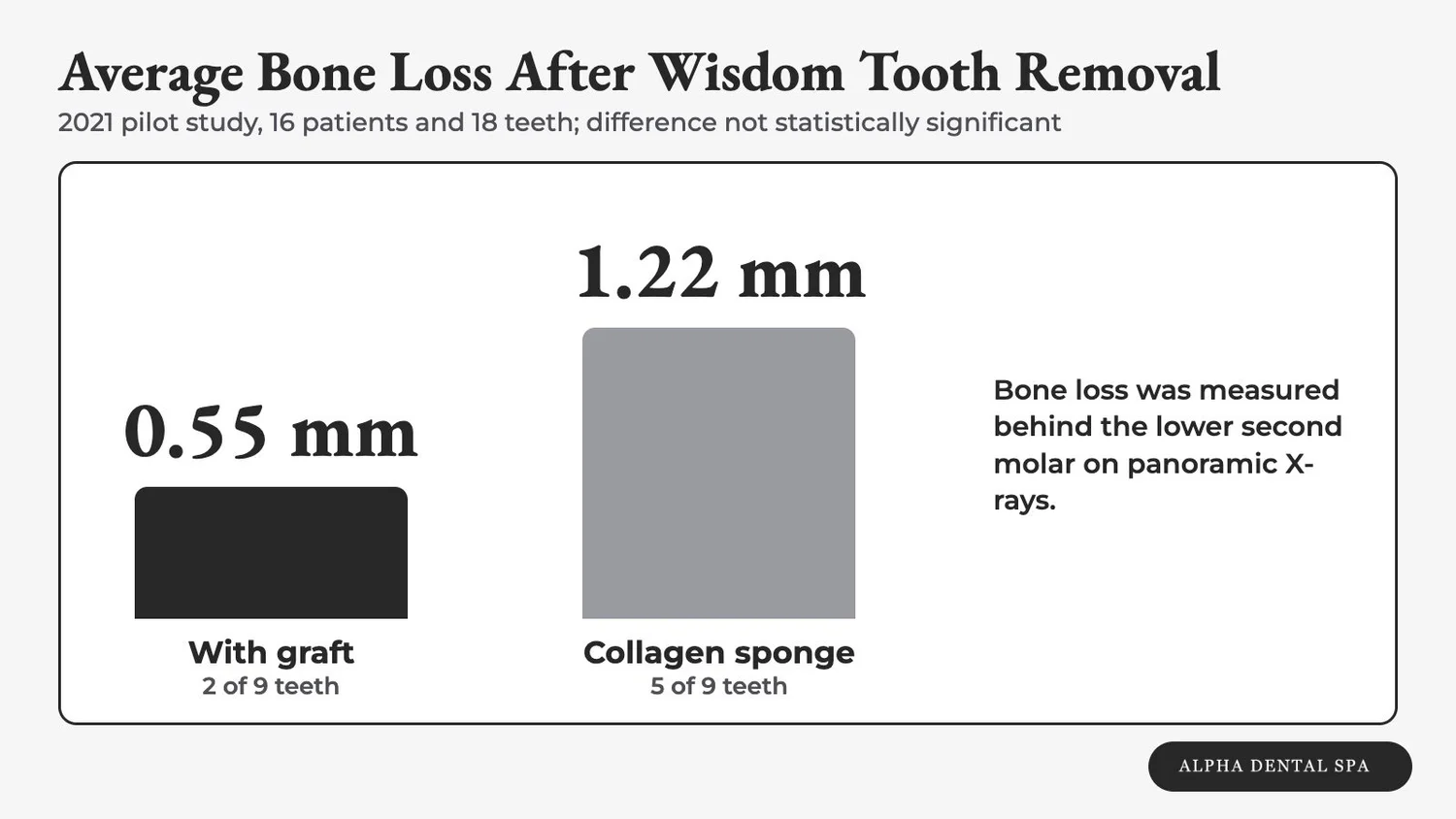
The chart above shows the pilot study's bone loss averages for both groups. The study found the gap was not statistically significant.
What Else Should You Know About Bone Grafts After Wisdom Tooth Removal?
How Likely Is a Dry Socket With a Bone Graft?
A dry socket with a bone graft is uncommon. The studies reviewed here did not measure whether a graft changes the rate. A 2023 trial reports dry socket from 1% to 4% after general extractions, up to 45% for lower wisdom teeth. Ask your surgeon about your own risk.
Does Salt Water Stop a Dry Socket?
Salt water does not stop a dry socket, because the ADA describes treatment as cleaning the site and placing a medicated dressing. A dentist changes the dressing daily until pain eases. Gentle rinsing after the first days supports hygiene only.
Why No Ibuprofen After Tooth Extraction?
Ibuprofen is not banned after extraction, since the 2024 ADA guideline names NSAIDs such as ibuprofen as first-line for dental pain. Follow the plan your dentist or doctor gave you. People told to avoid NSAIDs by a doctor should use the alternative they were given. A guide on extraction antibiotics covers the other common medicine question.
How Do I Know If I Dislodged My Bone Graft?
You may have dislodged a bone graft when many gritty particles come out at once, or sudden pain starts. Oral surgery instruction sheets describe a few granules in the first days as expected. Call the office for sudden pain or a large loss. Pus, fever, and swelling also need a look, and infected extraction signs are listed in our guide.
What Is the Downside of a Bone Graft?
The downside of a bone graft is added surgical steps and follow-up visits. MedlinePlus lists infection signs that apply to any extraction site. The 2021 pilot authors add that the benefit remains uncertain behind the second molar. Added steps are the main downside.
Frequently Asked Questions
How Long Should You Rest After a Dental Bone Graft?
Rest for as long as your surgeon advises, because no verified guideline sets one number of days. MedlinePlus advises a cold compress for 10 to 20 minutes at a time for swelling. Report heavy bleeding hours after surgery.
How Long Will My Jaw Hurt After a Bone Graft?
Soreness should ease as the socket closes over 1 to 2 weeks, based on MedlinePlus. Pain that grows worse days after surgery needs a call. The ADA 2024 guideline lists NSAIDs, with or without acetaminophen, as first-line pain treatment.
What Holds a Bone Graft in Place?
The gum covers the graft, and oral surgery instruction sheets describe stitches or a membrane as added protection. The clot and the gum seal protect the material while bone forms. Your surgeon decides which method suits your socket.
What Helps Bone Grafts Heal Faster?
Protecting the clot, avoiding tobacco, eating soft foods, and keeping follow-up visits support healing. MedlinePlus lists no straw for 24 hours and no tobacco. Healing speed still varies by person.
How Does Alpha Dental Help With Bone Graft Questions After Wisdom Tooth Extraction?
We help by examining the extraction site and explaining the next step in plain language. Dr. Hayat reviews pain, swelling, and healing at our Cinnaminson office. Patients with sudden extraction pain can reach the office by phone.
A missing tooth can also change how a replacement fits when bone shifts after extraction. Our team reviews tooth replacement options with you, including denture fit and other choices. Bring your X-rays and your surgeon's instructions to the visit.
Questions about healing are welcome at every stage, from the first day to the follow-up visit. Contact Alpha Dental Services to ask about your site.