Yes, seniors can get dental implants. The best dental implants for seniors match the number of missing teeth and the jawbone left. A 2017 meta-analysis of adults aged 65 and older found 96.2% of implants survived 5 years. The ADA states that general health matters more than age. A dentist confirms candidacy only after a full exam and a 3D scan of the jaw.
Key Takeaways
- Implants in adults 65 and older had 96.2% pooled survival at 5 years and 91.2% at 10 years.
- The ADA says health is more of a factor than age.
- Osteoporosis alone did not change implant survival in a 2025 meta-analysis.
- Original Medicare does not cover implants in most cases.
- Daily cleaning and regular checkups protect the gum and bone around an implant.
What Are the Best Dental Implants for Seniors?
The best dental implants for seniors are the ones that fit the number of missing teeth. Options include a single implant, several implants for a bridge, or implants that hold a denture. Dentists choose by tooth count, bone height, and health history. No single implant type fits every older adult.
The American Academy of Periodontology (AAP) defines an implant as an artificial tooth root. The root is placed in the jaw to hold a prosthetic tooth or bridge. Our team explains senior tooth replacement choices before you decide.
The table below lists four common plans and what each one replaces.
| Plan | Replaces | How it attaches |
|---|---|---|
| Single tooth implant | One missing tooth | One implant holds one crown |
| Multiple tooth implants | Several missing teeth | Several implants hold crowns or a bridge |
| Implant overdenture | All teeth in one jaw | Implants hold a removable denture |
| Full mouth implants | All teeth in both jaws | Implants hold fixed replacement teeth |
These plan names follow the AAP and ADA descriptions of implant care. Each plan raises its own question about the teeth, bone, and bite.
What Is the Best Tooth Replacement for Seniors?
The best tooth replacement for seniors is the option that suits the mouth, the health history, and the daily routine. Implants, bridges, and dentures each have a place. The ADA recommends talking with your dentist to see whether implants are an option.
Dr. Hayat reviews replacement teeth with each patient after an exam. The ADA notes that implants avoid removing good tooth structure for a bridge and can replace uncomfortable dentures. Dentures remain a standard choice when bone or health limits surgery. The decision comes from an exam, not from age.
What Is the Best Option for Dental Implants When Teeth Are Missing in Both Jaws?
The best option for dental implants when both jaws are missing teeth is either implant-held dentures or full mouth implants. The AAP lists full mouth dental implants for people missing all their teeth. The best full mouth dental implants plan depends on the bone in each jaw. The McGill consensus statement names two implants under a lower denture as the first-choice standard of care.
Researchers at the University of Bern and Mainz reviewed 27 studies with 3,892 implants in adults 65 and older. Splinted implants in overdenture wearers had 5.6 times higher survival than single attachments. The splint is a bar that joins the implants.
How Long Does It Take to Replace All Teeth With Implants?
Replacing all teeth with implants takes up to several months, because the bone must bond to each implant before final teeth attach. The ADA calls this bonding osseointegration. Some patients receive implants and replacement teeth in one visit, according to the ADA.
A temporary denture or bridge usually covers the gap during healing. The ADA says the permanent teeth take time to make. Healing time depends on the person, the bone, and the plan.
Is Age a Barrier to the Best Dental Implants for Seniors?
Age is not a barrier to dental implants for seniors. Pooled studies show high survival in adults over 65 and over 75. The ADA says health is more of a factor than age. The best age to get dental implants is the age when the mouth and body are ready.
The chart below shows pooled survival from the 2017 Clinical Oral Implants Research review of adults 65 and older.
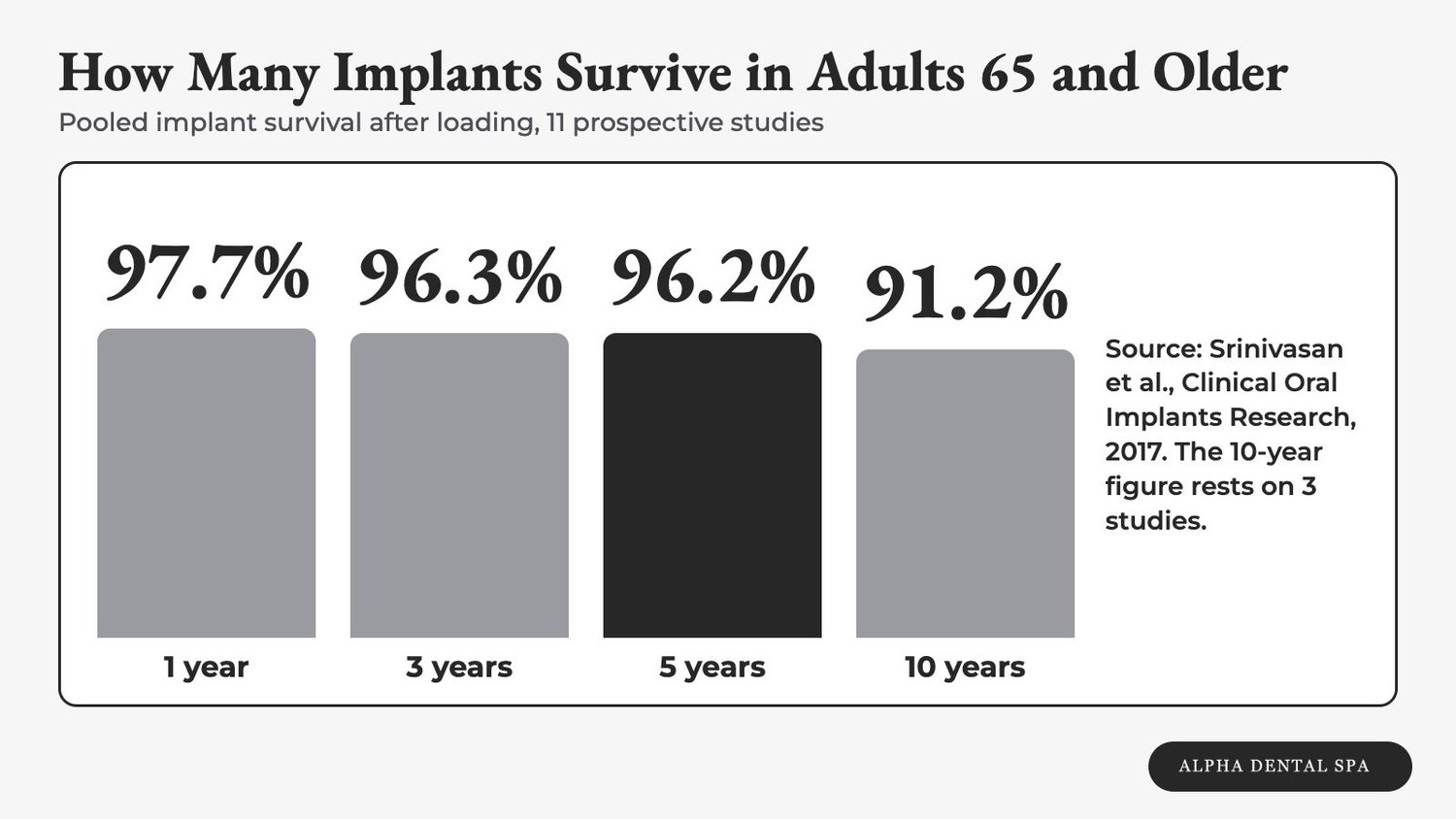
The 10-year figure rests on only three studies, according to the review authors. Newer data focus on the oldest adults.
Should a 70 Year Old Get Dental Implants?
A 70 year old should get dental implants when a dentist confirms good general health, enough jawbone, and healthy gums. The AAP lists those three conditions for candidates. Age 70 alone does not rule implants out.
The 2017 meta-analysis concluded that age alone should not limit implant therapy for adults 65 and older. Adults in their seventies fall inside the studied group. Medical review comes first, as the ADA notes.
Can an 80-Year-Old Get Dental Implants?
An 80-year-old can get dental implants, and a 2025 meta-analysis found 96.8% five-year survival in patients over 75. The same review found 92.1% in patients aged 65 to 75. The authors called implants a reliable treatment for adults over 75.
Peri-implant bone level did not differ between the two age groups. Plaque and bleeding on probing were more frequent in the older group, per the Clinical Oral Implants Research review. Cleaning therefore needs steady attention, as covered below.
Is It Worth Getting Dental Implants at 70 Years Old?
Getting dental implants at 70 years old is worth discussing when tooth loss limits chewing, speech, or comfort with dentures. A review of 68 studies linked implant-retained overdentures with better oral health-related quality of life in people 65 and older. Worth depends on goals, health, and budget.
The CDC reports that 12.9% of adults 65 and older had complete tooth loss in 2015 to 2018. Many of those adults face the same question about replacement teeth. A consultation sets realistic expectations.
How Do Dentists Choose Dental Implants for a Senior?
Dentists choose dental implants for a senior by checking general health, jawbone quantity, and gum health. These are the AAP candidate criteria. The ADA adds that a physician may evaluate you before surgery.
The graphic below turns those checks into a five-card sequence.
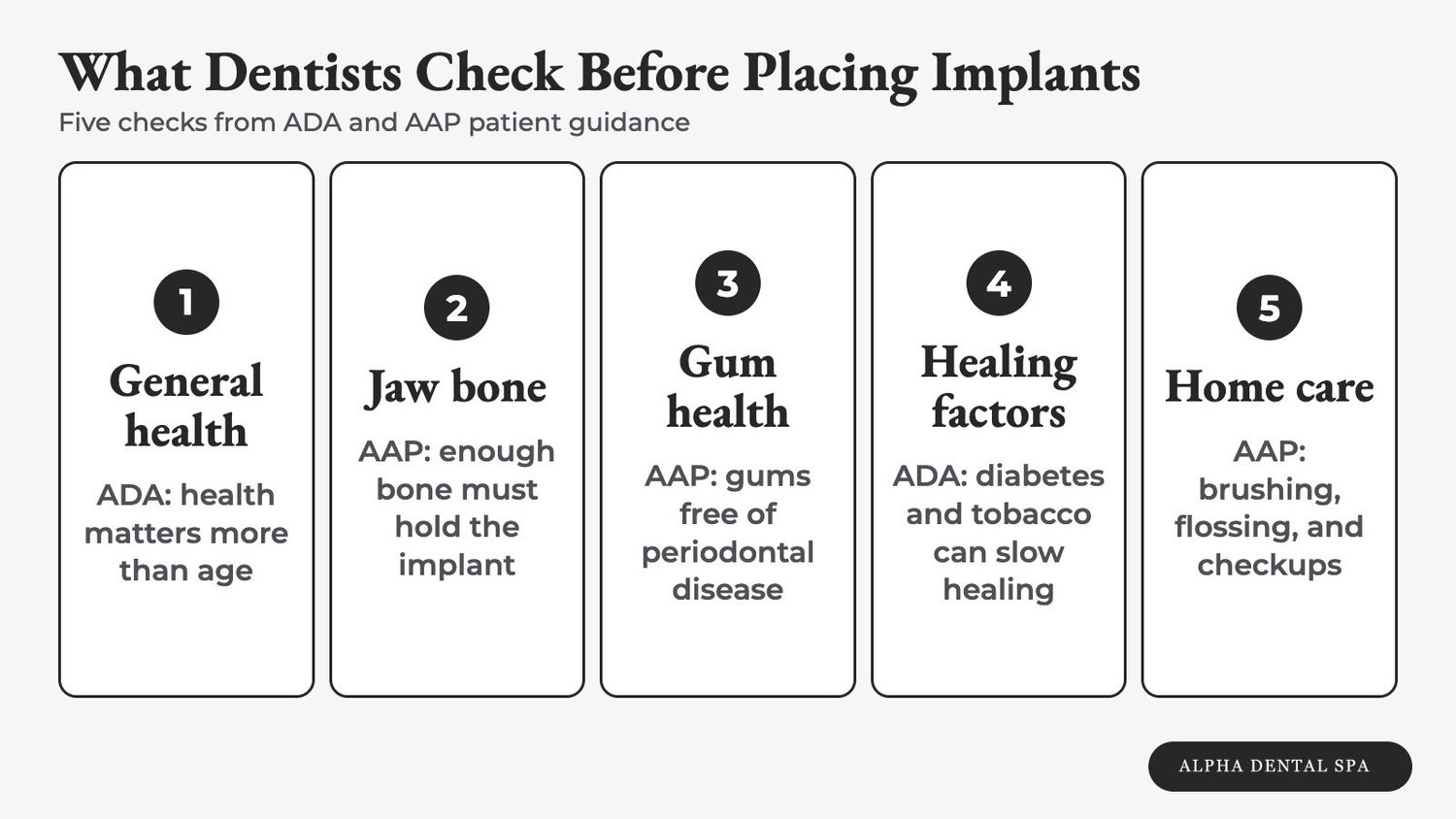
Each check connects to a named source and a named risk. The next headings explain the checks that raise the most questions.
What Disqualifies You From Dental Implants?
Poor general health, too little jawbone, and active gum disease can disqualify you from dental implants until they are treated. The ADA says chronic illnesses such as diabetes or leukemia may interfere with healing. Tobacco use can also slow healing.
The AAP adds that implant candidates need healthy gums free of periodontal disease. Treatment of these conditions can change the answer later. Only an exam confirms eligibility.
Do Osteoporosis and Bone Loss Rule Out Dental Implants?
Osteoporosis and bone loss do not automatically rule out dental implants. A 2025 meta-analysis in the Journal of Clinical Medicine compared implants in patients with and without osteoporosis. The review found no significant difference in survival (risk ratio 1.00). The authors noted limited evidence and called for more trials.
The AAP describes sinus augmentation as a way to add bone in the upper back jaw. Bone quantity and quality decide implant success, according to the AAP. A 3D scan shows what the jaw offers.
How Can You Find the Best Dentist for Dental Implants?
Finding the best dentist for dental implants starts with checking training, experience with older adults, and a clear written treatment plan. The AAP notes that periodontists complete three years of training beyond dental school. General dentists and oral surgeons also place or restore implants.
The ADA advises reviewing treatment options with a dentist before discussing financing. Ask who places the implant, who makes the teeth, and who handles follow-up. Our dentist, Dr. Hayat, answers those questions during an exam, and you can read the dentist profile first.
How Long Do Dental Implants Last for Seniors?
Dental implants lasted 10 years in 91.2% of cases in pooled studies of adults 65 and older. That figure comes from only three studies. Evidence beyond 10 years is limited.
Lang and colleagues reported short-term survival of 93.3% to 100% for full-arch fixed prostheses and 87.89% to 100% for their implants. The authors found long-term studies scarce. Survival numbers describe groups, not guarantees for one person.
What Happens to Dental Implants After 20 Years?
Dental implants after 20 years have little published pooled data, so no survival percentage applies. The reviews above stop at 10 years. Dentists therefore judge each implant by bone level, gum health, and the condition of the crown.
Regular checkups track those signs. The AAP says implants need routine monitoring as part of a periodontal evaluation. Early notice gives more treatment choices.
What Is the Downside to Dental Implants?
The downside to dental implants includes a surgical step and a healing period of up to several months. Peri-implant disease adds a third concern. The AAP defines peri-implantitis as inflammation with bone loss around an implant.
A BMC Oral Health review of 57 articles found peri-implantitis in 19.53% of patients and 12.53% of implants. Rates varied with the definition used. The AAP says peri-implantitis usually requires surgical treatment.
What Are the Alternatives to Dental Implants for Seniors?
The alternatives to dental implants for seniors are fixed bridges, partial dentures, and complete dentures. The best alternative to dental implants depends on how many teeth are missing and which teeth remain. Each option has a different cost, care routine, and fit.
The panel below compares four plans side by side.
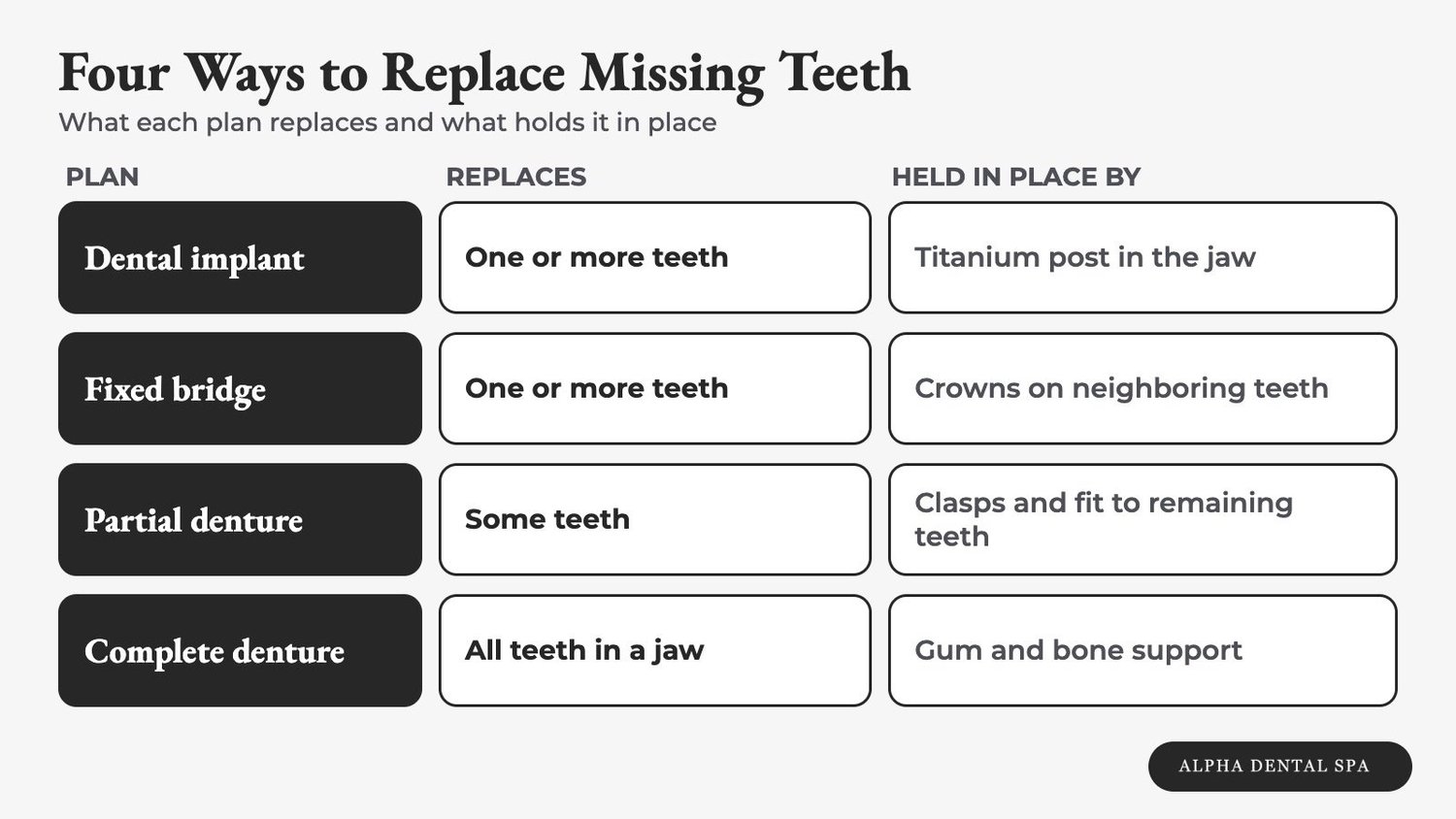
The table adds the main attachment point for each plan.
| Option | Replaces | Held in place by |
|---|---|---|
| Dental implant | One or more teeth | Titanium post in the jaw |
| Fixed bridge | One or more teeth | Crowns on neighboring teeth |
| Partial denture | Some teeth | Clasps or fit against remaining teeth |
| Complete denture | All teeth in a jaw | Gum and bone support |
The ADA states that implants spare the neighboring tooth structure that a bridge removes. Our blog explains denture candidacy for readers weighing both.
What Is Better Than a Dental Implant?
No option is better than a dental implant for every person, because the right option depends on bone, health, and goals. The ADA calls implants an excellent long-term option, but dentures and bridges serve patients who cannot have surgery. A dentist compares them against your exam.
Our team can walk through traditional dentures when implants are not the right fit. Dentures are a standard choice for adults with limited bone. Comfort and chewing ability guide the final pick.
Should I Get All My Teeth Pulled and Get Implants?
Getting all your teeth pulled for implants is a decision for your dentist and surgeon after an exam of each tooth. The AAP lists full mouth implants for people who are missing all their teeth. The dentist checks each tooth for that decision.
A written plan should list which teeth stay, which go, and what temporary teeth you wear. Ask for the timeline in writing. Fixed front tooth bridges are one alternative for a single missing tooth.
How Do You Clean Dental Implants With Floss and Brushes?
You clean dental implants with a soft toothbrush twice daily and one daily interdental tool. Floss, an interdental brush, and a water flosser all count as interdental tools. The AAP says implants need regular brushing, flossing, and checkups. The best dental floss for implants is a soft, non-shredding type your dentist approves.
A 2019 International Dental Journal consensus report found interdental brushes and floss both effective for peri-implant health. The report urges caution with floss if rough implant surfaces are exposed. The best dental floss for dental implants therefore depends on what your dentist sees around the implant.
A 2025 review of six studies found brushes and water irrigators performed higher than floss, but not significantly. Evidence on home cleaning is limited, per the authors.
Use this routine once your dentist approves the tools.
- Brush every surface of the implant and nearby teeth with a soft brush twice daily.
- Clean between the teeth and the implant once daily with floss, a small brush, or a water flosser.
- Rinse and check the gums for redness, tenderness, or bleeding.
- Report red, tender, or bleeding gums to your dentist soon.
- Keep every scheduled implant checkup.
The AAP says peri-implant mucositis can be reversed if caught early. Regular supportive care lowered peri-implant disease odds (odds ratio 0.42) in a 2023 Journal of Clinical Periodontology review.
Will Medicare Pay for Dental Implants for Seniors?
Medicare will not pay for dental implants for seniors in most cases. Medicare.gov states that Original Medicare does not cover dentures and implants in most cases. Some inpatient hospital dental services may be covered when tied to a medical condition.
Coverage rules differ by plan, so a plan document gives the exact answer. Our office can explain how dental insurance works with an estimate request. Review plan limits before scheduling treatment.
What Else Should You Know About Dental Implants for Seniors?
Do You Have No Teeth While Waiting for Implants?
You do not have to go without teeth while waiting for implants. The ADA says your dentist may give you a temporary crown, bridge, or denture to eat and speak normally. The temporary piece stays until the permanent teeth are ready.
Can Teeth Be Pulled and Implants Put in the Same Day?
Teeth can be pulled and implants put in the same day for some patients, according to the ADA. The ADA says other patients wait until the implant is completely integrated. The dentist decides after an exam and scan. Our post on same-day implants covers what healing looks like.
Can Diabetes or Smoking Affect Dental Implants?
Diabetes and smoking can affect dental implants, because both are listed risk factors for peri-implant disease by the AAP. The ADA says tobacco slows healing. Diabetic patients with good glycemic control had lower peri-implantitis risk (odds ratio 0.16) than those with poor control.
What Is the Fail Rate of Dental Implants?
The fail rate of dental implants in adults 65 and older was low, since pooled survival reached 96.2% at 5 years. The 2025 review reported 96.8% for patients over 75. Loss rates vary by study and patient.
Do Dental Implants Hurt?
Dental implants can cause some soreness after surgery, and the ADA suggests soft foods, cold foods, and warm soup during healing. Our post on implant soreness separates myth from fact.
Are Dental Implants Right for Back Teeth?
Dental implants can replace back teeth, including molars, when the bone supports them. The AAP describes sinus augmentation for the upper back jaw, where bone height is often the main question for planning. Our guide to molar implants explains what to expect.
Frequently Asked Questions
What Does No One Tell You About Dental Implants?
Dental implants need lifelong cleaning and monitoring, and healing takes up to several months. The AAP says implants need brushing, flossing, and checkups like natural teeth. The ADA says bone must bond to the implant before final teeth attach.
Can I Have All My Teeth Pulled and Get Implants?
You can have all your teeth replaced with implants when your dentist finds enough bone and good health. The AAP lists full mouth implants for patients missing all teeth. A planning visit confirms the steps and the timeline.
How Does Alpha Dental Help Seniors With Tooth Replacement?
Alpha Dental helps seniors compare implants, bridges, and dentures through a clear exam and a plain explanation of each option. Dr. Hayat reviews your health history, gums, and bite. Our Cinnaminson office also provides dentures and denture care through restorative dentistry.
We keep the plan simple and explain each step in plain words. Call us or visit Alpha Dental homepage to schedule a visit. Bring your medication list and any prior dental records.