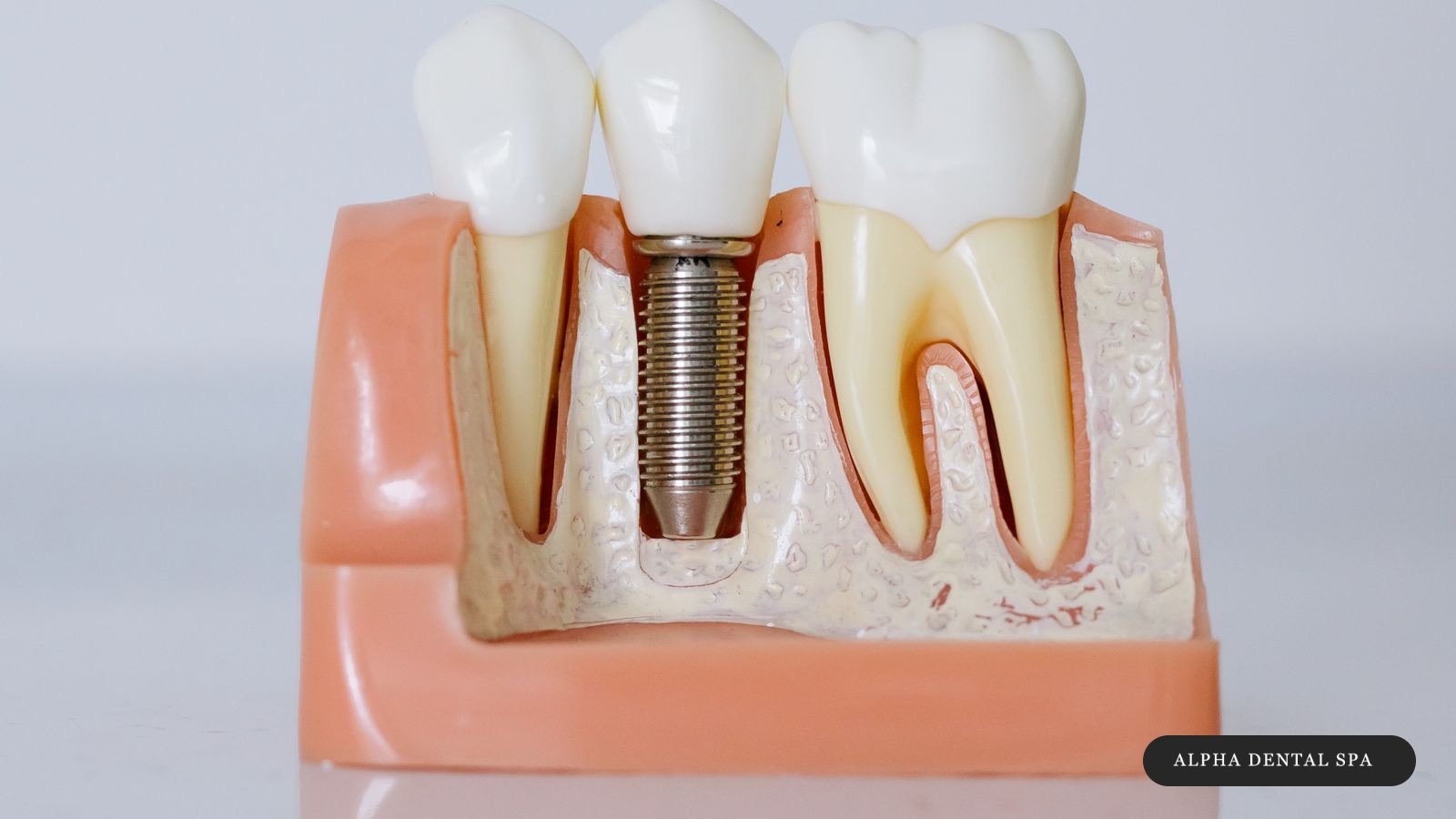
A finished dental implant looks like a natural tooth, because only the crown shows above the gum. According to the FDA, an implant system has 3 parts: an implant body in the jawbone, an abutment, and an artificial tooth. The body stays hidden below the gum line. A shaded crown and healthy gum make the tooth hard to tell apart from the natural teeth beside it.
Key Takeaways
- A dental implant has three parts: the implant body, the abutment, and the crown.
- Only the crown is visible, so the tooth blends in with natural teeth.
- Bone bonds with the implant over 2 to 6 months, according to the American Academy of Periodontology.
- Gray titanium can show through thin gums, while white zirconia abutments reduce that shadow.
- Peri-implantitis, an infection around the implant, affected 19.83% of patients in one meta-analysis.
- A dentist decides candidacy by checking health, bone, and gums, not age alone.
What Do Dental Implants Look Like?
Dental implants look like natural teeth because only a tooth-shaped crown shows above the gum. The FDA defines an implant system as an implant body, an abutment, and sometimes a fixation screw. The visible crown is shaped and shaded to match nearby teeth. The rest of the system sits under the gum and in the bone.
A dentist chooses the crown shade and shape from the teeth next to the gap. Our tooth replacement options start with an exam that shows which approach fits a given mouth.
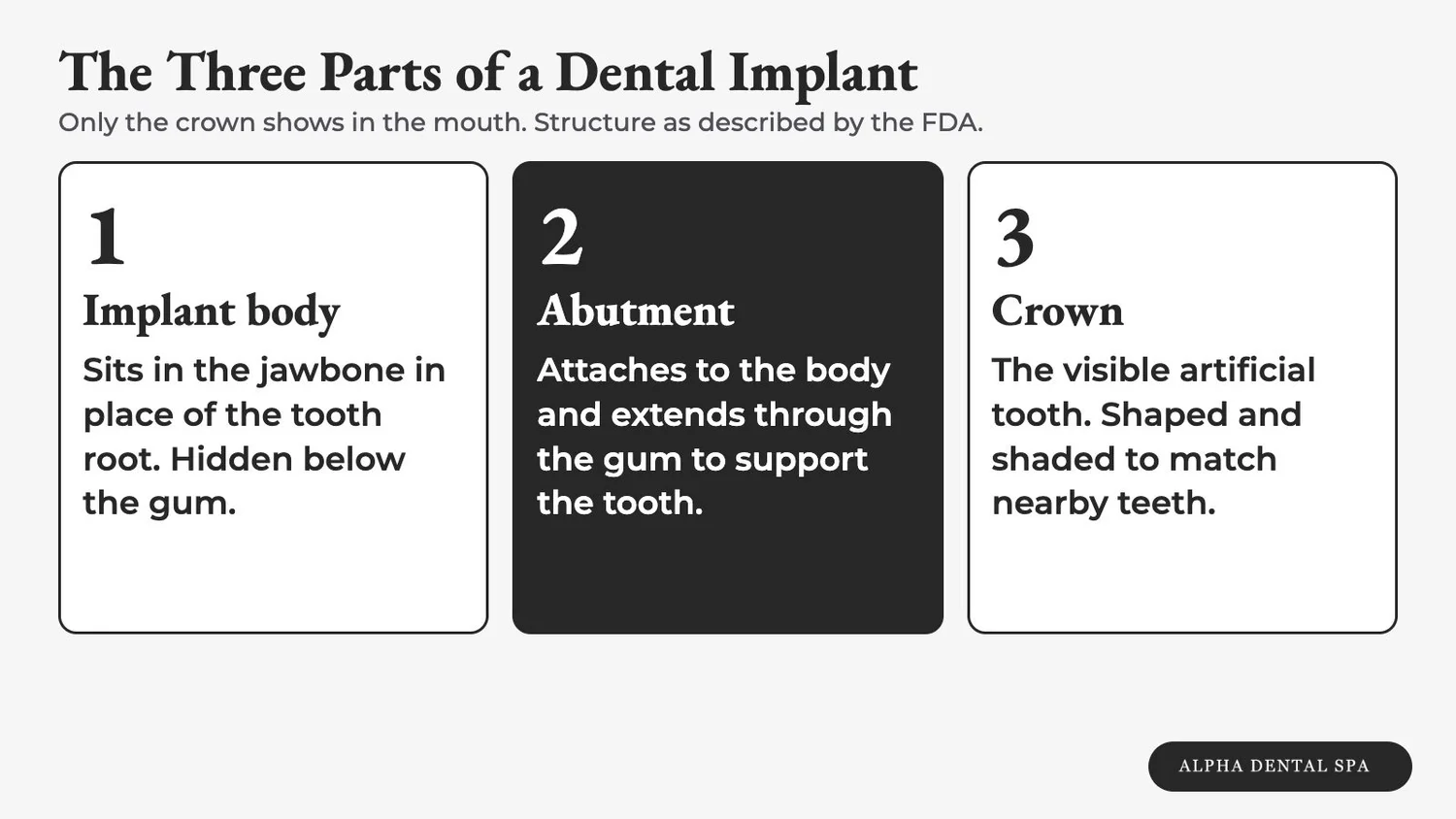
The graphic above shows the three parts in the order they sit, from bone to bite surface.
What Are the Three Parts of a Dental Implant?
The three parts of a dental implant are the implant body, the abutment, and the crown. The FDA describes the body as the part placed in the jawbone in place of the tooth root. The abutment connects the body to the crown.
- Implant body: a screw-like post that sits in the jawbone and replaces the root.
- Abutment: a connector that extends through the gum to hold the artificial tooth.
- Crown: the artificial tooth that shows in the mouth.
Each part has a different color and position, which explains why the crown is the only piece anyone sees.
What Do Dental Implants Look Like in the Mouth?
Dental implants look like regular teeth in the mouth when the gum has healed around the crown. The crown rises from the gum at the same line as neighboring teeth. A healthy gum hugs the crown and leaves no visible post.
Gum color and thickness matter for the final look. According to a 2018 meta-analysis in the Journal of Dentistry, white zirconia abutments caused less soft-tissue discoloration than gray titanium abutments. Thin gums over a gray metal part can look darker near the gum line.
What Do Full Dental Implants Look Like?
Full dental implants look like a complete row of teeth supported by several implants in the jaw. The American Academy of Periodontology says full mouth dental implants use a bridge or full denture attached to abutments. The visible part is a set of replacement teeth sitting on the gums.
A full set can replace the upper teeth, the lower teeth, or both. The implants themselves stay hidden, and the teeth appear as one continuous arch.
What Do Dental Implants Look Like Before the Crown Is Placed?
Before the crown is placed, a dental implant looks like a small cap or post at the gum line. A temporary tooth may cover the gap. The FDA says a temporary abutment typically replaces the tooth during healing. Healing may take several months or longer.
The American Academy of Periodontology says the implant and bone bond over 2 to 6 months before the crown is attached. The graphic below shows what appears at each stage.
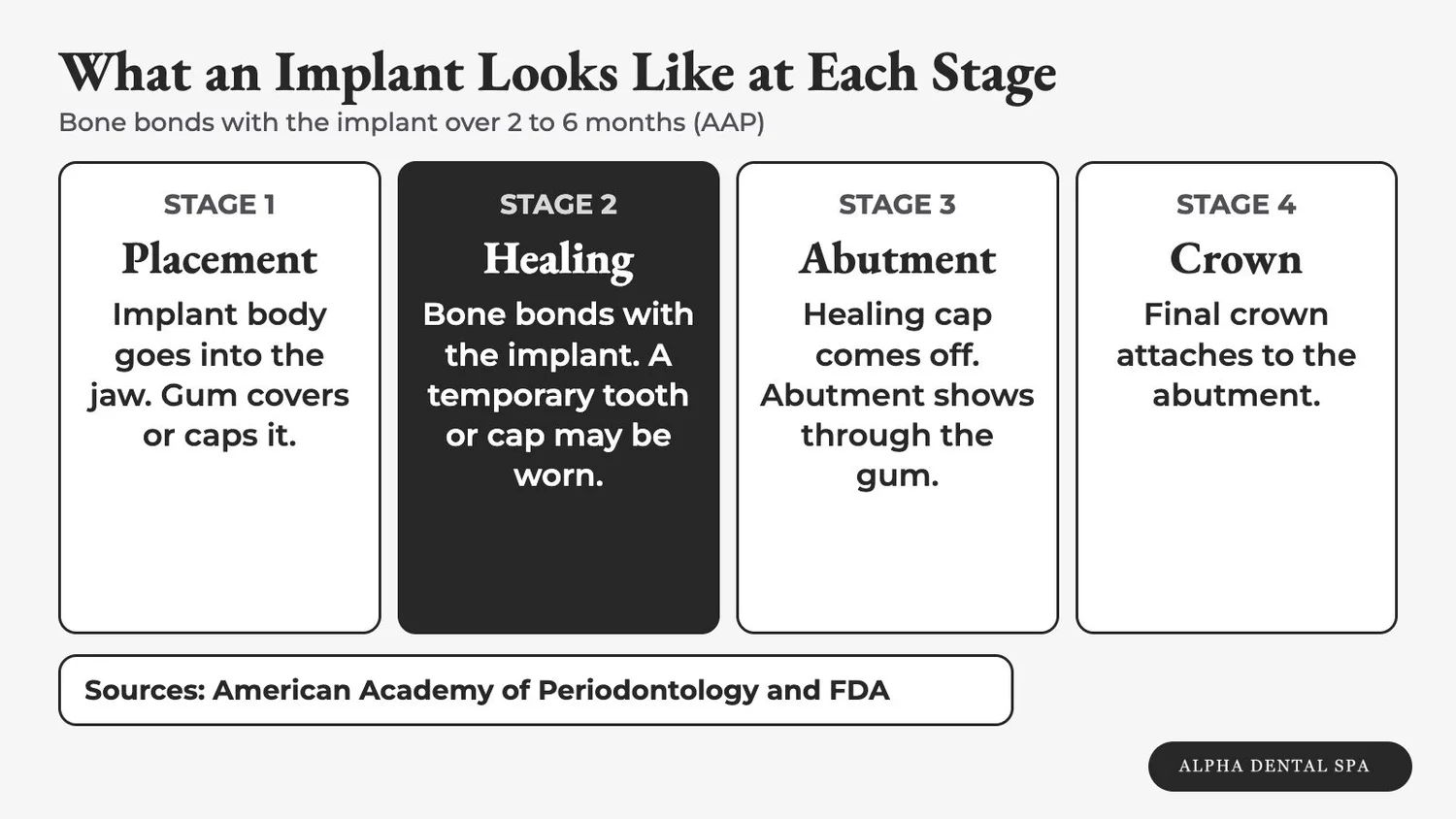
The steps below follow that order from first visit to final tooth.
- A dentist places the implant body in the jawbone.
- The gum heals over or around a small cap while bone bonds with the implant.
- The dentist uncovers the implant and attaches the abutment.
- A custom crown is made and attached to the abutment.
The order explains why a patient may see a short gap or a temporary tooth for months.
Can You Tell If Someone Has a Dental Implant?
You usually cannot tell if someone has a dental implant by looking. The crown matches the shape and shade of nearby teeth. The post stays under the gum, so no metal shows in a healed mouth. Small clues are a gum line that sits slightly different or a crown shade that does not match.
Differences in gum height or shade appear when a crown was placed in a thin-gum area. A dentist can check fit and shade at a regular visit. People who want a closer look at general dentistry can start with a routine exam.
Does the Implant Material Change How It Looks?
The implant material changes how an implant looks only at the gum line, because the crown is usually porcelain or ceramic. The FDA says most implant systems use titanium or zirconium oxide. Titanium is gray and zirconia is white.
| Part | Typical material | Where it sits | Visible? |
|---|---|---|---|
| Implant body | Titanium or zirconium oxide (FDA) | In the jawbone | No |
| Abutment | Titanium, gold, or white zirconia | Through the gum | Only at the gum line |
| Crown | Porcelain or ceramic | Above the gum | Yes |
The table shows that the abutment is the only part that can change gum-line color.
How Do Dental Implants Compare With Real Teeth, Bridges, and Dentures?
Dental implants compare with real teeth by replacing the root and the crown, while bridges and dentures replace only the visible tooth. The American Academy of Periodontology says a single implant replaces a tooth without sacrificing neighboring teeth. A bridge needs support from adjacent teeth.
| Option | What it replaces | How it attaches | Removable? |
|---|---|---|---|
| Dental implant | Root and crown | Bone bonds with implant (2 to 6 months) | No |
| Bridge | Crown only | Held by adjacent teeth | No |
| Partial denture | Several teeth | Rests on gums and teeth | Yes |
| Complete denture | All teeth in an arch | Rests on gums | Yes |
The American College of Prosthodontists states that dentures have limited lifespans and are not permanent restorations. Patients who compare options can read about full dentures before deciding.
A fixed bridge is another route to a complete-looking smile. The comparison table above shows that a bridge replaces the crown only.
A dentist weighs health, bone, and gum condition when comparing choices, and each patient's mouth gives a different answer. The comparison table above lists what each option replaces and whether it can be removed. A post on implants versus dentures lists the signs that point toward dentures instead of implants.
What Are Alternatives to Dental Implants?
Alternatives to dental implants are bridges, partial dentures, and complete dentures. The American Academy of Periodontology lists a tooth-supported bridge as the other common treatment for one missing tooth. Removable dentures replace several teeth or a full arch.
Each option has a different fit, upkeep routine, and impact on neighboring teeth. Our team can set up an implant consultation to review the mouth first.
What Is the Biggest Problem With Dental Implants?
The biggest problem with dental implants is peri-implantitis, an infection of the gum and bone around the implant. A 2017 meta-analysis in the Journal of Dentistry found peri-implantitis in 9.25% of implants and 19.83% of patients. Peri-implant mucositis, the milder gum inflammation, affected 46.83% of patients.
A 2015 review by Derks and Tomasi reported a different weighted mean of 22% for peri-implantitis. Studies disagree because they define the disease differently, as the review itself states.
Smoking adds risk. A 2021 meta-analysis of 292 publications found implants in smokers had a 140.2% higher failure risk than implants in non-smokers.
The FDA lists difficulty cleaning around the implant and untreated gum disease as risk factors. Daily brushing, flossing, and regular dental visits lower that risk, according to the American Academy of Periodontology.
A loose or sore implant needs prompt attention, and our emergency appointments cover urgent tooth pain.
Do They Pull All Your Teeth for Implants?
No, dentists do not pull all your teeth for implants. The American Academy of Periodontology lists single-tooth, multiple-tooth, and full-mouth implant options. A single implant replaces one missing tooth and leaves neighboring teeth alone.
Only teeth that cannot be saved are removed. A guide to extraction basics explains when a dentist recommends removal.
At What Age Should You Not Get Dental Implants?
No upper age limit appears in FDA guidance on dental implants, because the FDA says overall health decides candidacy. Growing jaws are the main age concern. A 2013 review in the Journal of Indian Society of Periodontology reports a pattern. Implants placed after age 15 in girls and age 18 in boys have the most predictable prognosis.
The FDA adds that health conditions affect healing time and implant longevity. The agency names uncontrolled diabetes and smoking as factors in implant failure. A dentist reviews health history, bone, and gums before planning treatment.
How Long Do Dental Implants Last in Your Mouth?
Dental implants showed a 95.2% survival rate at 10 years in one meta-analysis. The 2012 meta-analysis of 46 studies by Jung and colleagues reported 97.2% survival at 5 years. The implant crown survived at 89.4% after 10 years.
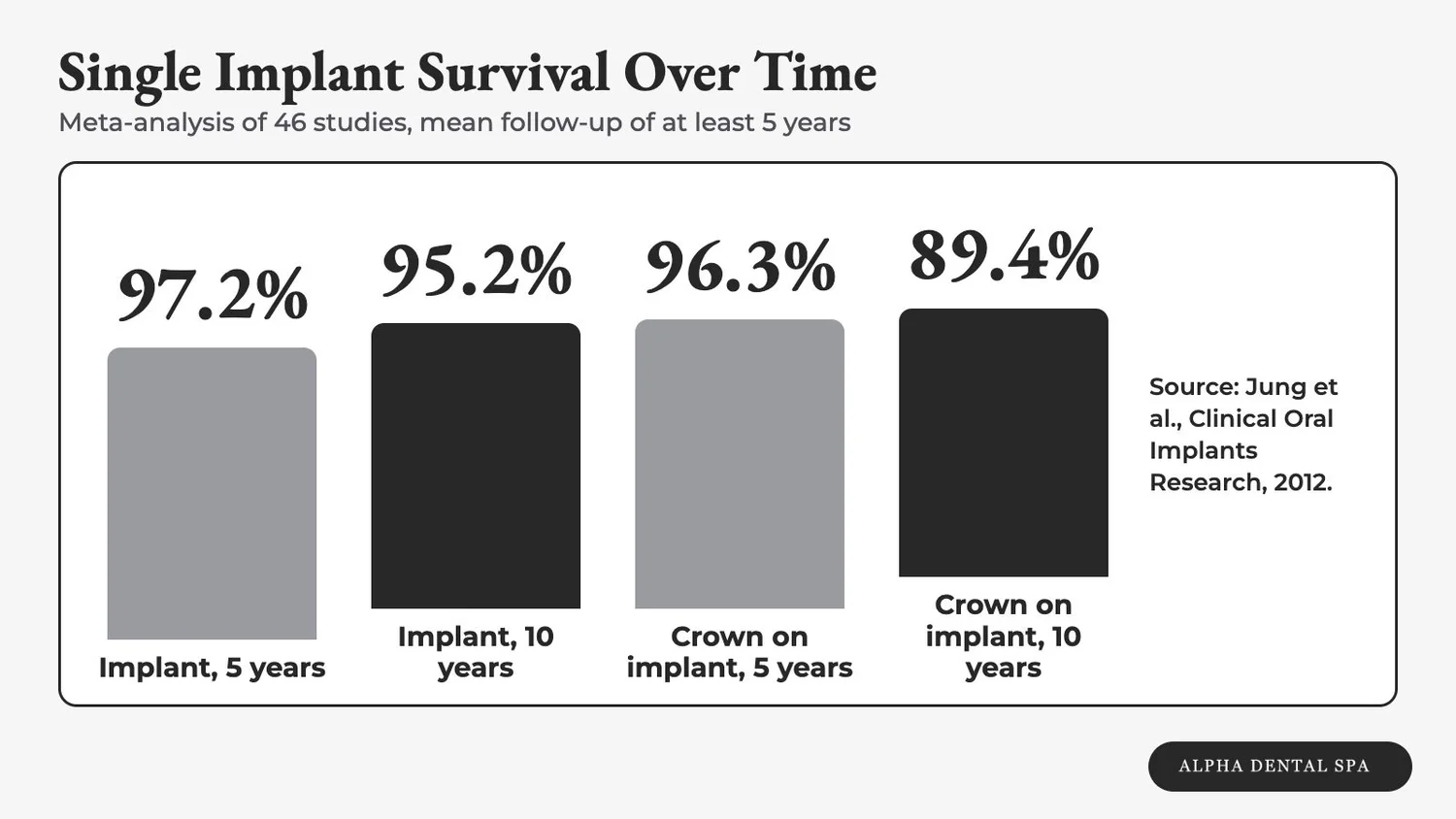
The chart separates the implant from the crown on top of it. Survival of the crown is lower at 10 years.
A second review by Pjetursson and colleagues found 93.1% survival at 10 years for implants supporting fixed prostheses. Both figures describe study groups and do not predict one patient's outcome.
Does Food Get Under Dental Implants?
Food can collect around dental implants, as it does around natural teeth, when cleaning is missed. The FDA lists difficulty cleaning the gums around an implant as a risk. Brushing and flossing around the implant daily removes the plaque that feeds gum inflammation.
The American Academy of Periodontology says implants still require brushing, flossing, and regular dental visits. A crown that fits well and a clean gum line leave little room for trapped food.
Can I Bite an Apple With Implants?
Yes, you can bite an apple with a healed, fully restored implant once your dentist confirms the bone has bonded. The FDA lists restored chewing ability as a benefit of dental implants. Bite force on implant overdentures falls between that of dentures and natural teeth.
A 2000 study in the Journal of Dental Research measured that range in people with implant overdentures. Healing comes first, so dentists give food guidance during the months before the final crown.
What Else Should You Know About Dental Implants?
How Painful Is It to Remove Dental Implants?
Removing a dental implant is a surgical step performed by a dentist or oral surgeon. The FDA says implant failure can require another surgical procedure to fix or replace the implant. Your dentist chooses the numbing and removal method.
Anyone with a loose or painful implant should tell the dental provider right away, as the FDA advises.
What Hurts Worse, Tooth Extraction or Implant?
No source ranks tooth extraction against implant surgery by pain, because pain varies with the case. MedlinePlus says an extraction socket heals in 1 to 2 weeks. An implant needs 2 to 6 months for bone to bond.
The ADA recommends nonsteroidal anti-inflammatory drugs, with or without acetaminophen, as first-line treatment for dental pain in adults. A guide on implant pain compares what patients report.
Is It Better to Pull a Tooth or Get an Implant?
Pulling a tooth and getting an implant are two steps, not rival choices, because an implant replaces a tooth that was removed. The FDA says tooth loss can cause rapid bone loss and chewing changes. An implant helps keep the jawbone from shrinking.
A dentist first judges whether the tooth can be saved. Timing details appear in a post on getting an implant after extraction.
Is There Anything Better Than Dental Implants?
No source names anything better than dental implants for every patient. The FDA says the choice depends on health and candidacy. Bridges and dentures suit patients who are not implant candidates.
Back-of-mouth cases have their own details, and a post on back tooth implants covers them.
Frequently Asked Questions
What I Wish I Knew Before Getting Dental Implants?
Patients who plan implants should know the process takes months. The American Academy of Periodontology gives a 2 to 6 month bonding window before the crown goes on. The FDA also says smoking may slow healing.
What Does No One Tell You About Dental Implants?
Implants need daily cleaning and regular checkups, as natural teeth do. The FDA says regular cleaning of the implant and nearby teeth is very important for long-term success.
What Is the Biggest Complaint About Dental Implants?
The biggest documented concern is infection around the implant, called peri-implantitis. The 2017 Journal of Dentistry meta-analysis found it in 19.83% of patients. Early gum inflammation is the warning stage.
Do Gray Titanium Implants Show Through the Gums?
Gray titanium can show through thin gums as a darker shade. The 2018 meta-analysis in the Journal of Dentistry found white zirconia abutments caused less discoloration than titanium.
Can a Dental Implant Be Seen on an X-Ray or MRI?
Dental implants can distort X-ray and MRI images, according to the FDA. The agency says to tell providers and imaging technicians about implants before any scan.
How Many Older Adults Lose All Their Teeth?
The CDC reports that 12.9% of adults aged 65 and older had complete tooth loss in 2015 to 2018. Complete tooth loss is one reason adults ask about full implants and dentures.
How Does Alpha Dental Help With Dental Implants?
Dr. Hayat reviews missing-tooth options with each patient, including dentures and replacement teeth. Our restorative care begins with an exam of teeth, gums, and bone. We explain what to expect at each stage before any treatment starts.
Patients in Cinnaminson and nearby towns can book a visit to talk through options with the team at Alpha Dental dentistry.