
What to take for toothache pain is an NSAID (nonsteroidal anti-inflammatory drug) such as ibuprofen, with or without acetaminophen. The American Dental Association (ADA) 2024 guideline covers adults and adolescents 12 and older. Both medicines carry label limits. Medicine calms pain for a short time, so the NHS advises a dental visit when pain lasts more than 2 days.
Key Takeaways
- The ADA lists NSAIDs such as ibuprofen, with or without acetaminophen, as first-line for toothache pain in people 12 and older.
- Ibuprofen plus acetaminophen gave 73% of trial participants at least 50% pain relief, compared with 52% for ibuprofen alone, per Cochrane.
- Adults and teens 12 and older should keep acetaminophen under 4,000 mg in 24 hours, says the FDA.
- Children, pregnant patients, and people with heart, stomach, or liver conditions should ask a professional first.
- Swelling near the eye or neck, or trouble breathing or swallowing, needs emergency care right away.
What Should You Take for Toothache Pain?
What to take for toothache pain is an over-the-counter NSAID such as ibuprofen, with or without acetaminophen, per the ADA guideline. The guideline applies when dental care is not immediately available.
The ADA built the guideline with the University of Pittsburgh School of Dental Medicine and the University of Pennsylvania. Medicine controls pain only until a dentist treats the cause, and we handle toothache care for that step.
Is Ibuprofen or Acetaminophen Better for a Toothache?
Ibuprofen is the first choice for a toothache because the ADA guideline lists NSAIDs first, and ibuprofen is an NSAID. Acetaminophen is not an NSAID, so the ADA pairs the two rather than ranking acetaminophen alone ahead.
Cochrane reviewers tested ibuprofen 400 mg alone in people with pain after wisdom tooth removal. Ibuprofen alone gave at least 50% pain relief over 6 hours to 52% of participants, compared with 7% on placebo.
Can You Take Ibuprofen and Acetaminophen Together for a Toothache?
Yes, ibuprofen and acetaminophen can be taken together for a toothache, as the ADA lists both as first-line. Package labels set the amounts for each product.
A Cochrane review pooled 3 trials with 1,647 people after wisdom tooth removal. Ibuprofen 400 mg plus paracetamol 1,000 mg gave 73% of participants at least 50% pain relief over 6 hours. Paracetamol is the name for acetaminophen outside the United States.
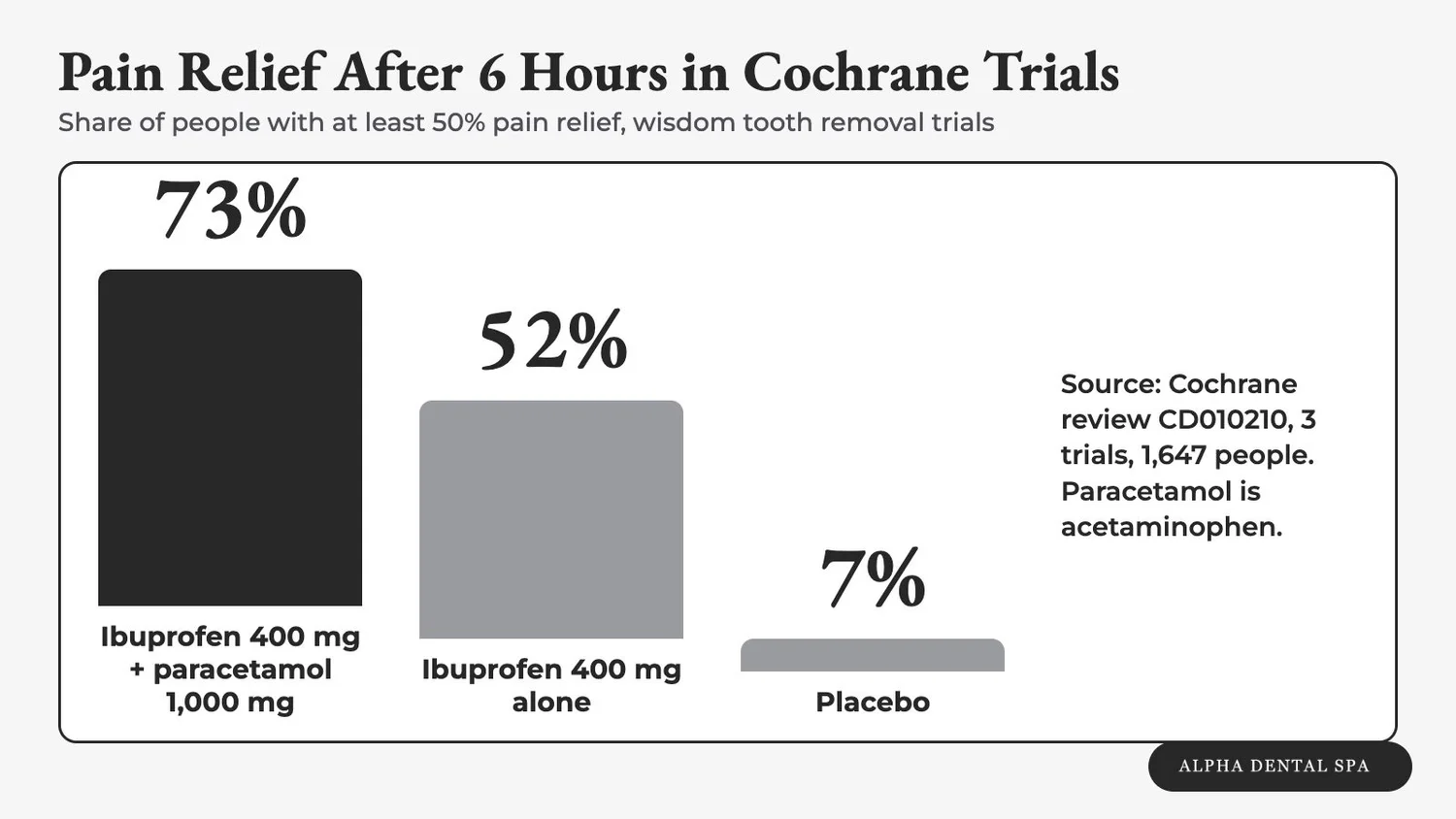
The chart shows the Cochrane results. The combination also delayed the need for extra medicine, with a median of 8.3 hours compared with 1.7 hours on placebo.
How Do Common Toothache Medicines Compare?
Common toothache medicines compare by role, with NSAIDs and acetaminophen first and other options limited by safety rules.
| Medicine | Role for a toothache | Source | Caution |
|---|---|---|---|
| Ibuprofen or naproxen | First-line for people 12 and older | ADA, 2024 | Take with food or milk |
| Acetaminophen | First-line alone or with an NSAID | ADA, 2024 | 4,000 mg limit in 24 hours |
| Ibuprofen plus acetaminophen | 73% reached 50% relief | Cochrane, 2013 | Count every acetaminophen product |
| Aspirin | Pain reliever for adults | MedlinePlus | Reye's syndrome risk in children and teens |
| Benzocaine gel | Numbing gel for the gum | NHS | Not for children under 2 (FDA) |
| Antibiotics | Dentist-prescribed for infection | ADA MouthHealthy | Side effects such as nausea |
| Opioids | Prescription only | ADA MouthHealthy | Not first-line per ADA |
The table shows why the ADA starts with NSAIDs and acetaminophen. The next section covers how to take them safely.
How Do You Take Toothache Medicine Safely?
Take toothache medicine safely by following the Drug Facts label, using one acetaminophen product at a time, and taking ibuprofen with food. These steps come from the FDA and MedlinePlus.
- Read the Drug Facts label before the first dose and follow its directions.
- Take ibuprofen with food or milk to prevent stomach upset, says MedlinePlus.
- Check cold and flu products for acetaminophen before adding another dose.
- Keep total acetaminophen under 4,000 mg in 24 hours if you are 12 or older.
- Call a dentist if the pain lasts more than 2 days.
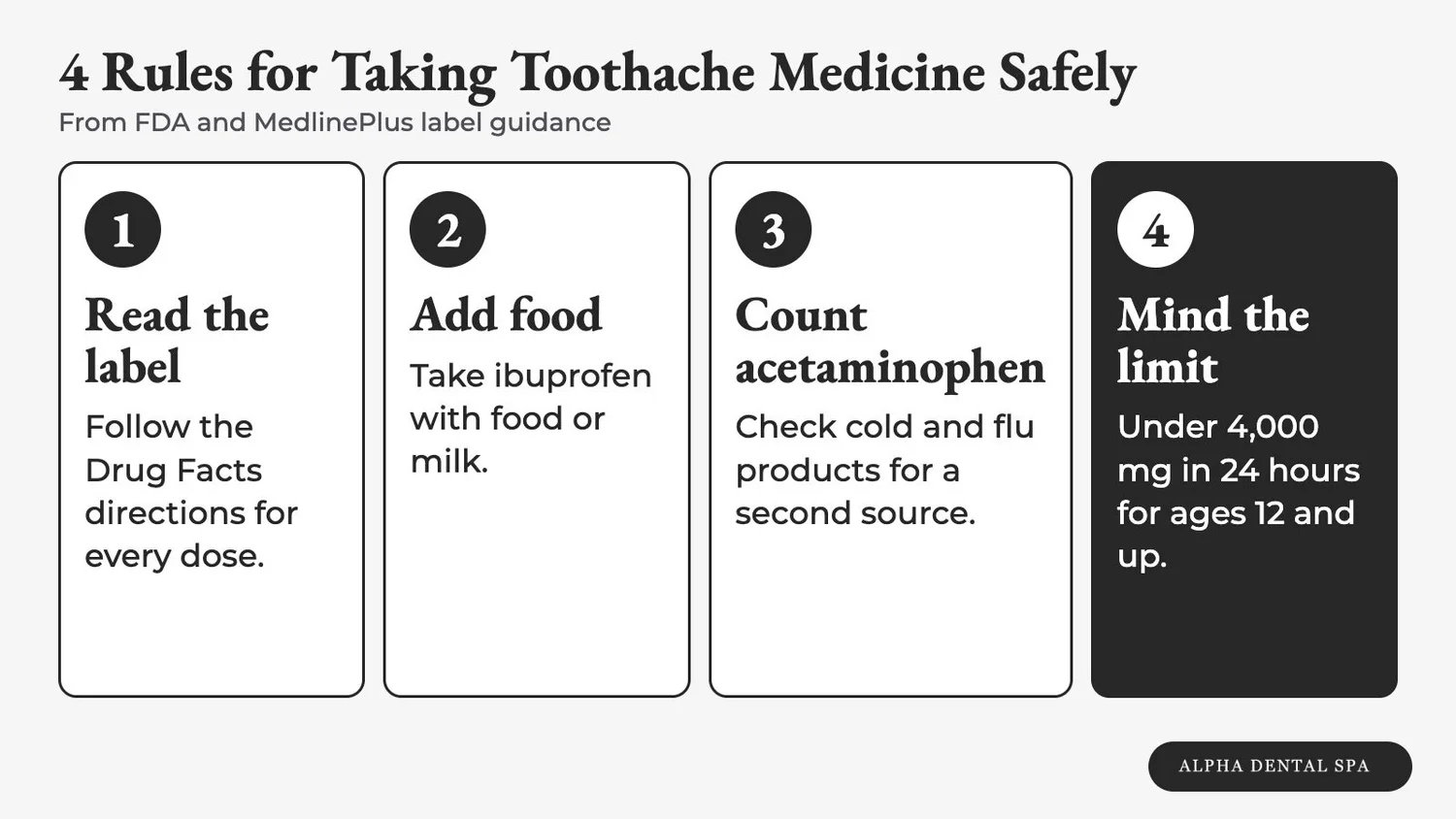
The graphic summarizes the first four steps. Each step lowers a named risk, and the next two questions explain the limits behind steps 3 and 4.
What Is the Maximum Acetaminophen Dose for a Toothache?
The maximum acetaminophen dose for a toothache is 4,000 mg in 24 hours for ages 12 and older, says the FDA. Never take more than the label says, even when pain continues.
MedlinePlus warns that too much acetaminophen can cause liver damage serious enough to require a transplant. MedlinePlus also says not to take more than one acetaminophen product at a time.
Can You Take Aspirin for a Toothache?
Aspirin is a pain reliever sold for adults, but children and teenagers should not take it for a toothache. MedlinePlus says aspirin may cause Reye's syndrome in children and teenagers, especially with a virus such as flu or chickenpox.
The NHS gives a matching rule that children under 16 should not take aspirin. A pharmacist can confirm whether aspirin suits an adult with other conditions.
Who Should Ask a Professional Before Taking Toothache Medicine?
People with heart, stomach, liver, or pregnancy concerns should ask a doctor or pharmacist before taking toothache medicine.
MedlinePlus names these groups for a talk before ibuprofen or acetaminophen use. Anyone asking what can I take for toothache pain should check them first.
- Adults with heart disease, high blood pressure, high cholesterol, or diabetes, because NSAIDs may raise heart attack and stroke risk.
- People with a history of stomach ulcers or bleeding, since NSAIDs may cause ulcers and bleeding.
- People with liver disease or three or more alcoholic drinks daily, who face added acetaminophen risk.
- Anyone taking other medicines, such as corticosteroids or SSRIs, which MedlinePlus lists as interacting with ibuprofen.
- Pregnant patients, covered in the next answer.
What Can You Take for Toothache Pain While Pregnant?
What you can take for toothache pain while pregnant is a doctor's decision. Ibuprofen is a medicine to avoid at 20 weeks or later, per MedlinePlus and the FDA.
In 2020, the FDA warned that NSAIDs at 20 weeks or later may cause rare but serious kidney problems in unborn babies. A dentist and an obstetric provider can agree on a plan together.
What Can Children Take for a Toothache?
Children under 12 can take acetaminophen or ibuprofen for a toothache, per the ADA, with doses set by a dentist. The ADA guideline doses can differ from package labels.
The FDA contraindicated codeine and tramadol in children under 12 in 2017, per the ADA. Our children's dentistry page explains how we care for young patients.
Do Numbing Gels, Antibiotics, and Opioids Help a Toothache?
Numbing gels, antibiotics, and opioids each have a narrow role in a toothache, and a dentist decides on the prescription options.
Does Numbing Gel Help a Toothache?
Numbing gel is a pain-relieving gel for the mouth that the NHS lists for easing a toothache while waiting for an appointment. The FDA warned in May 2018 that benzocaine oral products should not be used in children younger than 2 years.
The FDA warning concerns methemoglobinemia, a serious blood condition that lowers oxygen in the blood. Adults and children 2 and older should read the label warnings first.
Do Antibiotics Help a Toothache?
Antibiotics help a toothache when a dentist finds an infection that needs them. ADA MouthHealthy says an antibiotic prescribed for someone else may not treat your toothache. Side effects include nausea, vomiting, diarrhea, and yeast infections.
The NHS adds that a dentist may prescribe antibiotics after treating a dental abscess. Antibiotics are not a painkiller to keep at home.
Are Opioids Used for a Toothache?
Opioids are used for a toothache only in limited cases, because the ADA guideline names NSAIDs rather than opioids as first-line. Opioids such as hydrocodone, oxycodone, morphine, and codeine need a prescription, per ADA MouthHealthy.
The ADA also advises against "just in case" opioid prescriptions. Ask the dentist about pain control before a visit ends.
When Is a Toothache an Emergency?
A toothache is an emergency when swelling reaches the eye or neck, says the NHS. Swelling that makes breathing, swallowing, or speaking hard also needs emergency care.
Patients deciding what to do about toothache pain should see a dentist when pain lasts more than 2 days. Our guide to toothache emergency signs adds detail on the NHS list.
- Pain that lasts more than 2 days.
- Pain that does not go away with painkillers.
- A high temperature, pain on biting, red gums, or a bad taste.
- A swollen cheek or jaw.
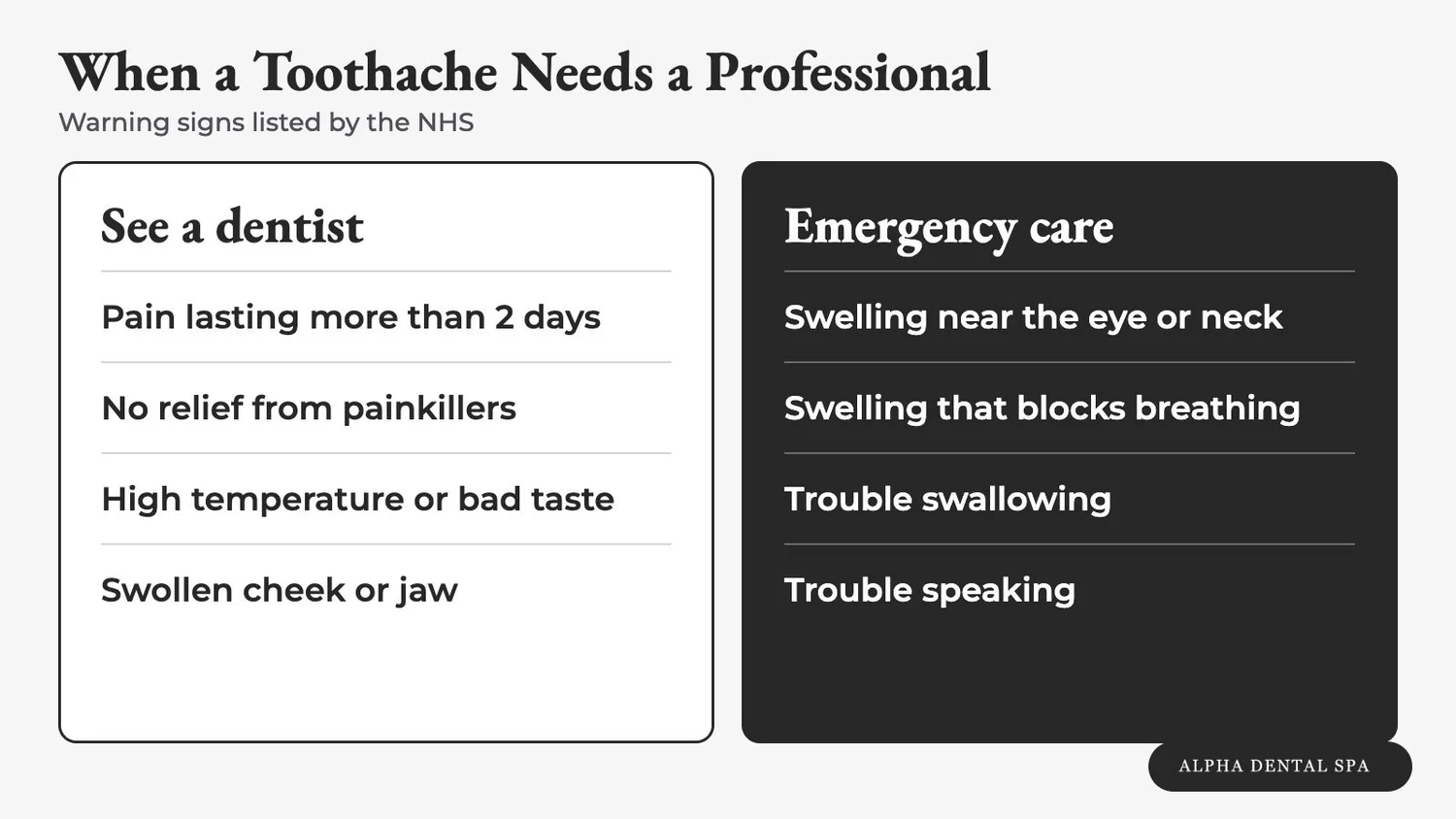
The graphic sorts the NHS signs into dentist visits and emergency care. A walk-in clinic does not replace a dentist for dental pain, as dentist or walk-in choices show.
What Should Patients Expect at the Dentist for a Toothache?
Patients should expect the dentist to find and treat the cause of the toothache, per the NHS. Treatment can mean draining an abscess, root canal treatment, or tooth removal.
The NHS lists tooth decay, a dental abscess, a cracked tooth, a loose filling, gum disease, and teeth grinding as causes. Our post on toothache causes covers each one in plain language for patients.
A local anesthetic prevents pain during treatment, and the NHS says painkillers may be offered for a few days afterward. Antibiotics may also be given when an infection is present. The post on emergency visit steps shows the order of care.
What Else Should You Know About Toothache Pain?
What Works for Toothache Pain Besides Medicine?
What works for toothache pain besides medicine is a warm salt water rinse, soft foods, and a soft toothbrush, per the NHS. Dissolve half a teaspoon of salt in a glass of warm water, rinse, and spit.
The NHS says children should not rinse with salt water in case they swallow it. Avoid flossing around the sore tooth until a dentist checks it. Rinses and soft foods are what can help toothache pain besides medicine.
A dentist visit still matters, and we offer an emergency toothache visit for sudden pain.
What Should You Not Do When You Have a Toothache?
Do not eat sweet, very hot, or very cold foods when you have a toothache, says the NHS. Smoking can also make some dental problems worse.
Taking extra medicine does not help either, since the NHS says a higher dose will not work better and can be dangerous. Our list of eating with toothache tips names softer choices.
How Long Will a Toothache Last?
A toothache lasts until a dentist treats the cause, and the NHS says to see one after 2 days. Medicine can ease pain in the meantime.
Will a Toothache Go Away on Its Own?
A toothache may ease for a while, but the NHS still advises seeing a dentist when pain lasts more than 2 days. Pain relief from medicine does not remove the cause of the pain.
Is Toothache the Worst Pain?
No agency ranks toothache as the worst pain, but oral pain is common among US adults. A PLoS ONE study of NHANES 2015-2018 data found 1 in 4 adults 30 and older reported oral pain. That study counted about 41.3 million adults.
Pain feels different to each person, so intensity does not show the cause. A dentist can find the cause, as our post on toothache fixes explains.
How Do You Stop Nerve Pain in a Tooth?
Stopping nerve pain in a tooth takes dental treatment, because medicine only eases the pain. The NHS says a problem tooth may need root canal treatment or removal.
Patients weighing both paths can read about extraction choices with the dentist.
Frequently Asked Questions
What Causes a Toothache?
A toothache is caused by decay, an abscess, a cracked tooth, a loose filling, gum disease, or grinding, per the NHS.
Can You Take Ibuprofen on an Empty Stomach?
Ibuprofen should be taken with food or milk to prevent stomach upset, according to MedlinePlus. NSAIDs may also cause ulcers and bleeding, with higher risk in older adults, smokers, and heavy drinkers.
Can You Take Too Much Toothache Medicine?
Yes, too much toothache medicine is dangerous, and the NHS says a higher dose will not work better. The FDA links too much acetaminophen to liver failure.
What Can I Take for a Bad Toothache?
An NSAID such as ibuprofen, with or without acetaminophen, is what to take for a bad toothache, per the ADA. Patients unsure what to take for bad toothache pain should read the label and call a dentist.
What Can You Take for a Bad Toothache Besides Pills?
What you can take for a bad toothache besides pills is a salt water rinse or mouth gel, per the NHS. Soft foods also help avoid chewing on the sore tooth.
How Does Alpha Dental Help With Toothache Pain?
We help with toothache pain by finding the cause and treating it, so medicine stays a short-term step. We explain what to take for toothache pain when you call, and we review any medicines you already use.
Our office is in Cinnaminson, and the team treats patients with sudden pain, routine needs, and denture questions. Patients can learn about Dr. Hamid Hayat before a visit and see how he approaches care.
Patients with sudden pain can call the office to ask about an urgent visit. We ask about symptoms, medicines already taken, and allergies before choosing pain relief. The page for dental pain help lists what we treat.
Patients who take blood pressure, stomach, or other daily medicines can share the list at the visit. That list helps the dentist and pharmacist choose safe pain relief. Questions are welcome at Alpha Dental NJ any time.