Dental crown before and after results show a damaged tooth covered by a custom cap that restores its shape and chewing strength. In a 2022 study of 1,037 crowns, 80.9% were still in place after 10 years. The American Dental Association (ADA) says crowns strengthen teeth with large fillings, protect weak teeth, and restore broken ones. Mild sensitivity is normal for a short time.
Key Takeaways
- The ADA lists five reasons for a crown. They are a large filling, a weak tooth, a broken tooth, a discolored tooth, and an implant.
- A trial of 209 crowns found that 50.7% of patients reported some sensitivity at any check during 3 months.
- Single crowns survived 89.9% at 5 years and 80.9% at 10 years in a study of 1,037 crowns.
- Soft, lukewarm food is the safe choice once numbness fades, and dentists set the timing for normal chewing.
- Pain that grows, a loose crown, or an uneven bite needs a call to your dentist.
What Does a Dental Crown Before and After Look Like?
A dental crown before and after comparison shows a damaged tooth covered by a custom cap with normal shape and size. The ADA states that a crown can make a tooth stronger and improve its appearance.
Alpha Dental Spa makes custom crowns and bridges that cement onto existing teeth. The change shows in the tooth, and the bigger change shows in how the tooth works when you chew.
What Does a Tooth Look Like Before a Dental Crown?
A tooth before a dental crown looks broken, weak, discolored, badly shaped, or heavily filled. The ADA names those conditions as reasons for a crown. The tooth may also have too little structure left to hold another filling.
The ADA also lists a dental implant as a reason, since the crown becomes the visible part of the implant. Each reason leads to a different before and after dental crown tooth result.
What Changes After a Dental Crown?
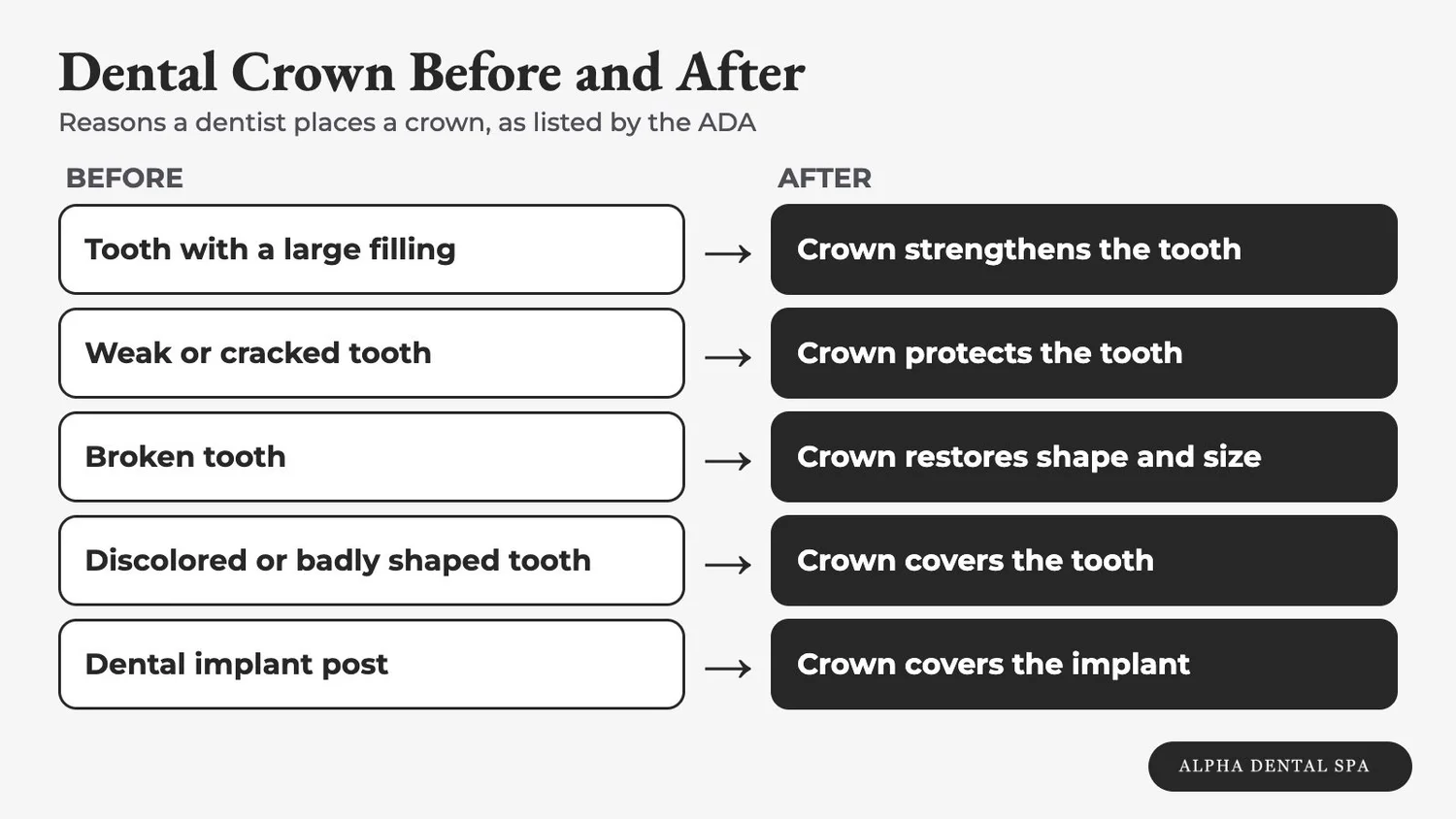
After a dental crown, the tooth is covered, strengthened, and reshaped, and the visible result depends on why the crown was placed. The table below pairs each ADA reason with the change.
| Reason | Before the crown | After the crown | Source |
|---|---|---|---|
| Large filling | Little tooth left to hold the filling | Crown strengthens the tooth | ADA |
| Weak tooth | Tooth at risk of breaking | Crown protects the tooth | ADA |
| Broken tooth | Missing or cracked tooth structure | Crown restores the tooth | ADA |
| Discolored or badly shaped tooth | Uneven color or shape | Crown covers the tooth | ADA |
| Dental implant | Implant post without a tooth | Crown covers the implant | ADA |
The graphic below shows the same five changes side by side.
These changes depend on a short procedure, which the next section walks through.
What Happens During a Dental Crown Procedure?
A dental crown procedure reshapes the tooth, records its shape, and then fits and cements the final crown. Dr. Hayat confirms each step for your tooth at the exam.
The steps below follow the order patients meet them.
- The dentist examines the tooth and checks the bite.
- Local anesthetic numbs the tooth and nearby gum.
- The dentist reshapes the tooth so the crown can fit over it.
- An impression or scan records the tooth for the crown.
- A temporary crown protects the tooth while the final crown is made.
- The dentist checks the fit and bite, then cements the final crown.
How Long Does It Take a Dentist to Fit a Crown?
A dentist fits a crown across a preparation visit and a fitting visit. The schedule depends on the tooth and crown type. We give the exact number of visits at your exam.
The fitting visit includes a check of the bite before the dentist cements the crown. That check protects the crown and the opposite tooth.
Do You Get Numbed for a Dental Crown?
Yes, you get numbed with local anesthetic before the dentist reshapes the tooth for a crown. The numbness fades after the visit, so wait to eat until feeling returns.
How Painful Is Getting a Crown Done?
Getting a crown done causes little pain during the visit because local anesthetic numbs the area. Afterward, tenderness is mild in measured trials.
In a trial of 209 crowns led by OHSU School of Dentistry, patients scored sensitivity on a 0 to 10 scale. The average was 0.52 for temperature and 0.23 for biting.
What Happens to Natural Teeth Under Crowns?
The natural tooth under a crown stays in the mouth as a reshaped, living tooth with less outer structure. Edelhoff and Sorensen measured that full-crown preparations removed about 63% to 72% of coronal structure on front typodont teeth.
Those figures come from resin practice teeth, not patients, so real amounts vary by tooth. The same study found veneers and resin-bonded retainers removed about 3% to 30%.
What Is Normal Pain After a Dental Crown Procedure?
Mild sensitivity is normal pain after a dental crown procedure. In a 3-month trial, 50.7% of patients reported some sensitivity. Patients rated sensitivity at 24 hours, 1 week, 1 month, and 3 months.
The graphic below shows the trial design and the average scores.
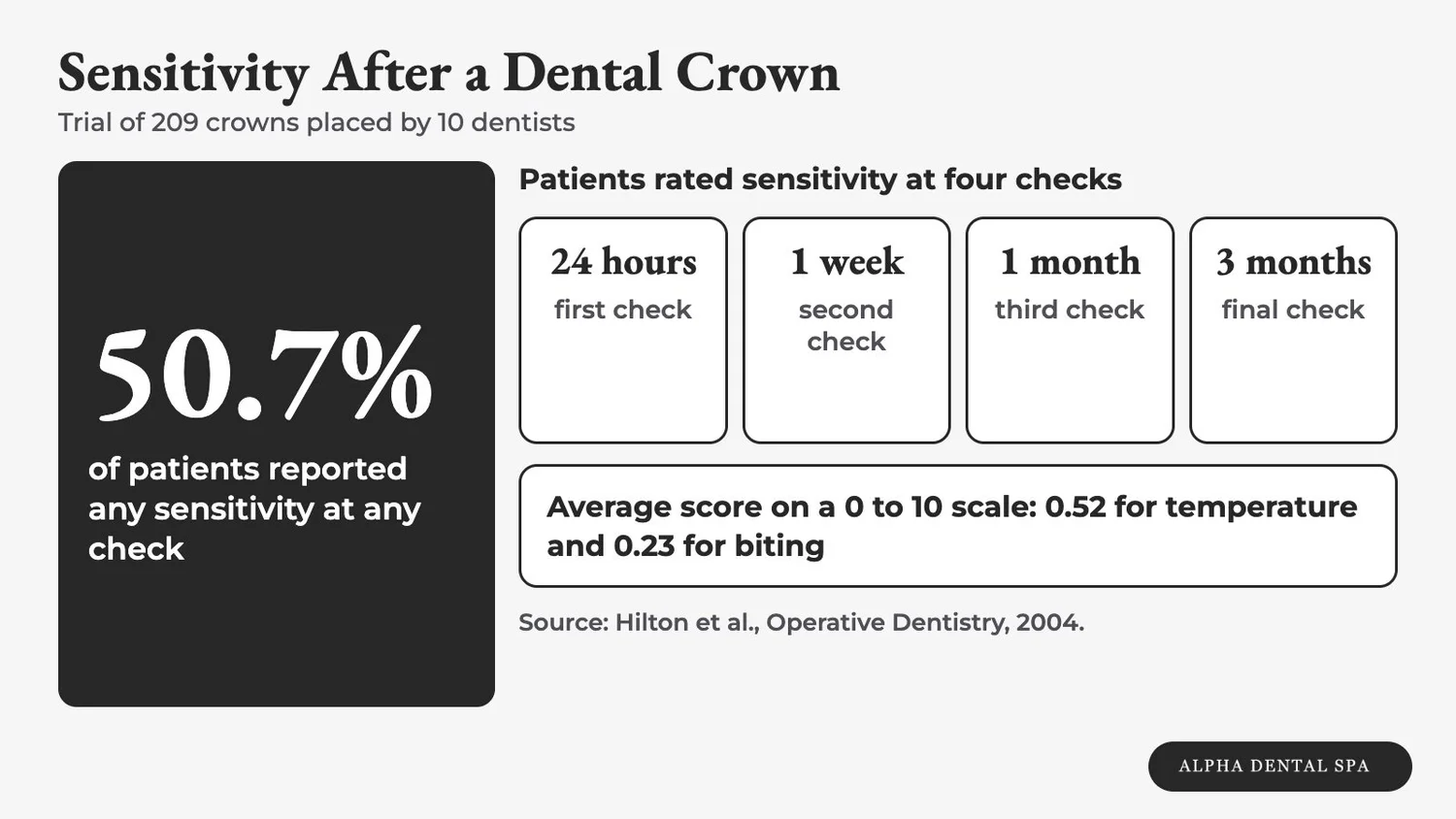
Scores stayed low on average, so mild dental crown pain after procedure is a documented finding. Persistent pain after dental crown procedure care needs a dentist.
Why Does a Tooth Hurt After a Dental Crown?
A tooth hurts after a dental crown because reshaping exposes dentin, the layer under enamel. The ADA explains that dentin tubules let heat, cold, acidic, and sticky foods reach the tooth nerves.
The ADA lists desensitizing toothpaste and fluoride gel as treatments for sensitive teeth. Severe and persistent sensitivity can lead a dentist to recommend a root canal.
What Causes Jaw Pain After a Dental Crown?
Jaw pain after dental crown work can come from holding the mouth open or from a bite that feels uneven. The National Institute of Dental and Craniofacial Research (NIDCR) says many jaw disorders last briefly and go away alone.
NIDCR lists soft foods and heat or cold on the face as first self-care steps for jaw pain. Call the dentist when jaw pain lasts or the bite feels off, since the crown may need an adjustment.
What Can You Take for Pain After a Dental Crown?
An over-the-counter NSAID such as ibuprofen, with or without acetaminophen, is first-line for dental pain. The ADA 2024 guideline covers adults and adolescents 12 and older.
The FDA sets the acetaminophen limit at 4,000 mg in 24 hours for ages 12 and older. Package labels and your dentist guide the amount.
What Causes Dental Crown Pain After Years?
Dental crown pain after years signals a new problem rather than normal healing. Causes include pulpal disease, a loose crown, or a cracked crown.
In a Tufts University review of 2,177 large restorations, 7.54% of patients with crowns developed pulpal disease. The Hawthan study named loss of retention, tooth loss, and fracture as the main reasons crowns failed.
Sharp pain, swelling, or a crown that moves needs prompt care. Our team handles severe tooth pain for patients who cannot wait.
What to Eat After a Dental Crown?
What to eat after dental crown placement is soft, lukewarm food chewed on the opposite side until numbness fades. The ADA notes that heat, cold, acidic, and sticky foods reach tooth nerves through exposed dentin.
Scrambled eggs, yogurt, mashed potatoes, soup, and pasta fit that rule. Let hot food cool before the first bite.
How Soon After a Permanent Crown Can You Eat Normally?
You can eat normally after a permanent crown once numbness is gone and your dentist confirms the cement has set. Setting time depends on the cement used, so Dr. Hayat gives the timing for your crown.
Return to firmer food in steps, and stop chewing on the crown if the bite feels high.
What Should You Not Eat After Getting a Crown?
You should not eat hard, sticky, or very chewy food after getting a crown. It can crack the crown or pull it loose. Goodacre and colleagues found crown fracture in 7% of all-ceramic crowns and loss of retention in 2% of conventional crowns.
The list below groups the foods to skip at first.
- Hard foods: ice, nuts, hard candy, and popcorn kernels.
- Sticky foods: caramel, taffy, and chewing gum.
- Tough foods: jerky and thick cuts of steak.
- Extreme temperatures: boiling soup and ice-cold drinks.
Can You Bite an Apple With a Crown?
Yes, you can bite an apple with a crown once your dentist says the crown has settled. Cutting the apple into slices first lowers the force on the crown during early healing.
How Long Does a Dental Crown Last?
A dental crown survived 10 years in 80.9% of cases in a study of 1,037 single crowns placed in 401 patients. Hawthan, Chrcanovic, and Larsson reported 89.9% survival at 5 years.
The same study reported 70.5% at 15 years and 61.8% at 20 years. The chart below shows all four checkpoints.
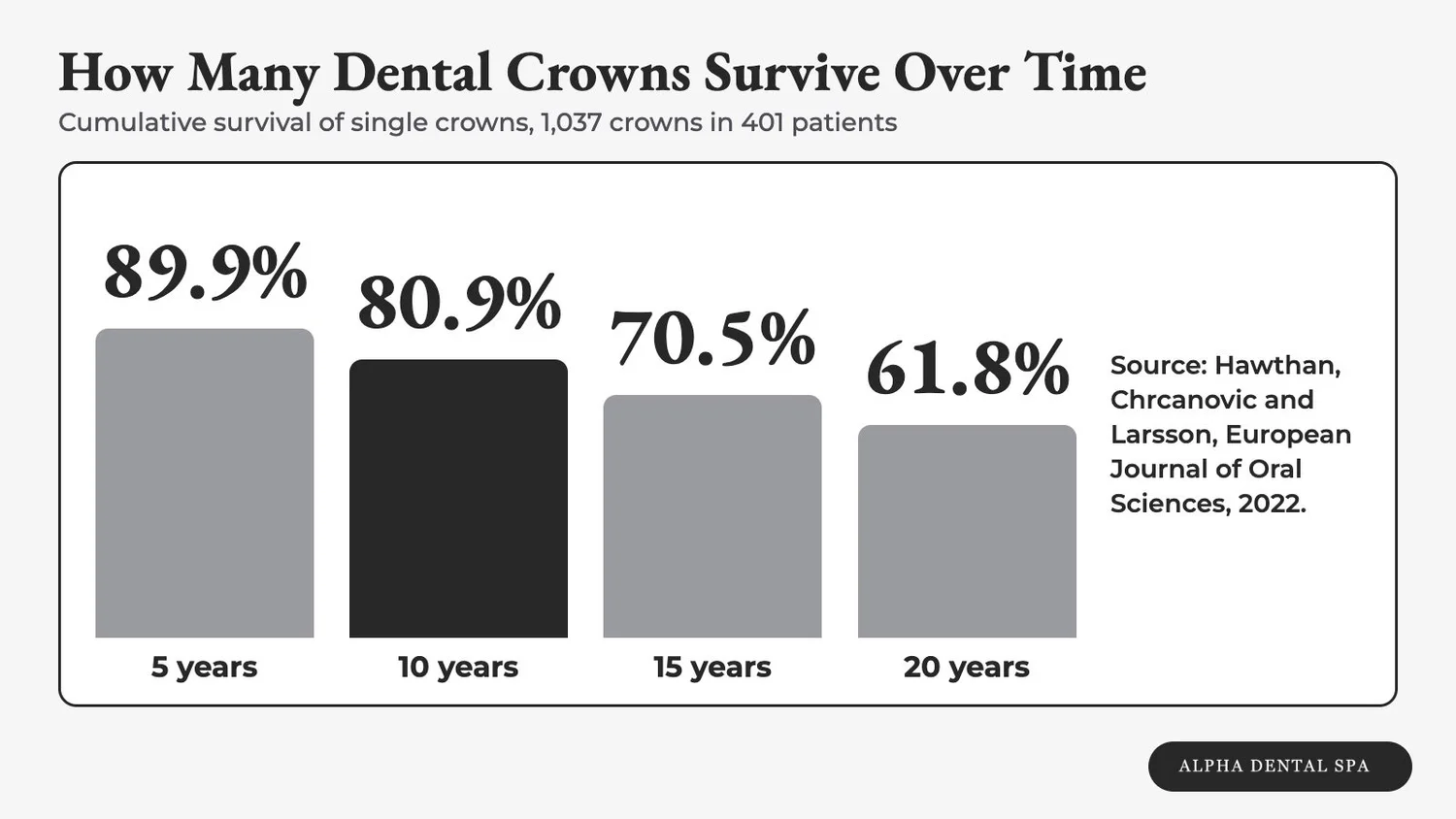
Survival depends on the tooth and the patient, which the next question explains.
How Many Years Should a Tooth Crown Last?
A tooth crown should last 10 years or more in 80.9% of cases, and 61.8% were still in place at 20 years. The study found that anterior placement, non-vital abutments, and bruxism raised failure risk.
Bruxism means grinding or clenching the teeth. Age, sex, crown material, and smoking did not change survival in that study.
Can a Tooth Still Rot Under a Crown?
Yes, a tooth can still rot under a crown. The crowned tooth is still a living tooth that plaque can reach at the crown edge. The ADA advises brushing twice a day with ADA-accepted fluoride toothpaste.
The ADA also advises cleaning between teeth once a day. Regular preventive care lets the dentist spot early changes around a crown.
How Do You Protect a Dental Crown?
You protect a dental crown with daily cleaning, careful chewing, and regular exams. The steps below follow that order.
- Brush twice a day with a soft-bristled brush and fluoride toothpaste, per the ADA.
- Clean between teeth once a day, per the ADA.
- Skip ice and other hard objects that can crack or loosen the crown.
- Ask about a night guard when you grind or clench your teeth.
- Keep a regular checkup schedule so the dentist can check the crown.
What Else Should You Know About Dental Crowns?
Is Getting a Crown on a Tooth Worth It?
Getting a crown on a tooth is worth it when the tooth is weak, broken, or too filled to hold another filling. Those are ADA reasons for crowns. A systematic review of root canal treated teeth found 81% survival at 10 years with a crown and 63% with direct restorations.
Stavropoulou and Koidis pooled 10 studies for that result. Our custom crowns serve those weak teeth.
Why Do Dentists Recommend Crowns?
Dentists recommend crowns to strengthen, protect, or restore a tooth, according to the ADA. The ADA adds that a crown can attach a bridge or cover a dental implant.
The recommendation follows an exam of the tooth and the bite. Dr. Hayat explains the reason for each recommendation.
What Are the Downsides of a Dental Crown?
The downsides of a dental crown are tooth reshaping, short-term sensitivity, and a small rate of complications. Goodacre and colleagues pooled studies and reported 11% clinical complications for conventional single crowns.
The most common were need for endodontic treatment at 3%, porcelain veneer fracture at 3%, and loss of retention at 2%. Reshaping removes about 63% to 72% of coronal structure on front typodont teeth.
Is It Better to Pull a Tooth or Get a Crown?
A crown is the better choice when enough natural tooth remains to hold it, and extraction fits teeth that cannot be restored. The dentist decides after an exam and X-rays.
The root canal treated tooth review supports keeping a crowned tooth, with 81% 10-year survival. Patients weighing a root canal against extraction can compare both paths.
Why Get a Crown Instead of Pulling the Tooth?
A crown keeps the natural tooth in place, which means the root and bite stay as they are. The ADA lists crowns as a way to restore a broken tooth.
A missing tooth needs a bridge, implant, or denture later, and each replacement adds its own steps.
What Can Be Done Instead of a Dental Crown?
A filling, onlay, or veneer can replace a crown when enough healthy tooth remains. Edelhoff and Sorensen found veneers and resin-bonded retainers removed about 3% to 30% of coronal structure on front teeth.
The same group measured inlay and adhesive designs at 5.5% to 27.2% on back teeth. A missing tooth can use a dental bridge instead. A bridge spans the gap and attaches to the neighboring teeth.
Each replacement route has its own steps and timing. The dentist reviews recovery and follow-up care with the patient before treatment starts. Patients often ask whether dental implants hurt. Both options need an exam first, and that exam sets the plan.
Frequently Asked Questions
Can I Eat Pizza After a Permanent Crown?
Yes, you can eat pizza after a permanent crown once your dentist clears normal chewing. Choose soft slices and avoid hard crust at first.
When Is It Too Late to Put a Crown on a Tooth?
It is too late for a crown when too little healthy tooth remains to hold it. The dentist then reviews extraction and replacement options.
How Many Times Can a Tooth Be Crowned?
A tooth can be crowned again while enough healthy tooth remains under the old crown. The dentist checks the tooth and X-rays before replacing a crown.
Can a Dentist See Tooth Decay Under a Crown?
A dentist can find decay near a crown with an exam and X-rays during checkups. Early findings keep treatment smaller.
How Does Alpha Dental Help With Dental Crowns?
Alpha Dental helps with dental crowns by examining the tooth, explaining options, and placing a custom crown when it fits the plan. Our team serves patients in Cinnaminson and nearby towns.
Patients can ask about a crown consultation at any exam, and we explain each step before treatment. The dentist answers questions about the tooth, the bite, and the timeline. Each answer comes before any treatment begins, so patients decide with full information.
Questions about pain, eating, or the bite after a crown are welcome at any time, including after the visit ends. We answer them directly. We explain what is normal for your tooth, what is not, and when to recheck the bite. Families can request a crown appointment through the office.
The office confirms each appointment and answers questions about the visit by phone. Dr. Hayat and the team welcome every patient, and the full list of services is on the Alpha Dental Care site.